Next in my Beatles retrospective comes Magical Mystery Tour, a less-than-successful episode in the band’s career.

Sooner or later, like nemesis accomplishing her fateful designs, comes the moment that has been the downfall of many a pop culture titan: the TV holiday special.
For the Beatles, the special in question was the Magical Mystery Tour, a roughly one-hour movie they made that aired on the BBC on Boxing Day of 1967. The TV movie was their first major foray into filmmaking since Help! in 1965. Measured by the calendar, about two-and-a-half years separated the movies; measured by the changes in the Beatles’ careers and the larger culture, about an eon had passed.
Between mid-1965 and the end of 1967, the Beatles had stopped performing live, either in concert or on television. They had instead opted to promote their new songs by circulating short, experimental films that featured the songs on the soundtrack—what we would today call music videos.
They had taken advantage of their move away from live performance by trying new sounds that could be created only in the studio, as with the string orchestra in “Eleanor Rigby” or the hypnotic wall of sound in “Tomorrow Never Knows.” As the Beatles embraced new styles and subject matter that went beyond the pop love songs of their early career, they produced in succession the monumental albums Rubber Soul, Revolver, and Sgt. Pepper’s Lonely Hearts Club Band. The experimentation also went beyond music, as the band got into LSD during this period.
As far as the outside world was concerned, the original wave of Beatlemania had crested, and the group’s popularity had waned somewhat. They were still very successful, but for a while they were no longer the biggest thing in music. Then, in June 1967, Sgt. Pepper revitalized their careers, becoming not only a phenomenally popular album (27 weeks atop the U.K. charts and 15 weeks for the U.S. ones) but making them heroes to young people again. The album’s release, together with their live TV performance of “All You Need Is Love,” also made them, at least briefly, leaders of the ‘60s-era counter-culture.
These years also brought tragedy, with the sudden death of the Beatles’ manager, Brian Epstein on August 27, 1967. Further, cracks in the band’s unity had already begun to appear.
All this was the context when Paul McCartney, on a visit to California, came up with the idea for the Magical Mystery Tour special. Inspired by the cross-country bus odyssey of Ken Kesey and his Merry Pranksters, Paul had the notion that the Beatles and their friends could travel across England in a bus, film their experiences, and turn the result into a short movie.
The Beatles recorded some songs meant to accompany the movie and then set out in September 1967, with a group of actors, musicians, and others, to shoot it. They had no screenplay but just filmed whatever they spontaneously came up with. They then edited the footage together later that fall, shooting some new material as they did.
When the resulting special finally aired during the 1967 holidays, it was promptly panned by critics. For his part, Paul acknowledged Magical Mystery Tour was not a success, commenting “You gotta do everything with a point or an aim, but we tried this one without anything.”
Watching it today, I can confirm that Magical Mystery Tour is indeed a bad movie. Moreover, it is not even bad in a jaw-dropping, cringe-inducing, what-on-earth-were-they-thinking kind of way, which would at least make it interesting. The movie is just bad in a dull, meandering kind of way.
The premise (if you can call it that) is that Ringo Starr and his Aunt Jessie (Jessie Robbins) have embarked on a bus tour of England. This tour is a magical one, though, meaning all sorts of strange and unexpected things may happen. At least that seems to be the conceit of some voice-over narration from John Lennon, who talks about the tour as if he were telling a fairy tale.
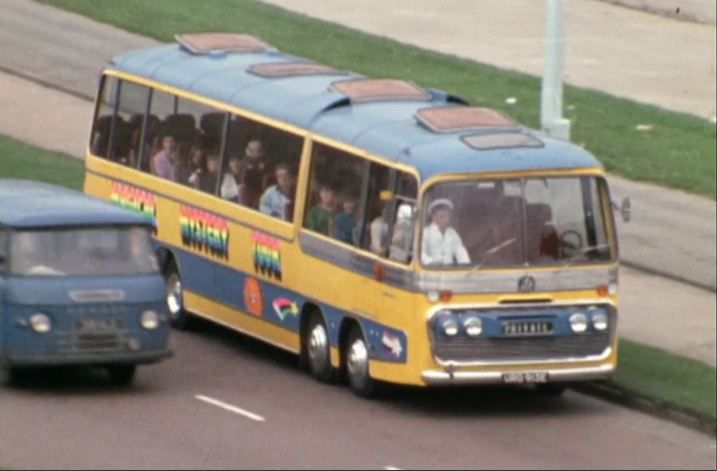

With this set-up, the rest of the special is a disjointed series of skits, sometimes on the bus, sometimes elsewhere, involving the Beatles and the various other passengers. Periodically the skits will be interrupted by the performance of a Beatles song.
The skits are about what you would expect from a group of people with no script randomly improvising. Mainly it is just the cast mucking around in whatever sets or outdoor locations they were able to find during production.
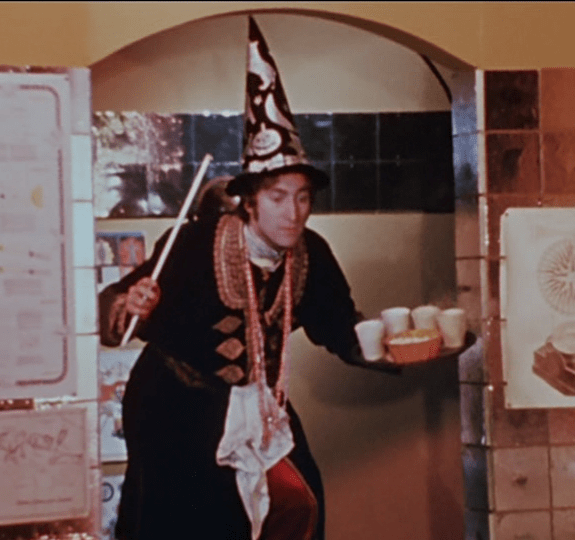
The common creative theme of these skits is typically the surreal or absurd: an army sergeant (Victor Spinetti, from A Hard Day’s Night and Help!) barks gibberish at the bus passengers; the tour stages a sporting event that features half-naked men wrestling, women doing a sack race, and men in suits playing blindman’s bluff; the four Beatles, dressed as wizards, exchange nonsensical dialogue about the trip, and so on.
In one weirdly off-putting scene, Aunt Jessie dreams of a restaurant in which John, dressed as a waiter, uses a shovel to put huge amounts of nauseating-looking pasta on her plate while other restaurant patrons dine in their underwear in the background.
At their best, these skits are interesting simply for their sheer weirdness, which foreshadows the type of grotesque chaos that Terry Gilliam would later specialize in. More often, though, Magical Mystery Tour’s little episodes are just about as boring as you would expect amateur improv to be. Sequences where, for example, the tour bus and some cars race each other on an airstrip or where Aunt Jessie and the creepy Mr. Bloodvessel (Ivor Cutler) have a romantic frolic on the beach are pretty tedious.
What about the featured Beatles songs? They mostly fall into the middling-to-good range. The title song, which opens and closes the special, has a carnival-like buoyancy to it, thanks to Paul’s vocals and the sweeping instrumentation.
George Harrison gives us “Blue Jay Way,” which is certainly distinctive–who but George could write a brooding, ominous lament about being bored at home one evening?–but not particularly enjoyable. “Your Mother Should Know” is a sweet music hall-style throwback from Paul but also an under-developed piece; it feels more like a warm-up for a song that was never quite completed.
The stand-outs are Paul’s ballad “The Fool on the Hill” and John’s utterly bonkers “I Am the Walrus.” “The Fool on the Hill” has a lovely wistful melody and poignant lyrics. “I Am the Walrus” is a triumph of sheer weirdness, with its nonsensical Lewis Carroll/naughty schoolboy lyrics and drawn-out, cacophonous conclusion.
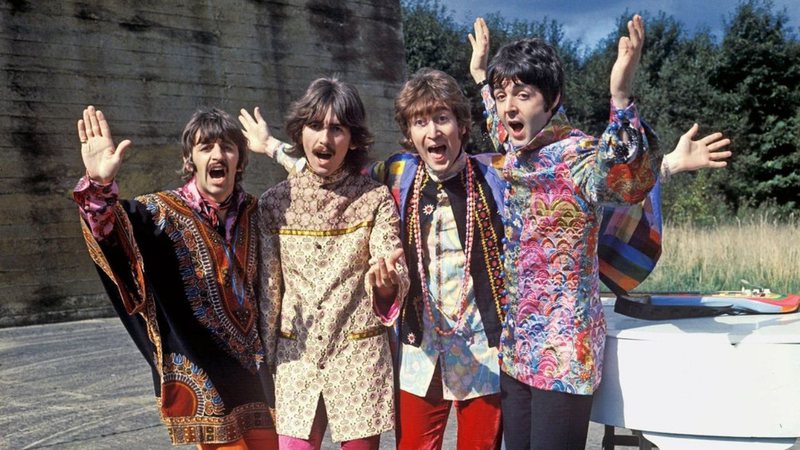
While the songs are a mixed bag, the musical sequences they are featured in are also a mixed bag stylistically. The “I Am the Walrus” sequence is certainly memorable, as it features the band dressed variously in full-blown hippie gear or in creepy animal masks, while various other cast members wander about in odd costumes.
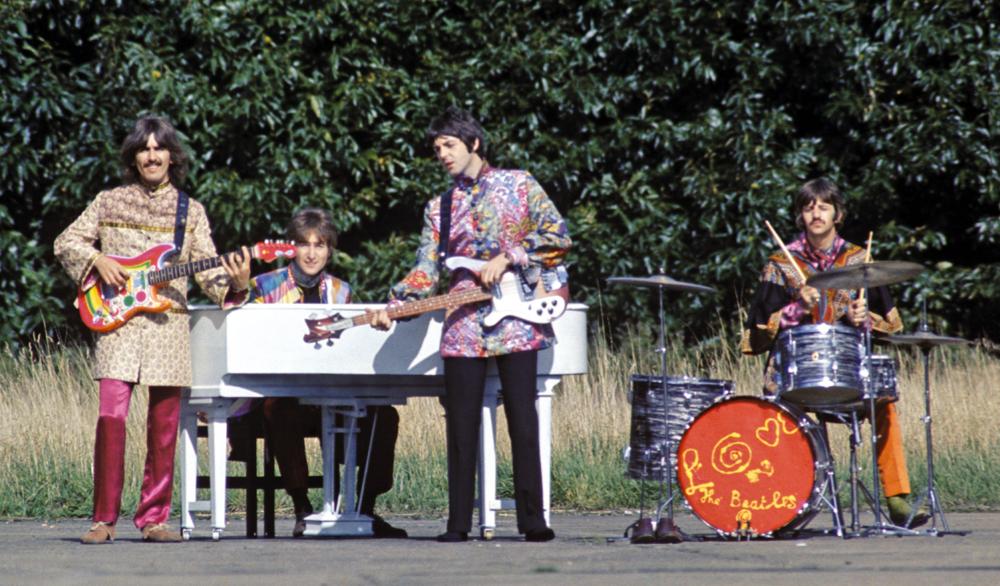

The final image, a low-angle shot of the tour bus driving through a field while the cast parades behind it, all set against a brilliant blue sky, achieves a kind of trippy grandeur.
In contrast, the “Your Mother Should Know” sequence is staged like an old-fashioned Hollywood musical: the four Beatles, dressed in spotless white tuxedos, sing the number as they descend a giant staircase. They are backed up by dancers in flashy evening clothes. Overall, the sequence is surprisingly polished, given how patched-together the rest of Magical Mystery Tour is.
The other musical sequences, though, are more of a piece with the amateurishness of the rest of the special. “Blue Jay Way” consists largely of George sitting cross-legged on the ground and mock-playing a piano drawn in chalk on the pavement (a few weird camera effects are thrown in for good measure).
“The Fool on the Hill,” which Paul shot on his own on a trip to France, is just footage of Paul in an overcoat wandering through the countryside. This sequence is perfectly pleasant–the song is pretty, the landscapes are pretty, Paul is pretty–but nothing to write home about.

I should mention that Magical Mystery Tour also contains a staged performance of a non-Beatles musical number, the vaguely Elvis-sounding “Death Cab for Cutie,” which is notable for a few reasons:
First, it appears in the special as the back-up music for a strip-tease (apparently you could get away with some interesting stuff on British TV in the 1960s).
Second, the song is performed by the Bonzo Dog Doo-Dah Band, a novelty song group whose hit song “I Am the Urban Spaceman” Paul would produce the following year. One band member, who co-wrote both “Death Cab for Cutie” and “I Am the Urban Spaceman,” was Neil Innes, best known as the leader of Sir Robin’s Minstrels in Monty Python and the Holy Grail. And, as it happens, Innes and the Beatles were destined to cross cinematic paths again.
Third, the song would go on to inspire the band named “Death Cab for Cutie.” So there’s also that.
What else is there to say about Magical Mystery Tour? A couple nice moments turn up amid the dreary non-musical portions of the special. A short scene where John and George play with a little girl on the bus is unforced and charming. Ringo demonstrates his acting ability: in the scenes where he interacts with his on-screen aunt, he is natural and at ease.
These brief bright spots are a reminder that the Beatles are reliably fun to watch even when stuck in a rubbish movie. The Magical Mystery Tour special demonstrates that they were not a group to be trusted with the behind-the-camera parts of filmmaking, though.
In fact, they could have made a much better, more entertaining show just by having someone film them spontaneously jamming in the studio for a while. Hmmm…there might just be something in that idea!
 The Cameraman