Next in my Zhang Yimou retrospective, I look at The Flowers of War.

Imagine one of the most wrenching scenes from Schindler’s List: the brutal sequence in which the Nazis forcibly round up the Jewish residents of the Krakow Ghetto, killing many of them. Now imagine that Steven Spielberg intercut that sequence with the Nepalese bar scenes from Raiders of the Lost Ark, in which Indy and Marion argue about their past romantic relationship before getting into a shoot-out with the (far more cartoonish) Nazis in that movie.
If you can wrap your head around the bizarre tonal clash that such a combination would entail, then I think you have a sense of what Zhang Yimou’s The Flowers of War (2011) is like. The movie freely mixes scenes of brutal violence, based in real-life events, with scenes filled with trope-heavy Hollywood action, romance, and sentimentality. The result is by no means boring, but is nevertheless a fundamentally misguided movie.
Written by Liu Heng, from a novel by Geling Yan, The Flowers of War is set against the backdrop of one of worst atrocities of the Second World War, the Nanking Massacre. The city of Nanking was the capital of China in the 1930s and was occupied by invading Japanese troops in late 1937. In the first months of the occupation, the Japanese turned their wrath on the Chinese civilian population, indiscriminately torturing, raping, and killing city residents. The total death toll was somewhere between 100,000 and 300,000 people.
The movie tells a fictional story about a disparate group of people trying to survive amid the Nanking Massacre. One is Shu (Zhang Xinyi), a 13-year-old girl attending a Catholic girls’ school in Nanking. She and her classmates are left without adult protection when the German priest running the school is killed.
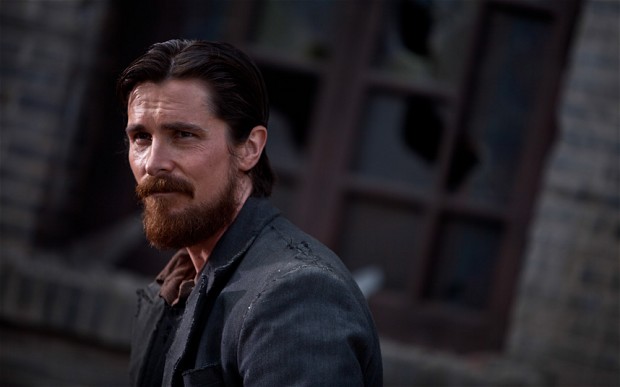
A new adult enters the girls’ lives when an American mortician and general ne’er-do-well named John Miller (Christian Bale) arrives at the school. Initially coming just to bury the late priest, Miller stays because the school offers a relatively comfortable haven from the city’s chaos.
Miller is soon followed by a group of well-heeled sex workers from Nanking’s red light district who are also seeking shelter at the school. These women end up hiding in the school cellar. A Chinese soldier, Major Li (Tong Dawei), also uses this cellar to hide a wounded comrade (Zhu Liangqi).
None of these characters initially trust or like each other. The schoolgirls resent the sex workers taking shelter in their school and the older women return the sentiment. Miller is purely out for himself and just wants to stay alive and enjoy the late priest’s wine supply, and perhaps the sex workers’ services.

Yu Mo (Ni Ni), the unofficial leader of the women, rebuffs Miller’s patronage but makes a counter-proposition: she will reward him if he can get her and the other women out of Nanking. As a westerner, he is less of a target for the Japanese and may even have some leverage.

Also putting pressure, of a very different kind, on Miller is George Chen (Huang Tianyuan), an orphan boy who served as the priest’s assistant and feels a sense of responsibility toward the schoolgirls. Now serving as a de facto assistant to Miller, he urges the American to help the girls.

The situation soon reaches a crisis point that makes clear just how dire the danger to Shu and her classmates is. Miller must then decide if he will just try to save his own skin or if he will do the right thing.
In its broad outlines, The Flowers of War tells a very familiar story, and one can easily predict how it will unfold. Miller will evolve from a scoundrel into a hero (and inevitably dons a cassock and presents himself as “Father John” to deceive the Japanese). The wary cooperation between Miller and Yu Mo turns to respect and ultimately romance. The schoolgirls and sex workers overcome their mutual hostility and establish sisterly bonds. Everything leads to a caper-like plan to get out of Nanking.
Nothing about this plot is inherently bad. Tropes become well-worn because they make for reliable storytelling. The movie even has a certain old-fashioned Hollywood feel: if the content were toned down to meet Production Code standards, The Flowers of War could be a 1940s B-movie in which a rogue and fallen woman redeem themselves by saving a group of orphans from bestial Axis soldiers. The movie could have been a solid adventure/melodrama.
The difficulty is that Zhang and screenwriter Liu keep shattering the tone necessary for such a story to work by reminding us of the extreme brutal reality of what is happening in Nanking. This reality intrudes most drastically in two horrifying sequences: one in which a Japanese raid on the school has tragic consequences and another in which two of the sex workers are chased down by Japanese troops. Both are presented in bloody, graphic ways that are so disturbing they make the rest of the movie’s Hollywood-style contrivances that much harder to swallow.
The raid on the school is particularly egregious in this regard. The raid is eventually disrupted, and the schoolgirls are protected from further harm, when Major Li intervenes. The Chinese officer becomes essentially a one-man army in this scene, taking down whole squads of Japanese single-handedly. The contrast is absurd—again, as if Indiana Jones had swung in to save Krakow Ghetto residents.
The inconsistent tone ultimately undermines the movie’s dramatic climax. Various characters’ self-sacrificial decisions, which could work in a different kind of movie, come across as glib and unconvincing. Considering what, as the movie has unambiguously shown us, sacrifice means in Japanese-occupied Nanking, I find it hard to believe the characters would really make such decisions.
To be clear, in making these criticisms of The Flowers of War, I am not suggesting that there is only one artistically right way of handling weighty historical subjects. Not all movies dealing with such subjects must be somber, realistic dramas. Movies as diverse as Stalag 17, The Producers, or Life Is Beautiful have combined the horrors of World War II with sentimental or comedic material and still been well received.
For that matter, Zhang’s previous movie, Under the Hawthorn Tree, pulled off such a tricky tonal balancing act, successfully blending the traumas of the Cultural Revolution and the messy emotions of first love with the improbabilities of a tear-jerker. Such a combination of clashing material does not succeed in this movie, though.
Parts of The Flowers of War work well, even if the overall movie does not. Zhang, cinematographer Zhao Xiaoding, and editor Meng Peicong make all the scenes of suspense or violence riveting. The frequent use of handheld cameras in these scenes works well to convey the characters’ panic and disorientation. The use of long unbroken takes as the two sex workers flee the Japanese through the city streets captures that nightmare-like sense of running yet never being able to escape one’s pursuers.
As with all Zhang movies, The Flowers of War has beautiful, striking images. In the school courtyard, a patched-together banner with an immense red cross (indicating the school as neutral ground) is a stark splash of color amid the grungy, bombed out cityscape. The sex workers, in their fur coats and colorful gowns, climbing over the school’s outer wall provides a similarly striking contrast. Cinematographer Zhao also uses light to very good effect, especially the light falling through the stained-glass windows of the school chapel.


The acting is generally good. Christian Bale gives a characteristically big performance but effectively portrays Miller’s emotional growth. His broad approach works well in the many scenes in which the character of John Miller is in a sense also “acting,” as he tries to bluff past the Japanese or comfort the children. Ni Ni portrays Yu Mo with a fierce, commanding poise but also shows a more vulnerable side to the character.
Most impressive are Zhang Xinyi and Huang Tianyuan as Shu and George, respectively. Both young actors rise to the challenge of not only handling emotional scenes, but (what is perhaps more impressive) being restrained when needed. Zhang is particularly good at giving Shu a kind of quiet, observant strength. Some of the movie’s most memorable shots are simply close-ups of Zhang’s face as she intently watches what is unfolding around her.

The good parts of The Flowers of War just make me wish all the more that the whole worked better. As it is, though, Zhang Yimou failed to make either an entertaining melodrama or a serious work about the Nanjing Massacre. The result is sadly one of his weakest movies.
Post-Script: The Nanking Massacre deserves a better film treatment than Flowers of War, and I want to acknowledge two such treatments that do justice to the many victims of this atrocity.
One is City of Life and Death (2009), directed by Lu Chuan. Another Chinese-made movie, City of Life and Death rejects conventional storytelling and characterization in favor of a docudrama approach. Episodes in the unfolding Japanese occupation are presented in cold, haunting black and white photography. What we are shown is unbearably raw and painful—for this reason, I cannot exactly “recommend” the movie—but it gives the people of Nanking the cinematic remembrance they deserve.
Another is Nanking (2007), directed by Bill Guttentag and Dan Sturman. Nanking is a documentary that recounts the massacre through the testimony of survivors, witnesses, and perpetrators. These testimonies are either read by actors or provided through footage of the real people. Simple and direct in its approach, Nanking is not as difficult to watch as City of Life and Death but is no less powerful.

 The Cameraman
Leave a comment