My Beatles retrospective continues with my review of their second cinematic outing, which marks a bit of a sophomore slump.

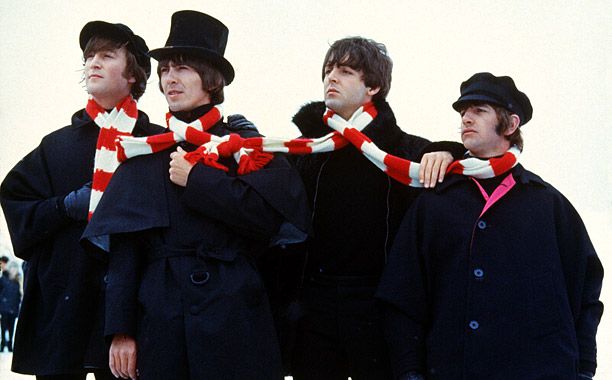
Help! (1965), directed by Richard Lester and written by Marc Behm and Charles Wood, was the second movie made as part of the Beatles three-picture deal with United Artists. Released one year after A Hard Day’s Night, when the band was still riding high on the original wave of Beatlemania, Help! is a kind of mirror image of their first movie.
A Hard Day’s Night works far better than a low-budget, hastily made movie meant to capitalize on the success of a pop group has any right to. In contrast, Help! works far less well than it should, given all it seemingly has going for it.
Help! boasts a reunion of the Beatles with the director who made them movie stars; a much bigger budget that allowed for shooting in color, memorable locations, and various elaborate stunts and gags; and (in my judgment) better songs from the four leads.
And yet…
Help! has more of a plot than A Hard Day’s Night, albeit a ridiculous one. The premise is that an impressive, jeweled ring that Ringo received as a gift from a fan is in fact an object sacred to a murderous cult (which seems to be a kind of comedy-burlesque version of the possibly legendary Thuggee). Cult practice dictates that those who wear the ring must ultimately become human sacrifices, so Ringo is now the target of the cultists, led by High Priest Clang (Leo McKern, aka Rumpole of the Bailey).
As the Beatles are subjected to various attempts first to steal the ring back and then to kill Ringo, they become aware of the danger they are in and respond accordingly. They attempt to get rid of the ring, but it is stuck on Ringo’s finger and will not budge. They therefore seek police protection, go into hiding, and resort to other desperate measures.
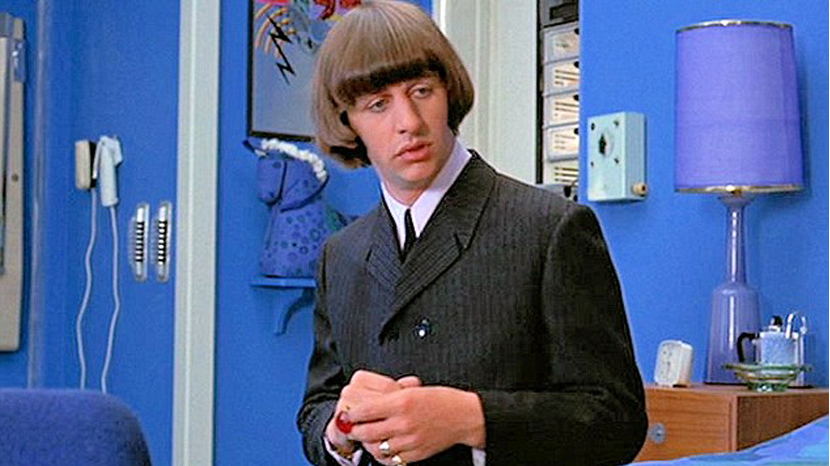
Along the way, they attract the malevolent attention of mad scientist Foot (Victor Spinetti, aka the TV producer from A Hard Day’s Night) and his bumbling assistant Algernon (Roy Kinnear, aka Veruca Salt’s father), who have their own reasons for seeking the ring. They also receive unexpected help from cult member Ahme (Eleanor Bron, aka the art museum patron from that Doctor Who episode set in Paris), who works against her fellows to protect them.
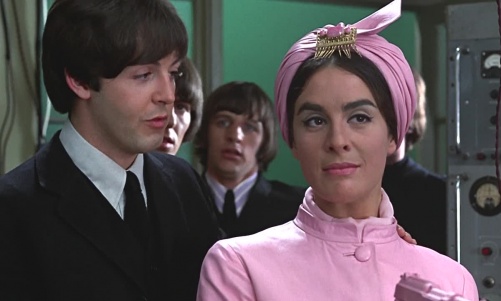
Also along the way, the Beatles travel to such exotic places as the Austrian alps, Salisbury Plain, and the Bahamas. Through it all, we get plenty of physical comedy sequences, wacky and surreal gags, and playing around with the cinematic medium, as when characters speak directly to the camera or title cards comment on the events on screen.
Some elements of Help! work quite well. The movie is wall-to-wall with droll dialogue that, as in A Hard Day’s Night, is tailored well to the Beatles’ speaking patterns and deadpan style. Often their delivery alone is enough to sell a line.
To cite a few favored examples:
RINGO: The Fire Brigade once got my head out of some railings.
JOHN: Did you want them to?
RINGO: No, I used to leave it there when I wasn’t using it for school. You can see a lot of the world from railings.
At one point, Ringo struggles against a cult member trying to pull the ring off his finger:
RINGO: Hey, someone’s got hold of me finger!
JOHN (uninterested): Are you trying to attract attention again?
At another point, the Beatles get a phone call from the cultists, and a police superintendent investigating the case decides to intervene:
SUPERINTENDENT: Allow me. I’m a bit of a famous mimic in my own small way, you know…James Cagney.
[speaking into the phone, he adopts a mock ‘Ringo voice’, to Ringo’s dismay]
Hello, there, this is the famous Ringo here, gear fab. What is it that I can do for you, as it were, gear fab?
GEORGE: Not a bit like Cagney.
Some of the more elaborate gags land. I liked a bit involving a music-loving tiger, which also sets up one of John’s best lines in the movie. The movie gets a good laugh from a very inappropriately timed Intermission break (a gag that the Pythons later reproduced in Monty Python and the Holy Grail). I also liked a moment when the police superintendent reviews a group of Bahamian police officers who turn out to be a less impressive force than they appear on first glance—I appreciated the simplicity of how the joke depends on a mere change in camera angles.
Comedy aside, Lester and his team sometimes create images that are just interesting or impressive in their own right: the cultists’ elaborate temple; an impromptu tank battle on Salisbury Plain; an overhead shot of a squadron of Buckingham Palace guards collapsing in unison; an enormous statue standing in the shallows of the seashore.
The strongest part of Help! is of course the music. The movie contains seven Beatles songs, most of them quite good. Standouts include the title song, with its wonderful combination of introspective lyrics and raucous instrumentation; the almost folk-like “You’ve Got to Hide Your Love Away”; and the melancholy, somewhat discordant “I Need You.”
Thanks to their previous collaboration, Lester is a practiced hand at filming musical sequences built around the Beatles’ songs, and so these sequences are the highlight of Help! As with A Hard Day’s Night, the musical numbers consist of montages of the band either performing the songs or cavorting around. Aided by the addition of color and better-looking locations, though, these montages have a new level of polish and glamour and are chockful of album-cover-worthy compositions.
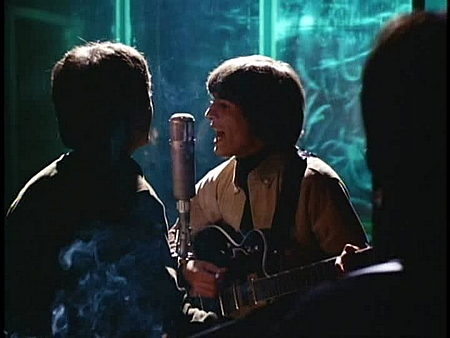
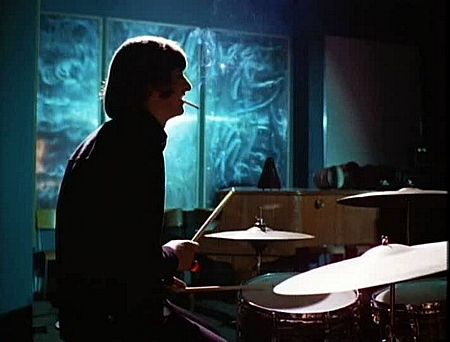
The band’s performance of “Help!” is filmed in an elegant, satiny black-and-white. Their recording studio performance of “You’re Going to Lose That Girl” is presented amid a stylish mix of overlapping shadows, tinted lights, and smoke.
“I Need You” and “The Night Before” are staged amid the deep green of Salisbury Plain, with Stonehenge in the background. With the wind blowing their hair about, the Beatles look especially cool during these last two songs.
Probably my favorite musical sequence, however, is the montage of the Beatles skiing and messing about in the alpine snow while “Ticket to Ride” plays on the soundtrack. The evening sunlight and immaculate snow elevate this part of the movie through their sheer beauty. And the song is a banger.

Having reviewed all these good elements, I must ask: what, despite these strengths, prevents Help! from fully succeeding as a movie?
One possible explanation lies in the behind-the-scenes behavior of the four stars: namely, the fact that they were stoned during most of filming. All of them later acknowledged this fact. Ringo commented that “A hell of a lot of pot was being smoked while we were making the film…Dick Lester knew that very little would get done after lunch. In the afternoon, we very seldom got past the first line of the script.” John similarly said, “Nobody could communicate with us; it was all glazed eyes and giggling all the time.”
While I appreciate the honesty of these self-assessments, though, I do not think the problem with Help! is the stars. While the Beatles’ altered states undoubtedly made filming Help! a trial for Lester and the others involved, little of that shows up on screen. (Kudos are perhaps due to editor John Victor Smith.)
In fact, the Beatles are probably the best part of the movie. None of them seem visibly out of it, and they all give relaxed, likeable performances. Ringo and George in particular are quite good: Ringo hones the comic innocent persona he first developed in A Hard Day’s Night and George projects a wonderful mixture of bemusement and exasperation perfectly suited to the silly plot. They also manage some relatively subtle acting in the “You’ve Got to Hide Your Love Away” number: witness Ringo’s lugubrious body language as he hits the tambourine or the pointedly flirtatious way George plays the guitar at Ahme.
Meanwhile, John does his usual wise-guy routine and does it well. Paul does not make a big impression here, but there is nothing bad or “off” about his performance.
The problems with Help! are to be found elsewhere. One issue is the supporting cast, who definitely commit to their preposterous roles but also go over the top and come across as more grating than funny. The one exception is Eleanor Bron, who manages to be charming as Ahme. She stands out in this regard, though.
Another problem is the movie’s repeated use of slapstick, as in the many scenes where the cultists or mad scientist try to ambush the Beatles. Richard Lester has professed admiration for Buster Keaton and would even work with the Great Stone-Face in the following year’s Something Funny Happened on the Way to the Forum. Nevertheless, a Keaton-esque skill in physical comedy is not in evidence here. What we get instead are rather awkward sequences of actors and stunt people blundering about in bits that just appear clumsy.
Both the broad supporting performances and lumbering physical comedy are merely symptoms of a bigger underlying problem, though: Help! is a movie that simply seems to be trying way too hard. Lester and company apparently think that rapidly throwing as many jokes and big-budget effects as possible at the audience will produce an entertaining movie.
In this regard, Help! can be viewed as a relatively early (and comparatively restrained) example of a sub-genre I will call the Swinging Sixties Comedy of Wretched Excess. This is the kind of movie that would come to dominate Peter Sellers’ career, as with the lavish James Bond spoof Casino Royale or The Magic Christian (with Ringo Starr!).
The underlying principle behind this type of comedy is that plot, characterization, and coherency do not matter—all that matters is that something funny happens frequently and that the movie clearly cost a lot to make. The result, as in Help!, is sometimes fun but also rather labored.
Given this disappointing second outing, and the ever-more-frantic pace of their lives, it is not surprising that the Beatles had minimal interest in returning for their planned third movie. By the time Help! wrapped, they may have wanted to be done with movies altogether.
And yet…
 The Cameraman