Returning to reviewing after a little hiatus, I look at the next movie in my Zhang Yimou retrospective, Curse of the Golden Flower.

Curse of the Golden Flower (2006) is Zhang Yimou’s third foray into the wuxia genre. The movie differs from its predecessors in two notable respects, though.
First, it reunites Zhang, for the first time in over a decade, with his former muse, Gong Li. Second, while Zhang’s previous wuxia movies, Hero and House of Flying Daggers, were picaresque tales about warriors on quests or missions, Golden Flower is a story of power struggles and intrigue within the Chinese imperial court.
Co-written by Zhang, Wu Nan, and Bian Zhihong, from a stage play by Cao Yu, Curse of the Golden Flower is set during the Tang dynasty, in the 10th century. The Emperor Ping (Chow Yun Fat) rules from his vast palace and, as the story begins, prepares to celebrate the Chrysanthemum Festival. The palace courtyard is accordingly filled with golden varieties of the flower.
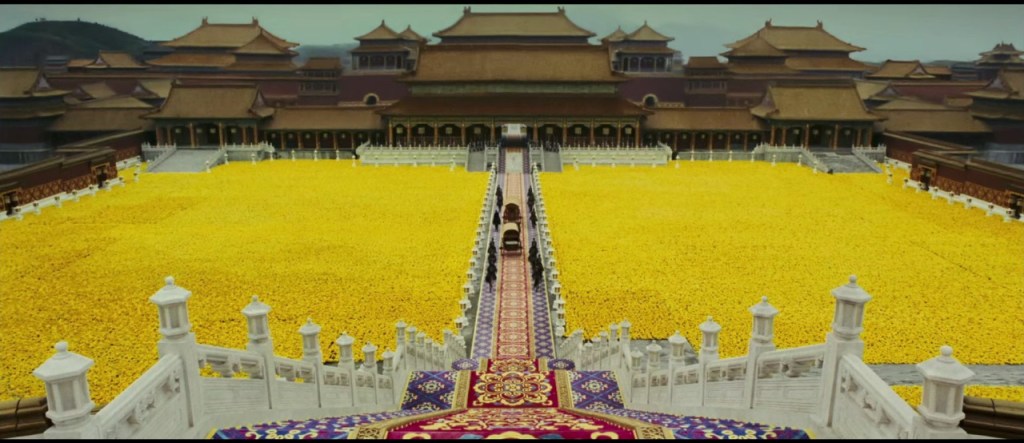
Something’s rotten in the state of China, though. The Emperor and his consort, the Empress Phoenix (Gong Li) hate each other. He is secretly having the court doctor (Ni Dahong) put doses of poison in her medicine. For her part, she is carrying on an affair with her stepson, the Crown Prince Wan (Liu Ye) while scheming on behalf her biological son, the younger Prince Jai (Jay Chou).
Meanwhile, Prince Wan is having another affair with the doctor’s daughter, Jiang Chan (Li Man), with the doctor’s encouragement. The youngest member of the imperial family, Prince Yu (Qin Junjie), seems innocent compared to his relatives, but is he perhaps up to something as well?

This summary should give you a sense of the movie’s flavor. As the plot unfolds, we get everything you might expect: secrets, confrontations, betrayals, incest, the unexpected return of an old flame, murders, and all the standard material from the venerable narrative tradition of Wealthy, Powerful People Being Horrible to Each Other (other entries in this tradition include I, Claudius and Dallas).
As with many Zhang movies, the chief pleasure here is the visual style with which the story is told. Cinematographer Zhao Xiaoding, Art Director Zhao Bin, and Costume Designer Yee Chung Man all excel in creating gorgeous imagery on screen.
The production team’s greatest accomplishment is the imperial palace, probably the best location in a Zhang movie since the house in Raise the Red Lantern. Every inch of the palace is covered with vibrant color: plenty of gold, but also red, green, and yellow.
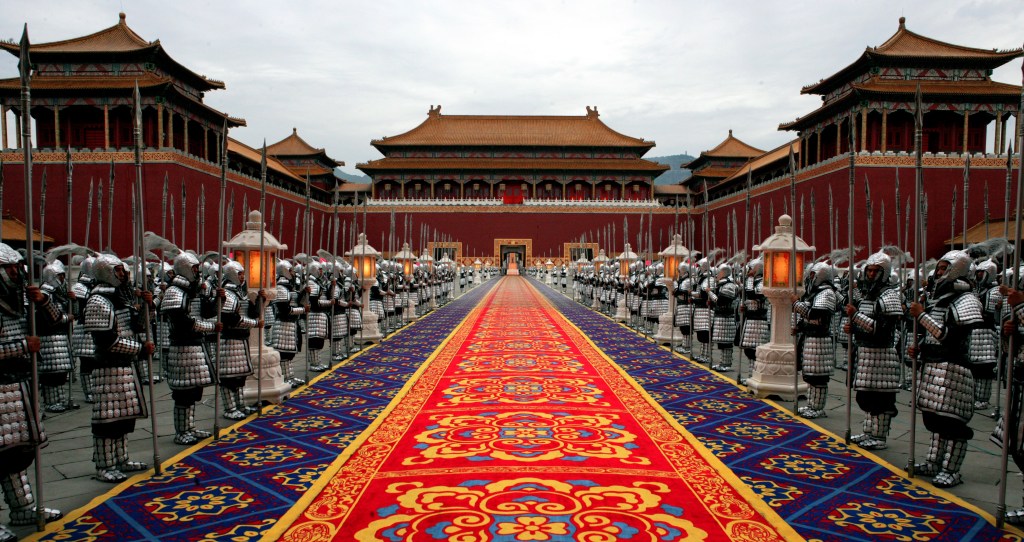
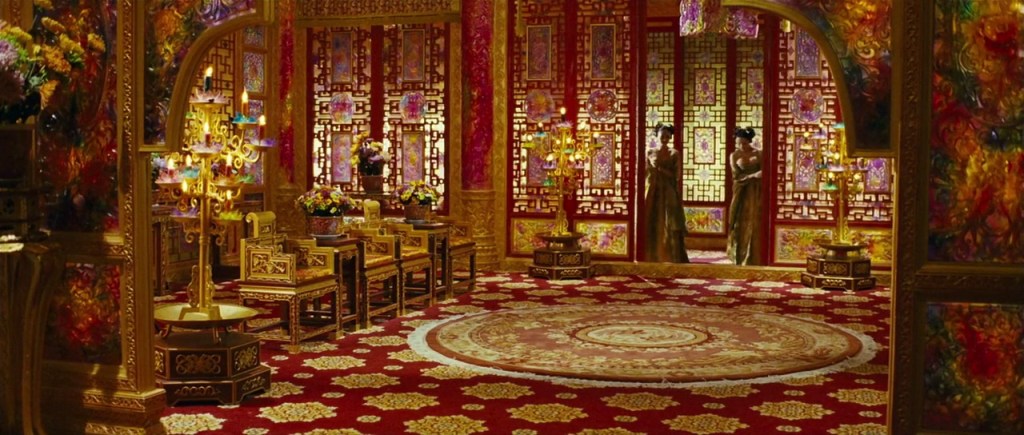
Moreover, the palace interiors are made of a translucent stone (meant to be jade, perhaps?) that provides an ethereal glow to indoor scenes. The effect is rather like being inside a rainbow.

The movie also includes various striking details about palace life. A group of servants routinely march through the long halls, banging instruments and announcing the hour of the day, like town criers. The Emperor has a hollow throne that his courtiers fill with hot water and herbs, making the throne a miniature steam room.
No less brilliant than the decor are the characters’ costumes, from the lavish golden robes of the Emperor and Empress, the alternately gold or silver armor of various contingents of soldiers, the dark blue robes of courtiers, or the all-black attire of the ubiquitous assassins. Beyond being a treat for the eyes, these color-coordinated outfits also help the audience keep straight who is who in various scenes.

Given such a great combination of setting and costumes, Zhang provides plenty of beautiful compositions. One stand-out image is an overhead shot of the imperial family gathered around an enormous table on a terrace: the table and terrace create a hypnotic collection of concentric rings and squares.

Other memorable shots are one of the Empress at the top of the endless stairs leading down to the palace courtyard and one of the Emperor, seen in backlit silhouette, walking down a corridor.
Consistent with the operatic quality of the story, Curse of the Golden Flower, like Zhang’s previous wuxia movies, uses theatrical choreography. Servants, soldiers, and assassins all move together in perfectly coordinated time. The movie’s bravura opening sequence, in which the palace’s various ladies-in-waiting get ready for the day, is akin to a Busby Berkeley number.
Golden Flower’s many fight sequences are not quite as good as those in Hero or House of Flying Daggers, partly because of less inventive staging and partly because too much fast editing undercuts the stunt work. Nevertheless, the movie’s combination of bright colors, synchronized groups of combatants, and a fast pace makes the fight scenes work reasonably well as spectacle.
The cast all give very broad, flamboyant performances, which is the right approach for this kind of story. The leads also include some nice acting flourishes that layer their big performances: I appreciated the small but contemptuous gesture with which Gong Li tosses her medicine cup down on a servant’s tray; Chow Yun Fat’s stroking of his beard to convey the Emperor in thought; or the calculated insincerity of the smiles the imperial couple aim at each other.
If the movie has a discernible theme, it is the ambiguity of family loyalty. The Emperor publicly proclaims family and filial piety as the highest goods yet he and most of his family deal with each other in the most vicious of ways. Family bonds are not presented purely ironically in the movie, though. Two family relationships (notably both between mothers and children) are genuine and meaningful. Yet the movie also makes clear that such sincerely loving bonds still may not save people from a terrible fate. The finale, and the characters left standing at the end, offers a last bitter twist on this familial theme.
Overall, I enjoyed Curse of the Golden Flower. I enjoyed it primarily as a triumph of great visual artistry, though, rather like viewing a series of great paintings. I did not find it very involving emotionally or imaginatively.
My chief problem was the characters. None of them are likable, but that is not necessarily fatal to a movie; none of the characters in Hero were especially likable either. In Hero, however, the characters felt mythic and larger than life, while in Golden Flower they just seem greedy and selfish, albeit very glamorous.
Zhang’s third wuxia outing is ultimately a cold movie that nevertheless is made with tremendous style. Like so many tales of Wealthy, Powerful People Being Horrible to Each Other, one finishes the story with the thought “Well, those people were pretty awful. But they had a really nice house.”

 The Cameraman
Leave a comment