I continue my Zhang Yimou retrospective with Riding Alone for Thousands of Miles.

Following his two wuxia movies of the early 2000s, Zhang Yimou returned to contemporary China and more naturalistic filmmaking with Riding Alone for Thousands of Miles (2005). The basic story is the stuff of tear-jerking melodrama, but the movie is subtler and more interesting than such material might be in other hands.
Written by Zou Jingzhi, from a story by Zou, Zhang, and Wang Bin, Riding Alone for Thousands of Miles begins in Japan, where taciturn widower Mr. Takata (Ken Takakura) lives in an isolated fishing village. Takata has long been estranged from his only son, Kenichi, a documentary filmmaker who studies Chinese folk opera.
As the movie opens, the older man receives terrible news from his daughter-in-law Rie (Shinobu Terajima): Kenichi has been diagnosed with terminal cancer. Takata rushes to the Tokyo hospital where his son is being cared for, but Kenichi does not want to see him.
As he seeks some way to reconcile with his son before it is too late, Takata watches a documentary Kenichi filmed featuring Chinese opera performer Li Jiamin (played by an actor of the same name). Kenichi promised Li he would return to China to film Li’s performance of the famed opera “Riding Alone for Thousands of Miles.”
Takata decides to take drastic action: he will travel to China to film Li’s opera performance and then show the video to Kenichi. Perhaps this gesture and gift will change his son’s attitude?
He flies to China and, aided by interpreter Jasmine (Wen Jiang) and local tour guide Lingo (Qiu Lin), tries to locate Li Jiamin. He meets a set-back, though: Li has been imprisoned for getting into a fight. If he wants to film Li performing the opera, he will have to do so in prison.
Takata is willing to try to get permission to film inside the prison. That is only the beginning of the complications and challenges he will encounter in his quest, though. Over the course of the movie, Takata will have to travel far and go through a great deal in pursuit of his goal.

Along the way, Takata also discovers that Li Jiamin has a son of his own, with whom the actor has a complicated relationship. Meeting this son, a young boy named Yang Yang (Yang Zhenbo), gives Takata a new perspective on his situation.
Riding Alone for Thousands of Miles combines and echoes elements from several earlier Zhang movies. The story of a determined protagonist on a quixotic errand resembles The Story of Qiu Ju and Not One Less; the themes of fidelity, grief, and parent-child bonds recall The Road Home; and the tone parallels Happy Times’ delicate balance of comedy and tragedy.
This last element is especially important. Riding Alone for Thousands of Miles is a movie that could have gone wrong in so many ways, becoming treacly, depressing, or just ridiculous. Zhang and screenwriter Zou avoid these pitfalls, though, largely by not pushing any particular sentiment too hard.
Takata faces considerable obstacles in his trip, but never any challenge that becomes too extreme. The movie contains no heartless bureaucrats or other clear villains. Everyone Takata meets in China is essentially well-meaning and helpful.
His difficulties abroad arise from more mundane issues, such as the language barrier: he speaks no Chinese, Jasmine is only occasionally available to translate, and Lingo speaks limited Japanese. Sometimes translation becomes an elaborate three-person relay, in which Lingo writes down what officials and others say and shares it with Jasmine, who translates for Takata.
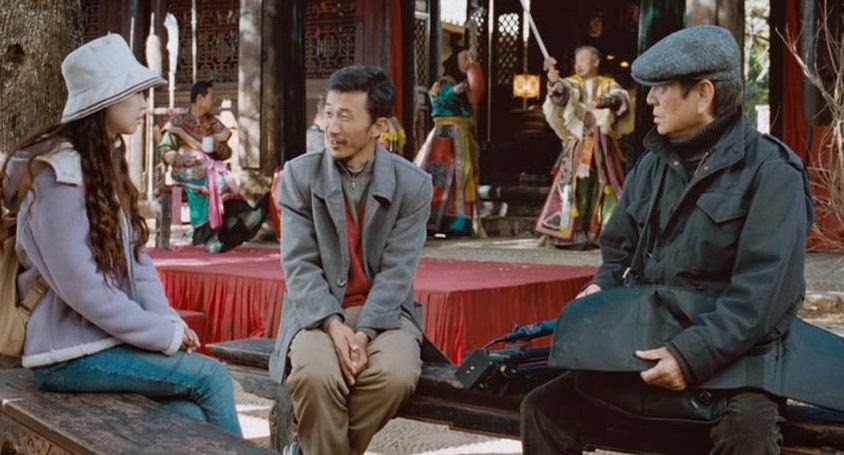
Another problem that dogs Takata is mechanical failures: cell phone reception is patchy, and a vehicle breaks down at a crucial point. Meanwhile, the biggest crisis in the trip is caused by a snap decision from a wholly innocent character.
These complications, especially the translation troubles, provide moments of quiet comedy. In one scene, a meeting between Takata and some irascible village leaders takes longer than expected because the leaders refuse to provide a simple “yes” or “no” answer to his inquiry (a response which Lingo could easily translate) before first giving him a piece of their mind on other issues (a harangue which Lingo cannot translate). Another scene shows the collision between Lingo’s earnest intention to take notes on what an official says and the official’s stream of repetitive blather.
Despite the low-key conflicts and humorous touches, though, the movie never tips over into being merely a shaggy dog story or becoming “heart-warming.” The unbearable tragedy of a loved one’s approaching death underlies everything that Takata does or experiences. The filmmakers avoid an overwrought approach, but they never allow us to forget the story’s underlying sadness.
Maintaining this tricky balancing act depends most of all on Ken Takakura, whose performance as Takata is the heart of Riding Alone for Thousands of Miles. Takakura rises to the challenge, anchoring the movie through careful underplaying. He is not impassive in the role, but his performance is made up of a collection of tiny gestures, such as a quickening of his breath or a barely perceptible gleam in his eyes. Takakura also knows when not to give anything away but to let the situation provide the emotion.
As Takata navigates difficult situations in an unfamiliar country, often hanging about by himself or at the fringes of groups, Takakura—his shoulders perpetually hunched, a cap usually pulled low over his eyes—conveys how isolated and closed-off his character is. This emotional distance, we gradually realize, is what estranged Takata from his son. Yet the father persists in his quest and his goal of reconciliation.

For much of Riding Alone for Thousands of Miles, Zhang and cinematographer Zhao Xiaoding use the quasi-documentary style Zhang generally likes to use in movies set in contemporary China. The movie features frequent long takes in which characters, usually held in long or medium shots, converse, interact, and go about their business. The filmmakers avoid noticeable camera moves or rapid editing. The non-dramatic camera work is in keeping with the movie’s overall approach of not pushing too hard for effects.
Occasionally the movie breaks from this pattern and features some memorable images: a row of tables at a village banquet that stretches on seemingly without end; a rural region filled with monumental rock formations and canyons; and, of course, Chinese opera performers. We also get recurring shots of characters framed against the sky that are dramatic and poignant.
The impact left by Riding Alone for Thousands of Miles when the final credits roll will probably vary by viewer. Some viewers might cry at the ending. I did not; perhaps the restrained tone and undemonstrative protagonist made the movie a bit too distant for that. Yet I felt I had watched a humane movie about an all-too-human character.

 The Cameraman