UPDATE: I have revised the ranking below to include The Boy and the Heron.
When I began this movie blog back in 2019, the first reviewing project I decided to undertake was a retrospective on Studio Ghibli’s work. I must admit I did not expect that (because of my slow work pace and various instances of life intervening) it would take me until 2022 to complete the project! After a certain point, I suppose I did not expect ever to finish at all.
Yet at long last I have. I hope to review future Ghibli movies on this blog—like so many others, I eagerly await Hayao Miyazaki’s How Do You Live? adaptation. [NOTE: This adaptation eventually became The Boy and the Heron.] For now, though, I am done reviewing Studio Ghibli’s feature films.
I will therefore conclude this retrospective by offering my ranking of all the Ghibli movies, from least to best. I will also offer my favorite picks of certain recurring elements (character types, music, and so on) that turn up in multiple Ghibli movies.
Before presenting this ranking and selection of favorites, though, I should emphasize three crucial points.
First, these choices are purely my personal opinion on the Ghibli movies—if you have a different ranking of the movies or different favorite characters or other elements, that is great. Nothing that follows is intended as a judgment on anyone else’s preferences. Please share your own rankings or favorites in the comments!
Second, I stress that the ranking is a relative one. I would not say any Ghibli movie is outright bad. Some are just better than others, sometimes significantly better. Even granting this relative difference in merit among the movies, though, I have gotten at least some enjoyment—and often much more than that—from all the movies listed below.
Third, while judgments on art are ultimately subjective (see point #1 above), I have tried in my ranking to err on the side of more dispassionate judgments about the movies’ quality. That is, I have tried to give higher rankings to movies I judged to be “good” or “really good” even if I do not always love them personally. On the flip side, I have great affection for some of the lower-ranked movies, despite their flaws. For example, I think The Wind Rises is a much better movie than The Cat Returns, but I would probably more quickly sit down and re-watch The Cat Returns.
Within my ranking, I found that different clusters of Ghibli movies in this list were sufficiently similar in their general quality that dividing the list into certain sub-categories seemed appropriate. The sub-categories are identified by headings and brief explanatory notes.
OK, that’s enough blathering from me. Without further ado, here is my personal ranking of Studio Ghibli’s movies, from least to best, each with a brief capsule review and a link back to my original full review:
The Lesser Ones
No Ghibli movie is “bad” as such, but some are definitely below the level of excellence one expects from the studio.
24. Ocean Waves. Even the Ghibli team’s consummate animation cannot make up for this movie’s uninteresting characters and plot.
23. Tales from Earthsea. Although not the cinematic disaster it is sometimes made out to be, Goro Miyazaki’s debut feature is a sometimes powerful but uneven sword-and-sorcery tale that lacks the special Ghibli magic.
22. Ponyo. Hayao Miyazaki’s cutest, most toddler-friendly movie benefits from an abundance of pastel, marine-focused animation, but it is also his only outright dull work.
21. Earwig and the Witch. Ghibli’s sole foray into entirely 3-D animation entertains with its flamboyant colors and amusingly acerbic view of children but is still a feather-weight, pretty slapdash affair.
20. The Cat Returns. Brightly colored, sweet, and totally insubstantial—this one is the cinematic equivalent of cotton candy.
19. When Marnie Was There. An otherwise moving story of a lonely young girl struggling with her complicated family history is marred by a badly unconvincing central relationship.
The Average One
18. My Neighbors the Yamadas. Visually distinctive, often funny, occasionally touching, yet ultimately just kind of unmemorable, Isao Takahata’s comic strip adaptation occupies a firmly “fair-to-middling” position (which paradoxically makes it something of an outlier in the Ghibli canon).
The “Problem” Ones
Too flawed to fall into the “Solidly Good” category, yet too good to be relegated to the “Lesser Ones” category, these movies have an ambiguous place in the Ghibli canon.
17. Pom Poko. Easily Ghibli’s weirdest movie, this unique blend of surreal imagery, black comedy, and tragedy is undercut by a woefully overlong run time.
16. The Tale of the Princess Kaguya. As in Pom Poko, Isao Takahata spins out a thin story for much too long, but the movie’s gorgeous sketchbook/watercolor-style animation makes it worth watching.
15. Kiki’s Delivery Service. A thoroughly charming coming-of-age story starring perhaps Ghibli’s most winsome heroine, Kiki sadly cannot quite stick the landing.
14. Howl’s Moving Castle. Two excellent leads, good supporting characters, and some of Ghibli’s most striking visuals narrowly triumph over an underwritten romance and over-complicated plot.
The Solidly Good Ones
Creative, often moving, and always a treat for the eyes, these are the reliable Ghibli standards.
13. The Red Turtle. Ghibli’s collaboration with Michael Dudok de Wit and Prima Linea produced this silent, myth-like tale of a man stranded on an island that dazzles with its beautiful, haunting depiction of the natural world.
12. The Secret World of Arrietty. My nominee for the Most Underrated Ghibli Movie: no frills, no especially weighty drama or themes, just a simple story about miniature people told with great detail and inventiveness.
11. The Wind Rises. Probably Ghibli’s emotionally coldest work, this fictionalized biopic of Zero fighter plane engineer Jiro Horikoshi raises unsettling questions about the harm brilliant people can do. Ghibli animation has rarely been more ominous in its beauty than here.
10. From Up on Poppy Hill. The Ghibli answer to American Graffiti, Goro Miyazaki’s second movie is an enormously likeable, wistfully nostalgic portrait of teenage life and love in 1960s Yokohama. Only some unpleasant plot contrivances keep this one from an even higher place on the list.
9. Castle in the Sky. Studio Ghibli took to the skies in more ways than one with their first movie. Although limited by too much slapstick and an unusually weak heroine, Castle in the Sky more than makes up for these problems with magnificent world-building, a great hero, and a dynamite climax the studio has never quite topped.
8. The Boy and the Heron. A loosely plotted meditation on life, death, and loss, The Boy and the Heron follows bereaved young Mahito on a journey to a fantastical world. The story offers little in the way of clear answers but much in the way of terror, beauty, and deep emotion.
7. Nausicaä of the Valley of the Wind. The “Ghibli movie before Ghibli,” this early Hayao Miyazaki effort anticipated much of what would make his future studio so distinctive, in a suspenseful science fiction adventure filled with evocative post-apocalyptic settings and well-choreographed action.
6. Porco Rosso. Watching this one is like watching an athlete at the top of his game: Hayao Miyazaki’s tale of a flying ace cursed to live as a pig gives us aerial spectacle, comedy, vivid characterization, and an undercurrent of sadness, all delivered with a remarkably light touch.
5. Only Yesterday. Maybe the most daring movie Ghibli ever made, Only Yesterday contains no magic, monsters, or even much conventional drama. Isao Takahata and his team nevertheless triumph by giving us a poignant, richly detailed portrait of a seemingly ordinary young woman coming to understand her life better.
The Classics
These are the crème-de-la-crème, the Ghibli movies that go beyond just being solidly good to doing something truly special that sets them apart from the rest.
4. Spirited Away. The Oscar-winning story of how young Chihiro enters the spirit realm and grows from self-pitying milquetoast to heroine contains enough unforgettable images, characters, and situations to fill the entire careers of a lesser group of artists. Watching this movie is like standing under a waterfall of pure creativity.
3. Whisper of the Heart. Yoshifumi Kondo directed only one movie in his tragically short life, so we can be grateful for that one movie being such a masterpiece. Whisper of the Heart is a lovely coming-of-age tale and a sweet romance, but above all it is probably the best depiction I have ever seen of what seriously pursuing writing as a vocation is like. Truth be told, while a few other Ghibli creations may be better in quality, this is the movie closest to my (pun intended) heart.
2. (tie) Grave of the Fireflies & My Neighbor Totoro. These two movies are perfect mirror images of each other: each one is a period piece about two siblings that was directed by a Ghibli co-founder. Fireflies is a searing portrait of how devastating war can be; Totoro is a no less powerful depiction of how joyful childhood can be. Both are unforgettable.
And finally, in the #1 slot, is (of course)…
1. Princess Mononoke. A stunning work of fantasy world-building; a rousing adventure story; a surprisingly complex examination of humanity’s relationship with nature; and an all-around great movie, Princess Mononoke is a monument to what a team of extraordinarily talented people can accomplish and is my choice for best Studio Ghibli movie.
Having provided my relative evaluations of Ghibli movies overall, I will now provide my top picks for some of the familiar elements that the studio does so well with in their movies (with a couple honorable mentions tossed in).
Favorite Flying Machine:
Marco’s red seaplane in Porco Rosso.

A bold, iconic aircraft inseparable from its world-weary pilot—this is the Millennium Falcon of the Ghibli universe.
Honorable Mention: Flying Machine:
Nausicaä’s glider in Nausicaä of the Valley of the Wind.
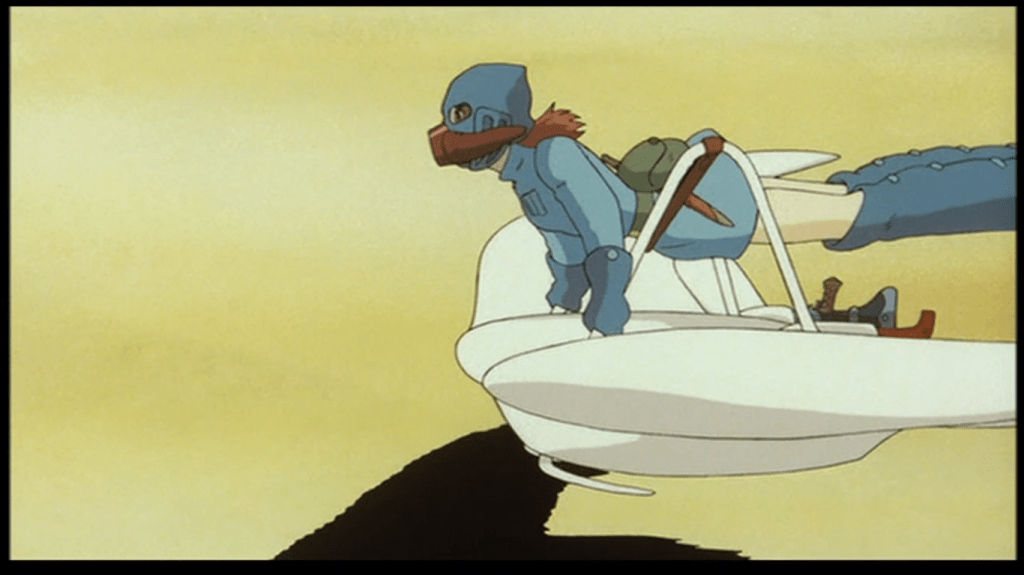
Not as stylish as Marco’s plane, but damn, she makes it look fun.
Favorite Building/Location:
The bathhouse in Spirited Away.

Despite stiff competition from Laputa and the Moving Castle, I must give the prize to Yubaba’s sinister, towering residence/place of business. The bathhouse is one of the great movie settings.
Favorite Otherworldly Being:
The Spirit of the Forest in Princess Mononoke.

I have never seen the spiritual rendered so powerfully or indelibly as in the mysterious being at the heart of the forest.
Favorite Frightening/Repellent Character:
The Demon from Princess Mononoke.
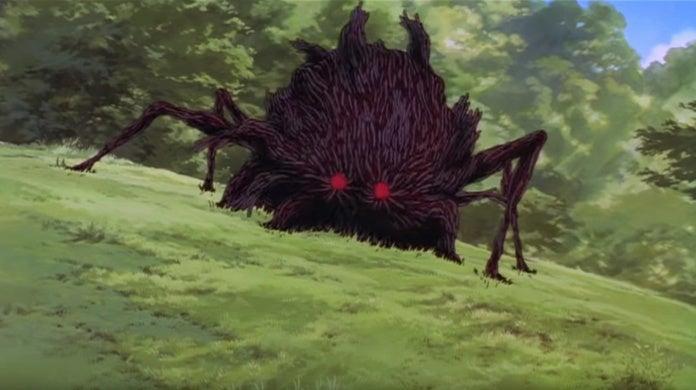
This spider-like assemblage of black tentacles is every bit as terrifying and disgusting as one would expect the personification of hatred to be.
Favorite Cute Character:
Haru from The Cat Returns.

I mean, look at those eyes.
Favorite Formidable Older Woman:
The Witch of the Waste in Howl’s Moving Castle.
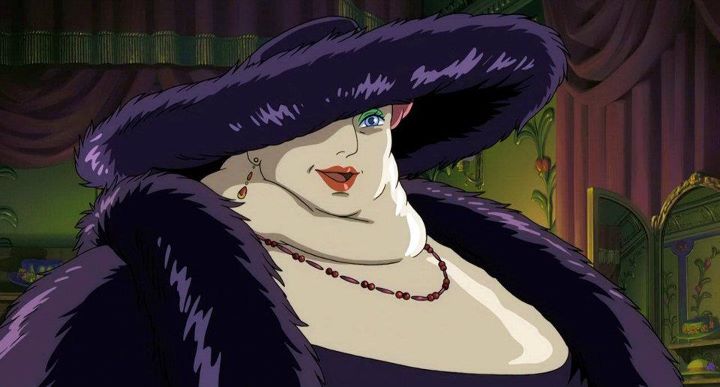
Dola may be more of a bad-ass and Yubaba may have more panache, but the Witch displays a complexity that surpasses theirs, being at turns frightening and pitiable, hateful and sympathetic.
Favorite Parent/Parental Figure:
Professor Kusakabe in My Neighbor Totoro.

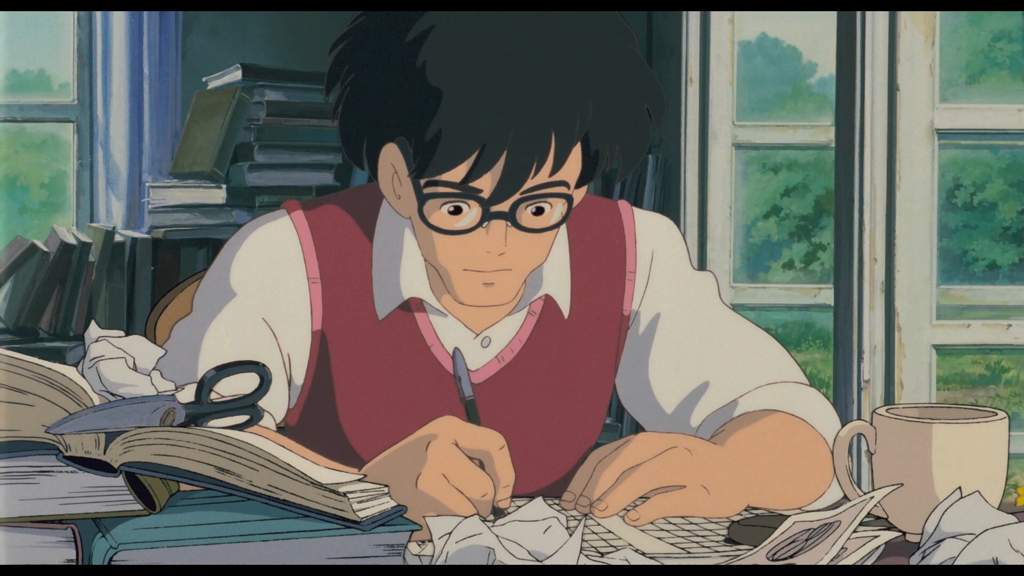
Satsuki and Mei are very blessed to be raised by such a kind, fun man.
I will pay the highest compliment I know: the good professor reminds me of my own Dad.
Favorite Couple:
Takeo and Toshio in Only Yesterday.
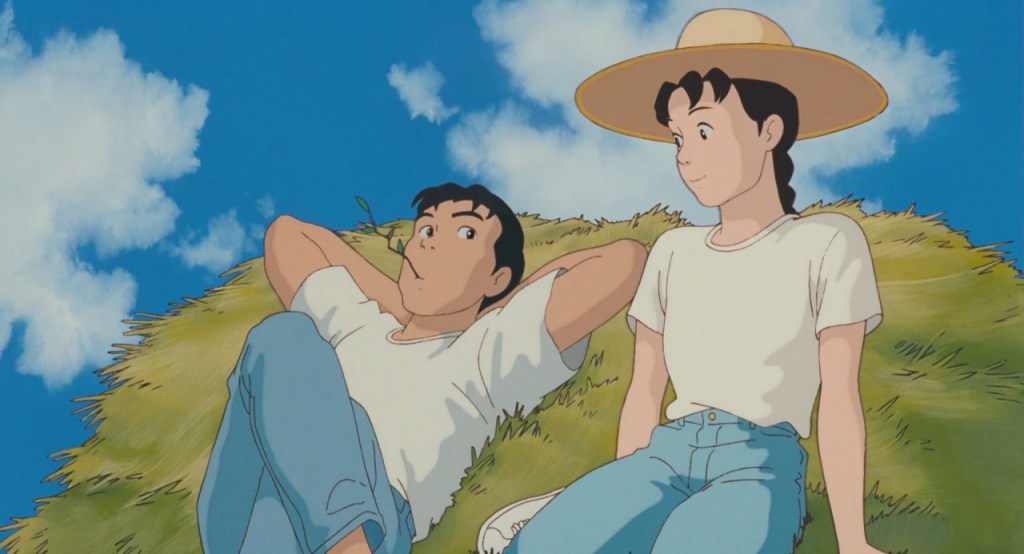
Note to screenwriters: If you give your two leads plenty of scenes together and devote time and energy to building their relationship, you end up with a convincing romance that a viewer will invest in! It sounds crazy, but it works.
Favorite Heroine:
This is perhaps the hardest choice of all (except for one other, which I will get to). From Nausicaä to Kiki, Chihiro to Sophie, Ghibli has consistently excelled in giving us good, memorable heroines.
With such a competitive field, I must throw objectivity aside and simply follow my heart (sorry) by giving the nod to…
Shizuku Tsukishima from Whisper of the Heart.

Imaginative and sensitive, insecure yet ambitious, Shizuku is the Ghibli heroine I most relate to, which makes her eventual triumph all the more rewarding.
Favorite Hero:
OK, this one is not hard at all. It’s Pazu from Castle in the Sky.

That kid was just too cool for school.
Now shifting my focus slightly from in-front-of-the-camera to more behind-the-scenes elements, here are some more favorites.
Favorite Orchestral Piece from a Ghibli Score:
Main “Laputa” theme from Castle in the Sky.
Joe Hisaishi is a giant among composers who has given us so many great pieces of music. Although picking a favorite is tough, I think I will go with this stirring, soaring piece, in which he manages to out-Williams John Williams.
Favorite Song from a Ghibli Soundtrack:
Kaze Ni Naru (Become the Wind) from The Cat Returns.
Ayano Tsuji’s performance of this hypnotically catchy song always brings a smile to my face.
Honorable Mention: Song from a Ghibli Soundtrack:
Teru No Uta (Therru’s Song) from Tales from Earthsea.
The music is an underrated element of the much-criticized Tales from Earthsea. Aoi Teshima’s rendition of this lament over loneliness is beautifully haunting.
Favorite Humanizing Detail:
Shizuku’s little half-step to catch her balance when Seiji hugs her.
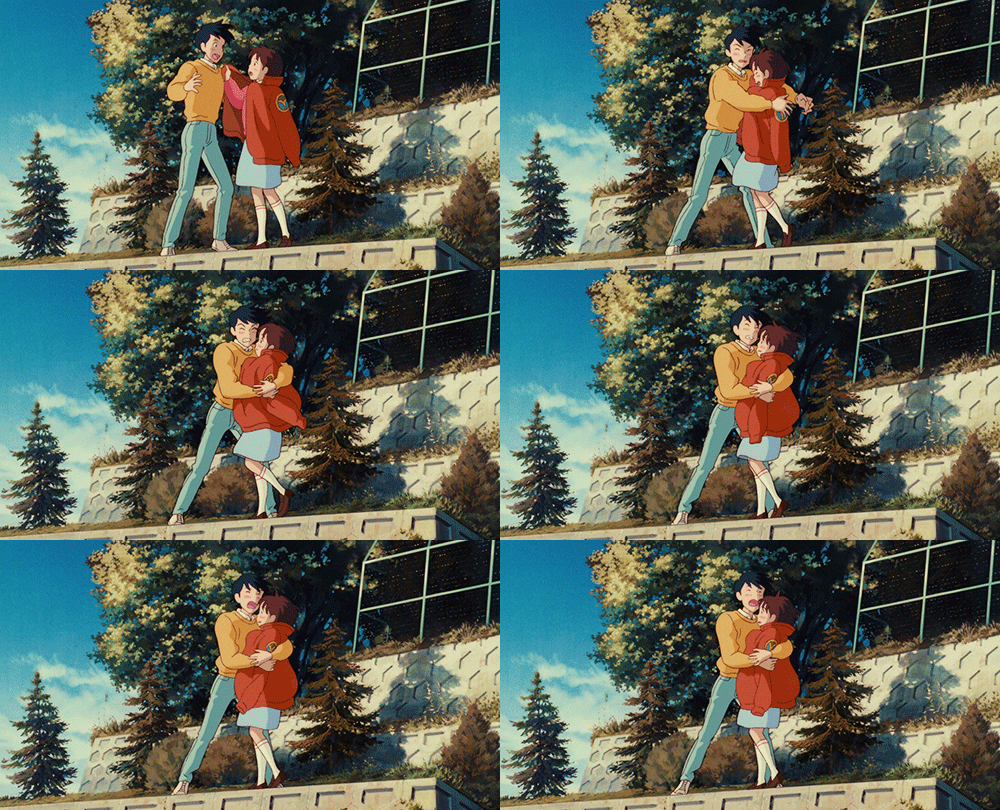
Many filmmakers would figure that a climactic declaration of love was a big enough moment that they did not need to add to the moment’s realism by throwing in little gratuitous details. The Ghibli animators, though, always go the extra mile.
Favorite Image:
This is absolutely the hardest choice of all to make, given that almost every shot in a Ghibli movie manages to be beautiful or otherwise memorable in some way.
So…I will not attempt to answer this one. I will simply make the recommendation:
Watch Ghibli movies. If you do, you will be guaranteed to see no end of amazing images. You can decide for yourself which one is your favorite. I am sure you will have one.
In place of a favorite image, I will instead end with what I think is an apt image, taken from where this retrospective all began, Ghibli’s first movie, Castle in the Sky.
As Sheeta and Pazu wave goodbye and fly off into the sunset, let me say goodbye to this retrospective. Farewell! It has been a marvelous time.


 The Cameraman
What a wonderful post, John! Reminds me of all the reasons I love Ghibli and also that I need to finish watching the ones I haven’t seen.
LikeLike
Thank you! I am glad you enjoyed it. You can’t go wrong with Ghibli.
LikeLike