Next in my Studio Ghibli retrospective, I turn to the most recent Ghibli movie to date, Earwig and the Witch.
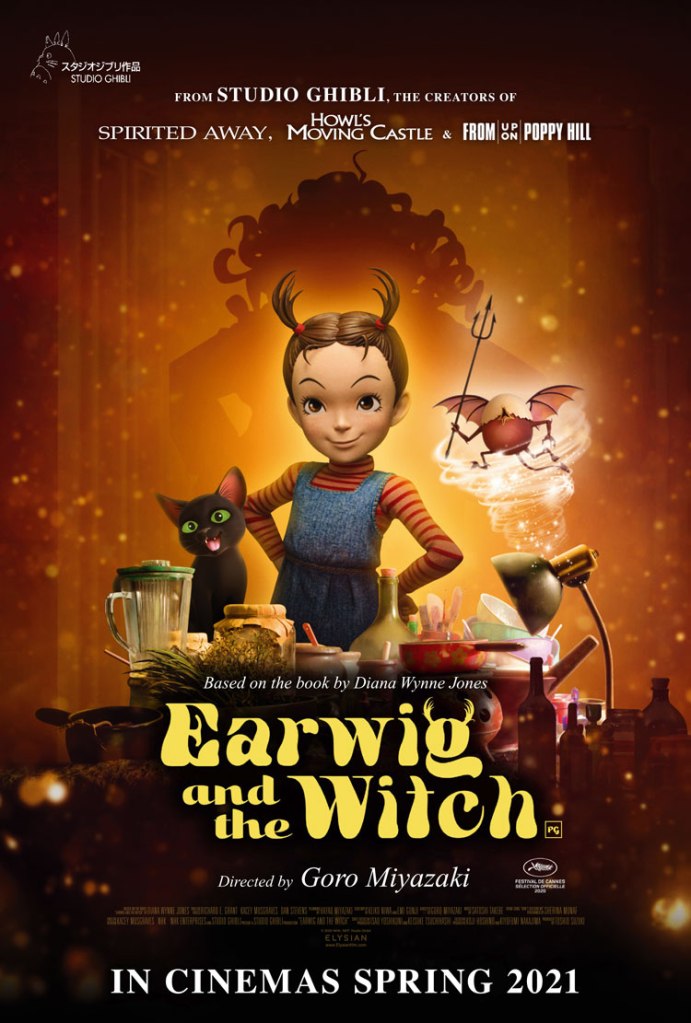
Earwig and the Witch (2020) feels like a movie made by some parallel universe version of Studio Ghibli. Recognizable Ghibli characteristics are here: a strong young heroine, a story that blends the domestic and the fantastical, and impressive visuals.
Yet the whole underlying tone and attitude has shifted: in place of the earnest, sometimes melancholy, atmosphere of most Ghibli movies, Earwig and the Witch has a boisterous, caustic quality. And the heroine is not the pure hearted yet often insecure young woman we are used to but rather a supremely self-confident little brat.
Some people apparently hate this inversion of the Ghibli model. I kind of liked it.
Directed by Goro Miyazaki from a screenplay by Keiko Niwa and Emi Gunji, Earwig and the Witch was originally made for television before later receiving a theatrical release. Adapted from a Diana Wynne Jones novel and set in the United Kingdom, the movie opens with an early morning chase as a mysterious red-headed woman on a motorcycle is pursued by a yellow car. She eludes her pursuers by apparently magical means and ends up depositing a baby girl on the steps of St Morwald’s Home for Children.
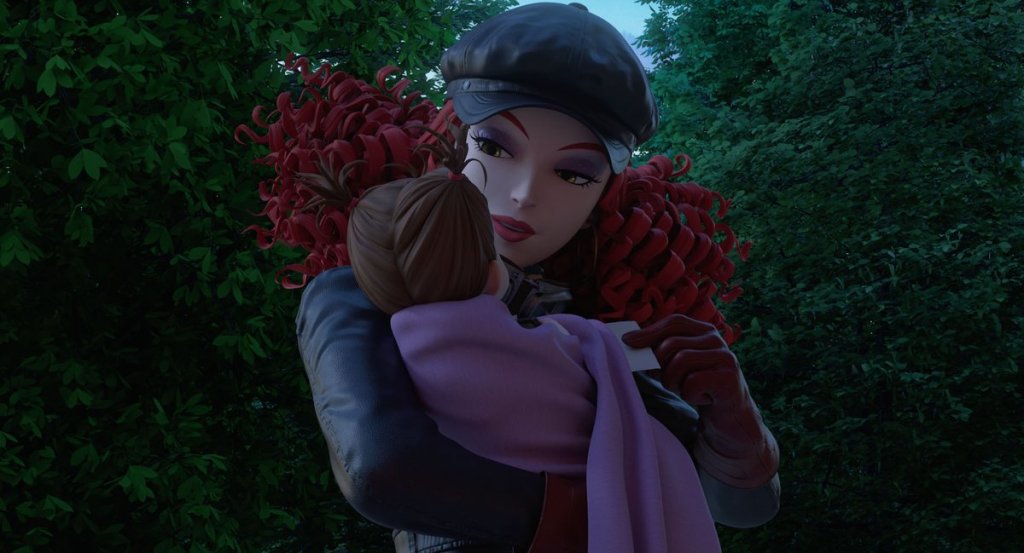
The red-haired woman, presumably the baby’s mother, leaves a note with the child. She also leaves a cassette tape, the significance of which will become clear later. In the note, she explains that she is a witch on the run from other witches and must leave the girl at the orphanage for safe keeping. The girl’s name is “Earwig.” The orphanage’s matron modifies this to the more socially appropriate “Erica Wigg.”
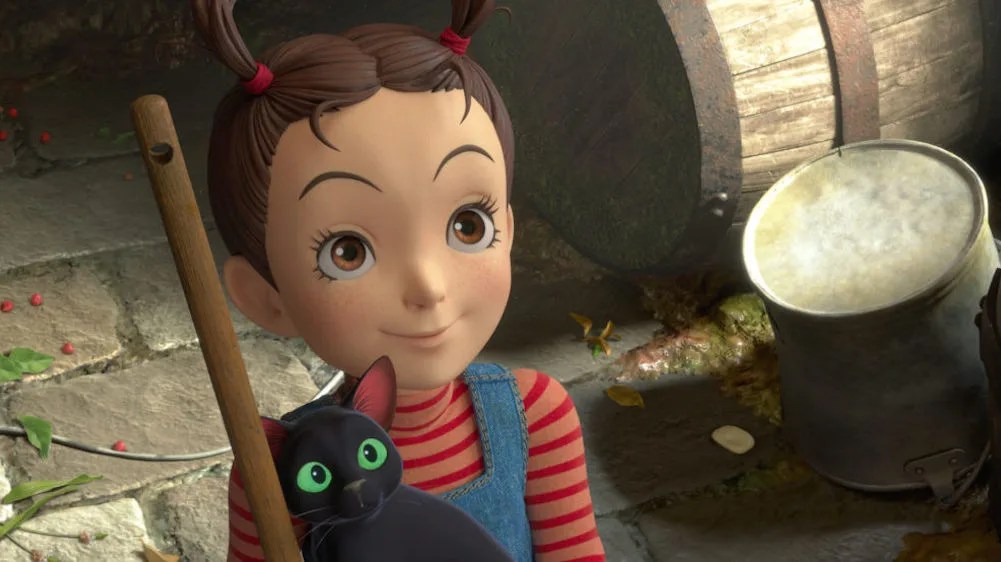
We then flash forward several years. Earwig/Erica is now about nine years old and sports perfectly vertical pigtails that recall both Pippi Longstocking’s famous braids and demon’s horns (she also appears to have borrowed Jack Nicholson’s eyebrows).

In keeping with her devilish appearance, Erica is not a very nice girl. When we first meet her, she and other children are sneaking out of St. Morwald’s at night to play in a nearby graveyard. Erica breaks into and climbs the bell tower of a church. All the while, she has fun bullying her friend, a timid boy nicknamed Custard. As they climb the tower, Erica torments him with possibilities such as “What if instead of a bell we find a severed head hanging there?”
When Erica talks to the orphanage’s matron the next day, however, she plays a different kind of game. She is all sweetness and light, flattering and helping the matron and explaining the previous night’s behavior in a way that makes her seem blameless. She also turns on the charm for the cooking staff in an effort to get food she likes.
This contrasting behavior makes clear who our protagonist is. Erica may be a rule breaker, but she is not a rebel. She is an operator. As a result, she pretty much runs the St. Morwald’s community and can do as she likes. Erica therefore has no desire ever to be adopted; as she muses to Custard, being part of a single-family household would dramatically reduce the number of people she can get to do her bidding.

Erica’s luck takes a turn for the worse, however, when despite her best efforts she is adopted. The couple who adopts her are an imposing, purple-haired woman and a seven-foot-tall man with pointed ears and opaque glasses. Moreover, the pair have the disconcerting names of Bella Yaga and the Mandrake.

When Erica gets to her new adoptive parents’ home, she learns the unsurprising truth that Bella is a witch who is not interested in having a daughter but simply wants an assistant to help her with both potion-making and more mundane household chores.
Erica takes all this in stride and says she is happy to help Bella as long as Bella teaches her about magic in return. The witch is not enthusiastic about this idea, but Erica is determined.

The rest of the movie revolves around the battle of wills between Bella and Erica. Bella tries to keep a tight rein on her young charge and use her as just an extra pair of hands around the house. Erica tries to learn more about Bella, the Mandrake, and magic in an effort to figure out how she can rule this roost as she did St. Morwald’s. Along the way, she is helped by Thomas, the household’s talking, Cockney-accented black cat.
Earwig and the Witch is a rarity among Ghibli movies in being completely computer animated. Further, unlike the last computer-animated Ghibli feature, My Neighbors the Yamadas, which imitated the simple style of a newspaper comic, Earwig and the Witch goes for a three-dimensional style.
The result looks wholly different from previous Ghibli movies and anime generally. Goro Miyazaki and his team lean hard into animation’s potential for exaggeration and caricature, as with Bella’s voluptuous figure, the Mandrake’s elongated frame, and the tangled profusion of curly hair on many characters. The animators also have fun with portraying the Mandrake’s quick temper: when he is angered, his dark glasses spontaneously reflect sparks.

Later, in the movie’s most over-the-top sequence, the Mandrake’s rage transforms him into a radically different form.
I enjoyed the similarly exaggerated expressions Erica displays to convey disgust, anger, or surprise. If she were a human actress, one would have to call Erica a ham—but her hamminess is entertaining to watch.


The most impressive aspect of this animation style is the use of colors, which fairly leap off the screen. From the reds of an early morning sky or the mysterious woman’s hair, to the purple of Bella’s hair and eye shadow, to the greens of the outdoors, Erica’s sweater, or Thomas’ eyes, the brightness of the movie’s colors are a delight to watch. The visual boldness extends to the opening credits, which unfold across a backdrop akin to an enthusiastically drawn pencil sketch.

Earwig and the Witch has many subtler, funny touches as well. I liked the modest, very British quality of Bella’s witchcraft, which serves ends such as “Making your pet win a dog show” or “Ruining a church fete.” I appreciated how the Mandrake is not only a demon but that even more temperamental of creatures, a writer. Criticism of his literary efforts, we learn, particularly sets him off. Speaking of literature, I liked how Erica’s interest in the grotesque and scary is indicated by the early glimpse we get of her reading The Hound of the Baskervilles.
Despite these various strengths, Earwig and the Witch also has significant weaknesses. The plot is a bit of a mess. After spending much of its runtime gradually showing us scenes of Erica and Thomas’ attempts to defy Bella, the movie resolves its story in a rushed and not wholly convincing way. Story threads are left hanging: we get a few revelations about Erica’s past and who the mysterious woman who left her at the orphanage was, but these just raise more questions that go unanswered. These revelations also involve what seems to be a massively contrived coincidence.
The movie’s final scene gives us a dramatic twist that never goes anywhere; we go straight from the big reveal to a smash cut to the credits. (Although given that dealing with the twist would require a degree of emotional realism that Earwig has avoided up to that point, perhaps the filmmakers were wise to avoid it.)
Meanwhile, we learn some information about various characters’ past occupations that is amusing and provides a cheeky contemporary touch to this world of witches and magic. The information does not really add anything to the story or its themes, though: the characters could have had any number of alternative occupations without it altering the movie significantly. Granted, we get a very vague and half-hearted attempt to give the occupations some thematic weight by drawing a parallel between magic and art, a la Kiki’s Delivery Service. This is not very convincing either, though.
The real theme of Earwig and the Witch, as I read it, has nothing to do with art but rather is about how manipulative children can be. Some little kids, and perhaps especially some little girls, know how to get what they want: sometimes by being cute and charming, sometimes by breaking rules, and sometimes by playing different authority figures off against each other.
This is a rather acidic theme for a Ghibli movie, but I found it entertaining. I might have been put off if the filmmakers had focused on Erica’s manipulations of the ordinary children and adults at St. Morwald’s but for most of the movie Erica’s bad behavior is directed against the two malevolent characters of Bella and the Mandrake, which takes much of the potential mean-spiritedness away. Instead, the story has an amusingly Roald Dahl-esque feel.
The English dub is very strong and feels especially apt given the story’s British setting. Taylor Henderson gives an ebullient vocal performance, alternately cheerful or nasty as the situation demands, as Erica. Vanessa Marshall rumbles and threatens expertly as Bella. As Thomas, Dan Stevens conveys a recognizably feline mixture of smugness and diffidence. Richard E. Grant is well cast as the Mandrake but is sadly given too little dialogue. (Also, one slight drawback with the dub is that in three-dimensional animation the gap between the dialogue and characters’ mouth movements is more noticeable than in two-dimensional animation.)
The soundtrack is by Satoshi Takebe, who also did the music for Goro Miyazaki’s previous feature, From Up on Poppy Hill. As in Poppy Hill, Takebe opted for a different approach than the standard orchestral score. The music in Earwig and the Witch has a distinctly rock ‘n roll vibe, with its heavy use of electric guitar. The result is not as memorable as Poppy Hill’s great jazz-influenced soundtrack, but provides a nice dose of energy to the movie.
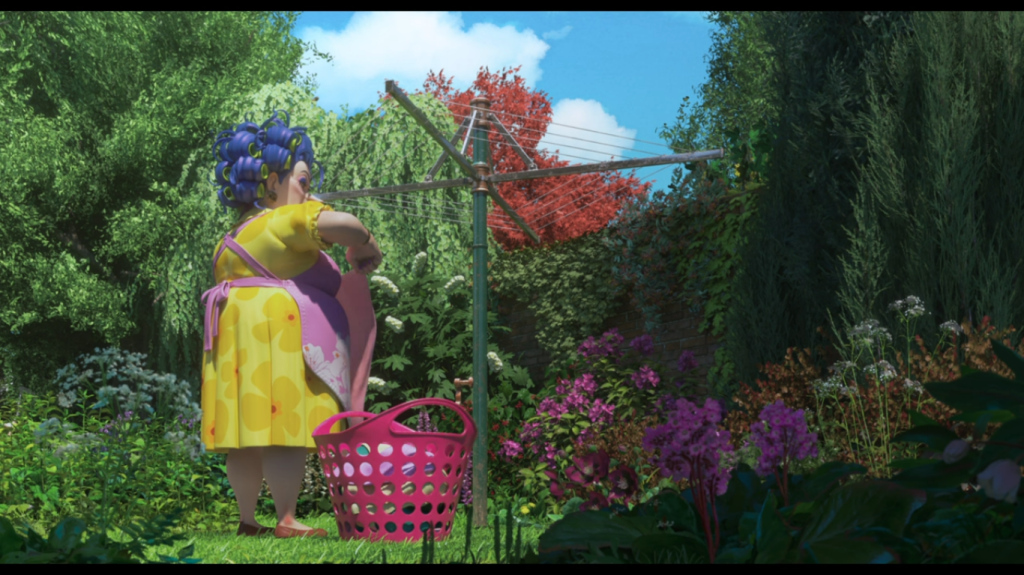
My choice for favorite image in the movie is one of Bella working in her garden. The shot shows off the movie’s candy-store color scheme to good effect.
I would also include an honorable mention for a more understated yet beautiful shot of ship sailing a night.

In keeping with Earwig and the Witch’s subversion of conventional Ghibli tropes, I will not pick a favorite humanizing detail but rather a favorite moment of stylization. When Erica is searching frantically through Bella and the Mandrake’s home, her body movements become jerky and sped-up in a way reminiscent of stop-motion animation or a Looney Tunes cartoon. The effect is not remotely realistic but still aptly conveys her agitation.
Earwig and the Witch is generally not well regarded. It received a poor critical reception and usually appears towards the bottom of Ghibli movie rankings. I certainly cannot claim it is a great movie, or even a wholly successful one. It is too lightweight and messy for such distinctions.
Nevertheless, I enjoyed the movie. I appreciated its audacity, both in its bold animation style and its vinegary take on its protagonist and story. Also, after a string of Ghibli products from The Wind Rises to The Red Turtle that, for all their strengths, took themselves pretty seriously, it was nice to watch a movie that was content to kick back and just have some fun. There is virtue in that approach to filmmaking as well.
Whether one likes it or dislikes it, though, Earwig and the Witch is significant for being the last movie Studio Ghibli has produced to date. It does not seem likely to be the last movie the studio will ever produce: Hayao Miyazaki is reportedly working on an adaptation of the young adult novel How Do You Live? and Goro Miyazaki may also direct more movies. For now, though, Earwig and the Witch marks the end of Studio Ghibli’s output.
While I may have reached the end of Studio Ghibli’s official movies, however, I have not quite reached the end of this Ghibli retrospective. Before I can bring the retrospective to a close, I must go all the way back to the beginning, to the studio’s pre-history, and look at what might be considered the “proto-Ghibli” movie. Until then…
 The Cameraman
Leave a comment