Next in my Zhang Yimou retrospective, I look at The Road Home.
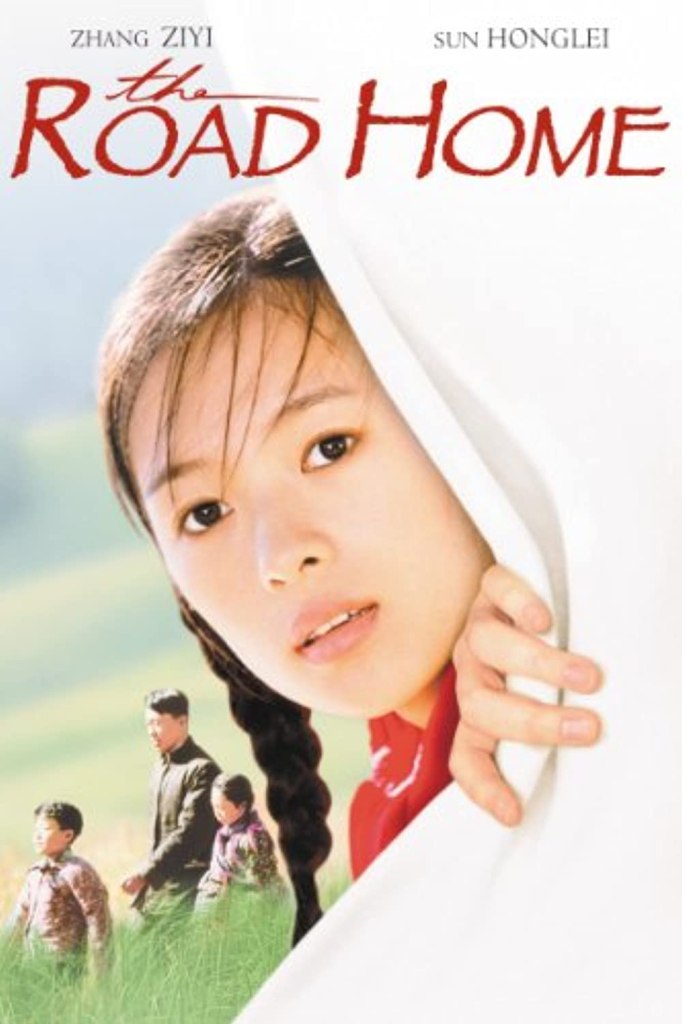
The Road Home, Zhang Yimou’s second movie of 1999, is full of emotionally powerful themes. The movie deals variously with China’s rural-urban divide, especially rural areas’ falling populations and accompanying decline in community life; the generation gap between parents and children; aging; and grief. Above all, The Road Home focuses on the theme of fidelity: fidelity to one’s spouse, parents, and community, even in the face of challenges.
These are all resonant subjects that could provide the material for a deeply moving film. However, I must report with regret that Zhang has not made such a film. For all its thematic strength, The Road Home lacks the plot and characterization to fully realize the underlying themes.
The Road Home’s screenplay is by Bao Shi, who also wrote the novel, Remembrance, the movie is based on. This screenplay is sadly underwritten. The resulting movie feels almost as though Zhang took a 5-page treatment of a possible Remembrance adaptation and started filming it without yet having a fully realized script. Because Zhang and his team are such talented filmmakers, though, we occasionally get glimpses of the better movie the Road Home could have been.
The movie begins one winter with a man named Luo Yusheng (Sun Honglei) returning to the small village where he grew up. His father, Changyu, has suddenly died and Yusheng is coming home to make funeral arrangements and to be with his mother, Di (Zhao Yulian).
Changyu was the village’s schoolteacher of many decades and died in another town while trying to raise money to repair the one-room schoolhouse. His body could be brought back to the village by car, but Di wants Changyu to receive a traditional funeral in which he is carried back on foot, so he can “remember the way home.” The deeply stricken woman insists to her son and the community’s elders that they conduct the funeral in this way. She also insists on weaving a cloth to cover the coffin herself, using a creaky old loom she has had since she was a girl.
Having presented this complicated situation for the grieving Luo family, The Road Home then flashes back to Di’s youth, to the beginning of her relationship with Changyu. We see how Changyu (Zheng Hao) first came to the village to teach its children and how Di (Zhang Ziyi) single-mindedly sought his attentions in various ways. Her efforts included cooking for Changyu, waiting along the path he walked when going to and from work, and weaving a red banner for the schoolhouse’s roof.
The greatest strengths of The Road Home are precisely those one would expect from a Zhang Yimou movie: visual flair and a knack for telling details.
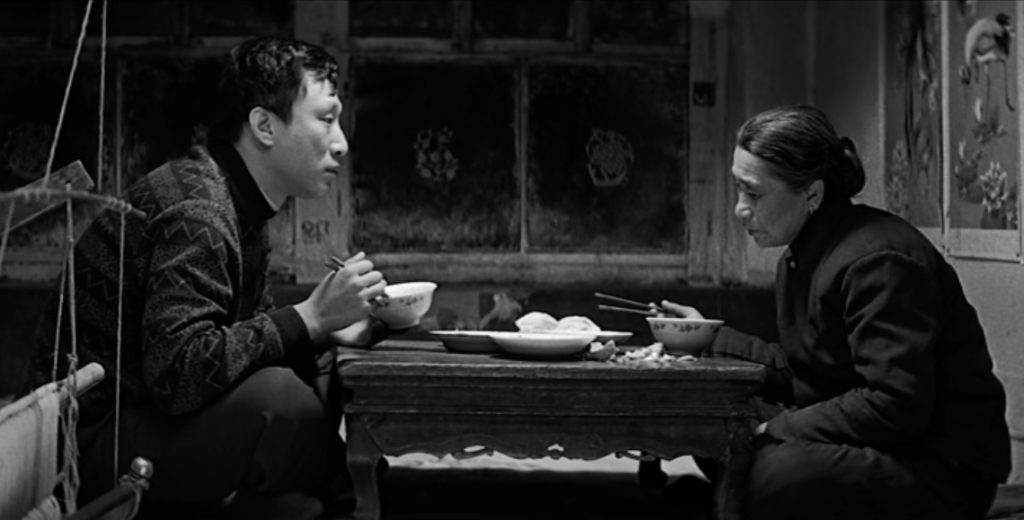
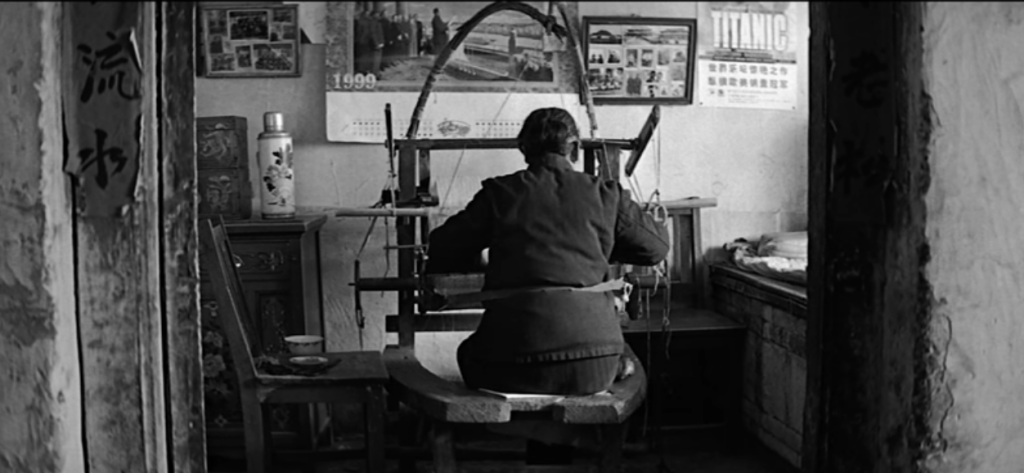
The present-day village scenes involving old Di and Yusheng are filmed in black-and-white and have a stark clarity to them. During these scenes Zhang generally avoids close-ups or other techniques meant to grab the viewer’s attention. Some compositions during these passages of the movie could be still photographs.
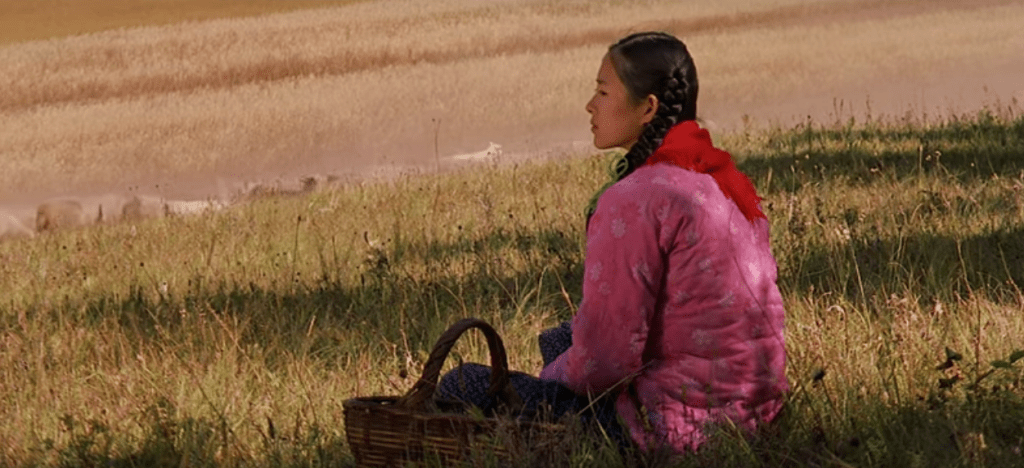
In contrast, the flash-back scenes of young Di and Changyu’s courtship are in color and cinematographer Hou Yong does not stint in giving us a riot of bright hues, from the countryside to the villagers’ clothes.
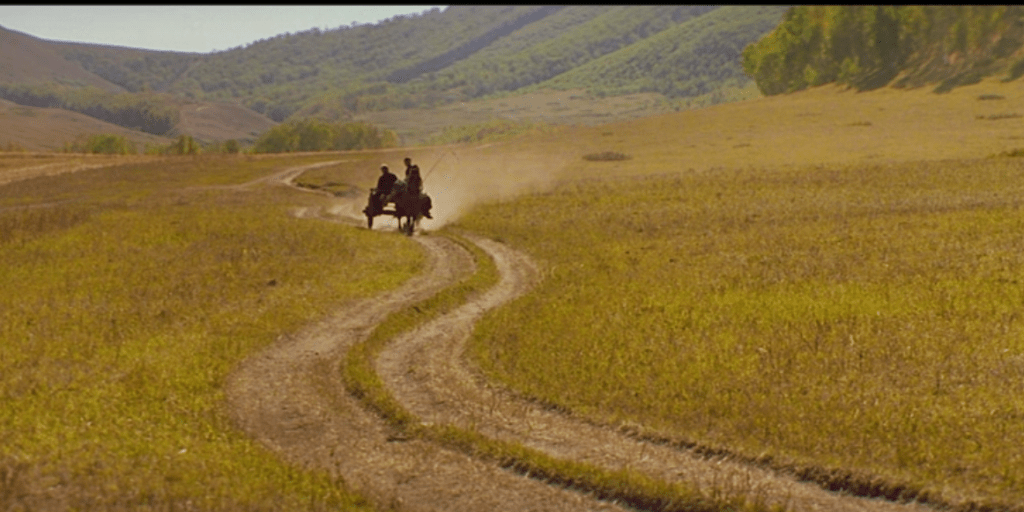

The most memorable color in these scenes is yellow, whether in delicately beautiful autumn leaves or the glow of sunlight coming in through the schoolhouse’s shades.
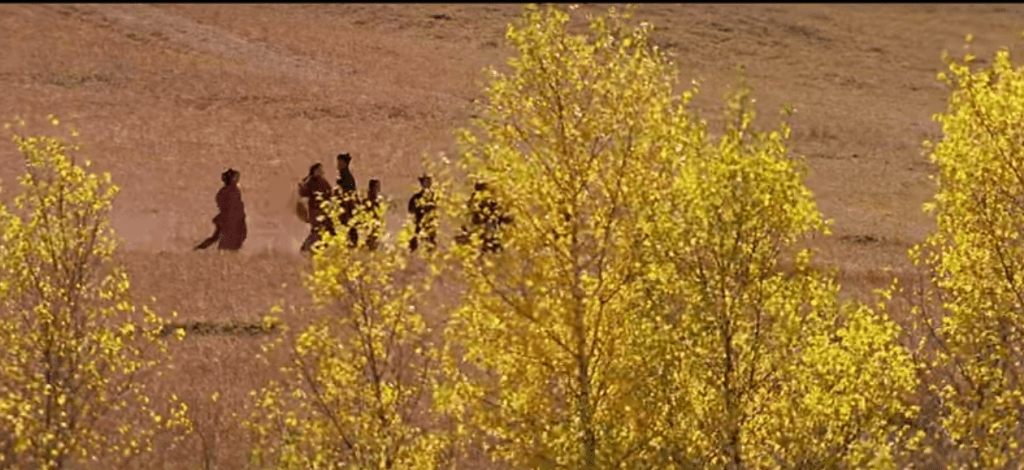
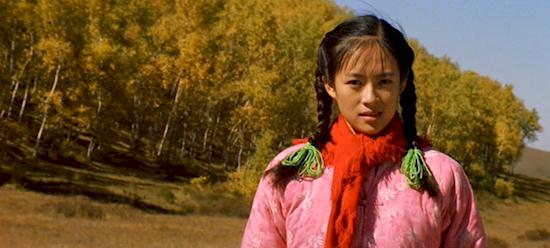
Red is also used to good effect in a shot where young Di’s face is glimpsed through the red threads on her loom, which offers a nice visual representation of the passion underlying her work.
Close-ups abound in the flashback scenes, and Zhang also employs jump cuts at one point to convey Di’s excitement as she cooks for Changyu.
The differing filmmaking styles underline the contrast between the vibrancy of the past (at least as recollected by Di) and the emptiness of the present. The approach is not subtle, but it is powerful. It is also a nice flip-flopping of the long-time movie cliché where past-tense scenes are in black-and-white and present-tense ones are in color.
Scattered through The Road Home are small details that convey something significant about the characters and their situation. In the flashback scenes, the village’s men build the schoolhouse while Di and other women watch at a distance—because, as Yusheng informs us in voice-over, women’s presence was viewed as bringing bad luck to such activities. In the present day, we get a bracingly unsentimental scene where the village’s mayor explains the practical details of a traditional funeral, including how much the coffin bearers must be paid and how much must be spent to provide them with adequate alcohol and cigarettes.
We see young Di make a regular routine of walking past the schoolhouse during the day so she can hear Changyu’s voice reading the lessons. As we watch her, we also get another voice-over from Yusheng, who shares the startling and poignant detail that his mother never learned to read.
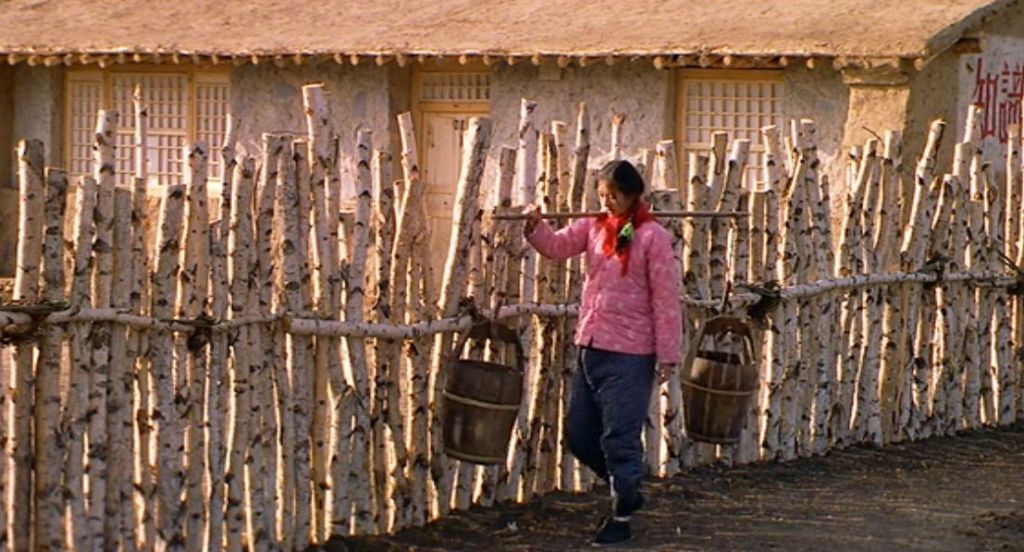
In the present-day, old Di’s home contains, just barely visible in the background, two posters advertising James Cameron’s Titanic. Their presence is both a nice nod to how global pop culture has reached this remote village and a reflection of Di’s romantic sensibility.
Some of the performances are good. As the elderly Di, Zhao conveys the woman’s grief effectively. As Yusheng, Sun brings off the harder task of showing the grief and emotion behind an undemonstrative exterior. In the flashbacks, Li Bin has a nice turn as Di’s blind mother, providing an affecting sketch of a superficially irascible but deeply loving woman.
Nevertheless, none of these strengths can quite overcome the movie’s main problem, which is that Changyu never emerges as a well-realized character. The man who is the object of Di’s devoted affection and a pillar of his community as the village schoolteacher is pretty much a blank on screen.
We hear people talk about Changyu, and we briefly see him in the flashback scenes. Yet apart from overhearing him read lessons, we get very little sense of what he is like as a person or a teacher or what he means to the generations of village students he has presumably taught.
The romance between Di and Changyu is badly underdeveloped. The couple exchange only a few lines of dialogue in the flashbacks, and for the most part Zhang must fall back on cinematic clichés to cover the absence of real relationship development. (If you played a drinking game in which you took a shot every time Di stares either longingly or rapturously at Changyu while soft music plays, you would be smashed by the half-way mark.)

These underwritten romantic scenes are not helped by Zhang Ziyi’s performance as the young Di. Although she looks striking, having a kind of elfin sweetness and radiant smile, Zhang falls into the trap of using big, obvious facial expressions to convey every emotion Di is feeling. This type of acting comes across as overdone. To make a perhaps unfair but inevitable comparison, Zhang lacks the subtlety of Gong Li.
Moreover, as limited as the portrayal of Di’s relationship with Changyu is, it is still the most fleshed-out relationship in The Road Home. Although Yusheng narrates the movie, we do not learn much about his relationship with his father. Meanwhile, the limited number of characters means that we learn next to nothing about the other villagers or their relationships with Changyu. He clearly was deeply respected in the community, but what earned him such respect is left unexplored.
Because Changyu and his place in the village receives so little attention, some final acts of devotion do not have the impact they should. The closing scenes are clearly intended to be moving, and certainly the ideas behind these scenes are powerful. Because the filmmakers have not done the work necessary to establish the significance of Changyu’s loss, though, the movie’s conclusion is underwhelming.
While I am all in favor of storytelling economy—and have criticized other movies for spinning out thin stories for too long—I think The Road Home, at 90-odd minutes, suffers from just being too short. In a longer movie, Zhang could have developed the characters and their relationships in a way that carried the necessary emotional power. The actual movie Zhang made is an interesting and beautiful-looking work that does not realize the story’s potential.
 The Cameraman
Leave a comment