The next installment in my Zhang Yimou retrospective is Not One Less.

Following Shanghai Triad and his split from Gong Li, Zhang Yimou made a comedy called Keep Cool (1997). This movie does not appear to be available anywhere with English subtitles, however, so I have to skip over it in this retrospective. (If I ever find a copy, I will add a review later.) A couple years later, clearly on a roll, Zhang came out with two movies in a single year. Here I will look at one of these movies, Not One Less (1999).
Not One Less displays Zhang breaking into an entirely new genre: the feel-good movie. The filmmaker who had previously made a name for himself mainly with tragic stories set in China’s past goes for something radically different here. A contemporary story featuring a spunky young protagonist, cute kids, a positive message, and a heart-warming but rather improbable plot, Not One Less could fit in comfortably on the Disney Channel.
Two crucial characteristics elevate the movie, though, and prevent it from being just blandly sentimental: Zhang and his team’s skill in handling this material and a compelling central character and performance.
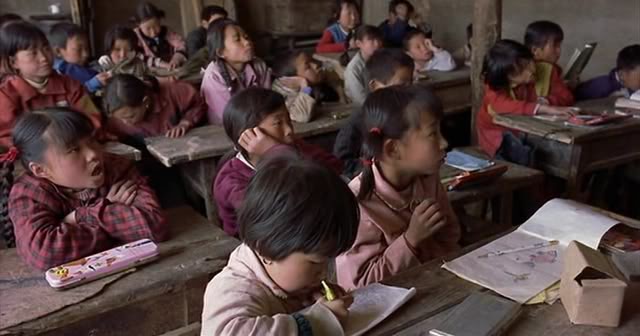
Written by Shi Xiangsheng, most of Not One Less takes place in Shuixian, a very poor village located amid rocky hill country in northern China. The village children learn their lessons in a run-down schoolhouse where the desks break easily and supplies are scarce. When their regular teacher, Mr. Gao, has to leave town for a month on family business, the children require a substitute.
The only person willing to take the job is a 13-year-old girl from a neighboring community, Wei Minzhi (played by a young woman of the same name). Taking the substitute position purely to make some money, Miss Wei has no particular qualifications or even interest in teaching. The departing Teacher Gao makes one point very clear to her, though: if she wants to receive her 50 yuan payment for a month’s teaching work, she must keep all her students attending school—“not one less” must be in the class when she finishes.

At first, Miss Wei goes through the schooldays making the barest minimum of effort: she writes the lessons on the blackboard and waits outside the classroom while the students copy them. She gradually becomes aware, however, of both the inadequacy of her lackluster teaching and just how hard it is to keep all the kids in school.
A particular challenge for her is the class clown and general troublemaker Zhang Huike (played by a boy of the same name). She initially struggles to get him to behave. Then, one day, she discovers he is gone from the class. The boy has left Shuixian to find work in a city and thereby support his ailing mother. Conscious of her “not one less” duty, Miss Wei begins a quest to bring Zhang Huike back from the city somehow.
Zhang and screenwriter Shi have found an interesting way of telling this story that both softens the potential soppiness of the material and smooths over the various plot contrivances.
Recruiting a cast of non-professional actors essentially to play themselves (hence most of the characters are named after their actors), Zhang filmed Not One Less in a somewhat cinema-verité style. As in The Story of Qiu Ju, city scenes were filmed by inserting the actors and crew into the daily bustle of ordinary city-dwellers. Zhang also frequently employs his favored approach of filming scenes, especially those involving several people, in long shots and long, unbroken takes.
All this gives the movie a level of realism and avoids the obvious emotional manipulation that would be apparent in a more conventional filmmaking style. For example, while the kids playing the Shuixian students are untrained (they wear shy smiles in most scenes), they are also unaffected enough not to act in the self-consciously precious way more accomplished child actors might.
Shi’s screenplay contains some unexpected turns and quiet humor that similarly prevent events from becoming too melodramatic. As rescuing Zhang Huike becomes a fixation for Miss Wei and her students, they try various schemes to raise money for a trip to the city. They mobilize to do work on a building site, yet end up causing more trouble than anything else. The building crew manager is a decent sort, though, and is willing to give them a break.
Later, the students spend time doing some complex calculations to determine how many hours of work could earn bus fare into the city. They conclude that two days of manual labor by the class would earn the necessary amount. One student then opines that this is too much effort and sneaking on board a bus would be easier. The class then opts for the sneaking approach (although that does not quite work out as expected either).
I should also mention, though, that the funniest moment for me in Not One Less was one presumably not intended by the filmmakers to be humorous. While watching a long scene in which Miss Wei asks questions of men exiting an office complex, I realized that the sequence was the likely result of Zhang sending Wei Minzhi out onto a city street to talk to random passers-by who did not know they were being filmed. I laughed out loud at this, not because of anything inherently amusing about the scene but simply at the filmmakers’ audacity.
Zhang’s camera captures much more than just perplexed bystanders, though. An inescapable fact throughout the movie is the class and regional divide among the characters. The humble circumstances of the schoolhouse and its students are made apparent, and not just by the makeshift classroom. Miss Wei, like Teacher Gao before her, lives in a tiny room at the back of the schoolhouse. Several students, presumably because of their families’ poverty or distance from the school, spend their nights at the schoolhouse: the boys sleep in the classroom, while the girls share a bed with Miss Wei. Chalk for the blackboard is treated as a rare and precious commodity.
Others in the larger community are clearly doing much better, though. Standing in contrast to the crumbling schoolhouse is the village’s clean, well-appointed general store, where people can buy luxuries such as cans of Coca-Cola. (At one point, the class is able to scrape together enough money to buy a couple Cokes that they share among themselves.)
While Zhang Huike’s mother lives in a humble dwelling that seems to have been carved out of a hillside, the village mayor lives in a far more comfortable modern-looking house. When characters visit a city, the urban landscape of cars, restaurants, office buildings, and people in westernized clothes is a world far removed from the village, where a single horse roams the streets. Not One Less offers an intriguing snapshot of the disparities that can exist in a society.
Despite all the movie’s other strengths, though, the crucial element of Not One Less is the character and performance of Wei Minzhi. She must carry the movie. She succeeds, in part because she makes for such a paradoxical, even maddening heroine.
As noted, Miss Wei is not the idealistic, civic-minded youth one might wish to have as a teacher. She starts out purely interested in the money the substitute job will bring and her concern for keeping all the students in the class also seems initially motivated just by a desire to hold on to her salary.
Further, her fixation on the “not one less” principle is not just self-interested but also rather myopic. Before embarking on the mission to rescue Zhang Huike, she goes to some rule-breaking lengths to prevent the village’s mayor from pulling another student out of the class. The student, a girl who is a skilled runner, is being taken from the class so she can attend a better school on an athletic scholarship. Her change in schools is presumably good for her and one can hardly believe Teacher Gao would object to a student leaving the class for such a reason. All Miss Wei is concerned about is the letter of the law, though: no student should leave her class.
Even the quest to get back Zhang Huike raises questions. Granting that the boy is better off in school than laboring as a migrant worker in an unfamiliar city, what will become of him and his mother without a source of income? Is it really good for the other students in her class that Miss Wei would be so concerned for this one student that she is prepared to leave the village and the school behind to look for him?
Yet Miss Wei’s peculiar approach has its strengths as well. Her concern about not losing students jolts her out of her early indifferent attitude to the job. Her efforts to raise money for a trip to the city get her students more involved in the class, prompting them to do the complex calculations that had previously seemed beyond them.
Above all, the sheer relentlessness of this young woman ultimately compels respect. As the quest for her missing student unfolds, Miss Wei goes further and further in her efforts to get the boy back, enduring considerable hardships along the way. She displays a single-minded determination that would be remarkable in an adult, let alone a 13-year-old. This determination comes across as the positive flip side of her more questionable tunnel vision. Right or wrong, she will pursue her goal to the end.
Zhang’s documentary-like filmmaking helps underline his heroine’s tenacity. Several scenes, especially in the movie’s later passages, consist of Miss Wei pestering or arguing with people while the camera, for the most part, just sits there and records her efforts. These scenes can get a bit wearing, but I think that is the point: they convey to the viewer the exasperation of both Miss Wei and the people she accosts.
Much credit is also due to Wei Minzhi. Whether despite or because of her lack of formal acting experience, she gives a remarkably subtle performance. She does not emote or give much away; I appreciated how in an early scene, when she is engaged in a deception, she allows herself a faintly coy expression. For the most part, though, she pursues her mission stoically, allowing the situations and her actions to convey what is going on within her. This restraint makes a late scene in which she finally expresses intense emotion all the more affecting.
Not One Less is not a great movie. It is both too slight and too implausible. Given these limitations, though, the filmmakers breathe remarkable life into the movie. That’s a worthy accomplishment by itself.

 The Cameraman
Leave a comment