In the next installment of my Zhang Yimou retrospective, I look at the magnificent To Live.

To Live (1994) is a masterpiece. Director Zhang Yimou, screenwriters Lu Wei and Yu Hua, and the rest of the cast and crew have created a movie of great subtlety that packs an enormous emotional punch. Zhang has returned to some familiar subjects from his earlier movies—China’s past, family drama—but this time has included a warmth, energy, and scope not found in his previous work.
The movie, based on a novel by screenwriter Yu, begins in the 1940s with Xu Fugui (Ge You) finishing an all-night session of gambling at a local nightclub. Fugui is the adult son of a well-to-do family in the small town where most of To Live takes place.
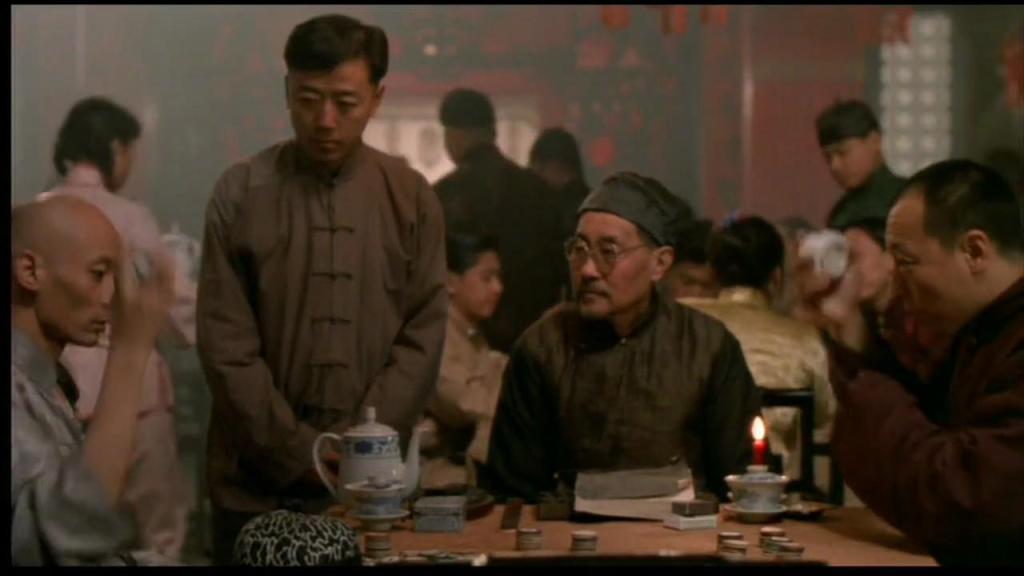
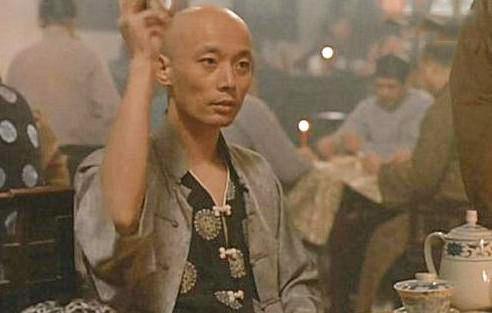
An indolent wastrel, Fugui largely ignores his wife Jiazhen (Gong Li) and their children and earns the disapproval of his elderly parents while indulging in his gambling addiction. Meanwhile, the shrewd Long’er (Ni Dahong) schemes to extract as much money from Fugui as he can.
Fugui’s irresponsible behavior soon reaps predictable results, and he must adapt to a very different way of life. He has some skill as a musician and finds a new vocation leading a troupe of men who use music and shadow puppets to entertain audiences with tales of adventure and romance.


Jiazhen also finds work, delivering water to the town’s households, and together the couple just manage to support themselves and their two children, daughter Fengxia and son Youqing (played by various actors at different points in their lives).
However, larger events will intervene in the family’s life, as they are caught up in many of the major events of 20th-century Chinese history: the civil war between Nationalists and Communists; the Communist victory; the Great Leap Forward; and the Cultural Revolution. As To Live moves from the 1940s to the 1970s, we see the family go through the many joys and sorrows that these events, and life in general, bring.
From the opening scene, Zhang makes it clear he is now using a different, more dynamic filmmaking style. Gone are the abundant long shots and long takes emphasized in his earlier movies, as well as the quasi-documentary look of his previous film, The Story of Qiu Ju. I felt like Zhang used more close-ups—of characters’ faces and hands, of significant objects—in the first scene of To Live than in all his past movies combined. The pace is faster, if only because so many events are crammed into the movie. He uses techniques I do not recall him using before, such as musical montages and a dramatic tracking shot. He cross-cuts between the shadow puppet performances and other action to pump up the energy of scenes. The whole movie feels livelier.
The canvas is broader, as well. Wartime scenes involve large casts of extras. These scenes provide some memorable images of great masses of troops appearing against a snow-covered landscape.

Despite these new approaches, Zhang also sometimes employs his older style to good effect. The small town’s long, narrow streets and the dirt roads of the surrounding country provide the settings for some memorable static long shots. In one shot, two characters’ nighttime reunion is captured at the end of a street checkered by light and shadow. In another nighttime scene, an emotionally broken character’s exit is given added weight and desolation by the long, darkened street along which he walks away from the camera.
One pivotal section of To Live begins with an unbroken take of Fugui and Youqing walking along a rural road toward the camera as Fugui gives his son some quasi-proverbial wisdom. This section of movie ends with a long shot that inverts the opener: a lone character walking away down a similar road.
This use of mirroring shots to bookend a crucial episode is an example of another of the movie’s strengths. To Live’s imagery and plot are full of parallels, echoes, and other elements that somehow mirror or complement each other. The passage dealing with the Chinese Civil War begins and ends with images of a soldier’s bayonet intruding onto the shadow puppets. Fugui’s terrible reversal of fortune early in the movie is balanced by a very different (yet still unnerving) reversal later on. One character’s endearing, rather comical, fixation comes to have a deeply tragic significance. The wisdom Fugui dispenses to Youqing is repeated at the movie’s close, only with a subtle but significant change.
Zhang and screenwriters and Lu and Yu also inject a welcome dose of humor into this story. Sometimes the humor is broad, as when Youqing plays some elaborate practical jokes on other characters. These pranks play out in a prolonged way that adds to the suspense of the gags’ set-ups—and include perhaps the most dramatically filmed spit take I have ever seen.

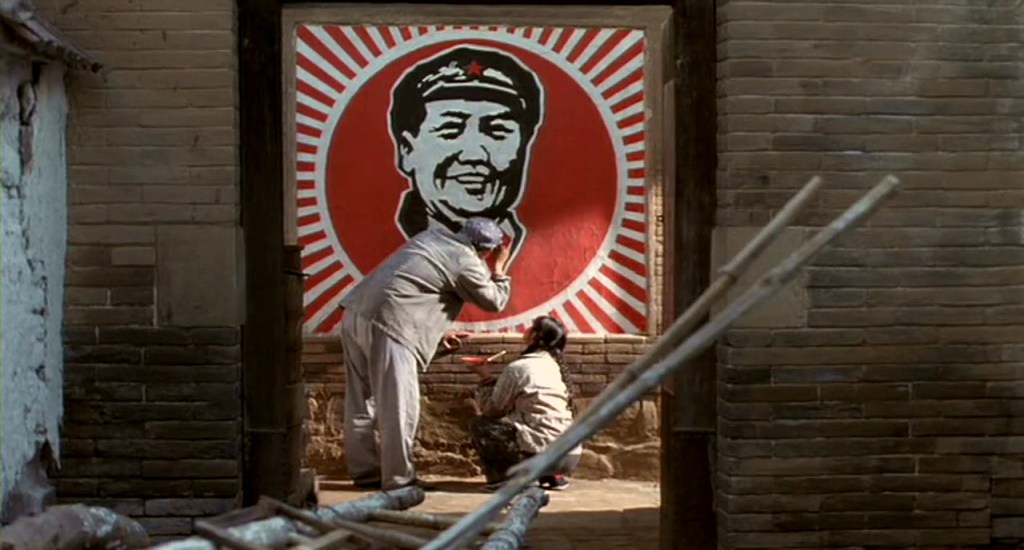
Sometimes the humor is subtler and wrier, as when the movie depicts courtship in 1960s-era China. We see parents and a would-be matchmaker boasting about proletarian ancestry as their forebears might have highlighted aristocratic ancestry. A young woman’s primping before a mirror involves donning a Red Guard-style cap. Painting a mural of Chairman Mao together serves as a young couple’s “date” in the same way a visit to the movies might be for their counterparts in the United States.
The meaning of To Live’s story is deeply ambiguous. Viewed one way, the Xu family’s experiences are broadly relatable: marriage, parenthood, work, community life, aging, death. The movie depicts with special power the peculiar, often cruel, ways events and people can defy expectations.
We see how misfortunes turn out to conceal blessings and how well-intentioned, seemingly inconsequential, decisions can lead to disaster. We see how a good-hearted person can end up causing great harm and how someone who initially inspires suspicion can turn out to be trustworthy. Someone who owes another person an apparently un-payable debt is eventually able to pay it in an unexpected way. In a sense, the movie is simply about life and how happy, sad, unfair, and unpredictable life can be.
Viewed another way, though, To Live tells a far more specifically Chinese and pointed story. The movie’s passages that deal with the Great Leap Forward and with the Cultural Revolution each contain shattering tragedies. Both tragedies are somehow the result of Communist Party policies or at the very least the actions of Party members. Granted, the movie does not treat these events in quite the same way. The filmmakers are relatively subtle and indirect in drawing the connection between the Great Leap Forward and subsequent terrible events. The Cultural Revolution’s damaging consequences are far more directly addressed. In both cases, though, the connections between Communist Party actions and human suffering are there. To Live could thus be understood as a critique of how the Communist regime sacrificed the Chinese people in pursuit of its goals. (This interpretation might be part of the reason why the movie was banned in China.)
Yet while To Live could plausibly be interpreted in this more political way, the movie does not feel at all angry or polemical. No character is treated as an outright villain. The town’s local Party chief is a genial, paternal figure. A Red Guard displays basic decency. Even some over-zealous students who cause considerable harm ultimately come across as more naïve and pathetic than genuinely malicious.
In the same way, town life following the Communist revolution is presented not as some dystopian hell but as just the relatively ordinary routine of a close-knit community. Scenes of the townspeople working night and day to melt iron for the Great Leap Forward (being entertained as they do by Fugui’s shadow puppet troupe) or of a Communist-themed wedding party have real warmth. One gets the sense of watching ordinary people who just try to get along and live their lives, for whom the dictates of ruling regimes are as impersonal and inexplicable as natural disasters.

The story’s ambiguity extends to its protagonist. Fugui seems to reform his life after his dissipated ways bring misfortune to his family. He gains humility, works hard, and carefully avoids potential risks. Yet his new-found caution has a distinct whiff of cowardice to it. Further, his attempts to avoid trouble lead more than once to bad decisions that hurt another person. Has Fugui really grown into a better man or is his old weakness of character just expressing itself in another way?
Simply condemning the man does not seem fair either, though. Fugui proves that he clearly loves his wife and family. His most harmful decisions are ones he could not possibly have predicted the consequences of and for which he suffers grievously. Fugui simultaneously invites our skepticism and sympathy.
Ge You captures this duality masterfully, in a performance that anchors To Live. Ge’s guileless face and reedy build can come across as alternatively vapid or vulnerable, effete or frail. Watch how the actor, using similar vague gestures and loose body language in different scenes, conveys both the gambling Fugui’s insouciance and the humbled Fugui’s subservience. Ge gives us a moving portrait of a soft-hearted man who bends under pressure but nevertheless endures.
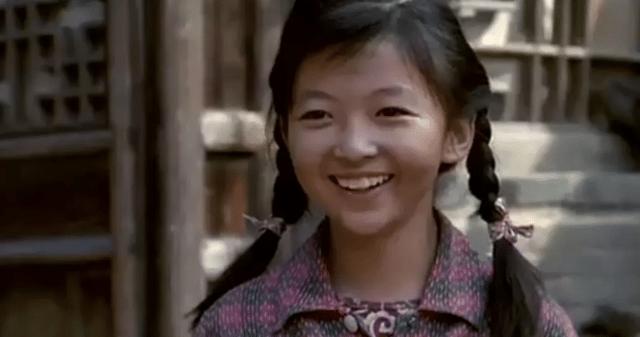
The other actors do good work. Gong Li plays strength amid suffering here as well as she has in her many previous Zhang movies but adds a warmth to Jiazhen not found in her past characters. The actors who play Fengxia and Youqing have wonderfully expressive faces and give affecting performances.
I also appreciated Guo Tao as a friend of Fugui’s whose cheerful disposition is worn down by time and events.
The movie is not perfect. The early scenes of Fugui’s downfall veer a little too far into soap opera. The staging is sometimes clumsy. For example, during a wartime scene, one significant character is felled by a bullet and I could not figure out, from the geography of the scene, just where the fatal bullet supposedly came from.
These are quibbles, though. Overall Zhang and his team succeeded in making a beautiful, heart-breaking film. To Live’s nuance and power continue right to the final scene. After witnessing much loss and pain, we are given a few signs of hope for our characters and so many others: the simple comfort of a family sitting down to eat; the promise of new life within the shell of past tradition; and the persistent dream that maybe, just maybe, the future will be better.

 The Cameraman
Leave a comment