Next in my Zhang Yimou retrospective, I look at The Story of Qiu Ju.
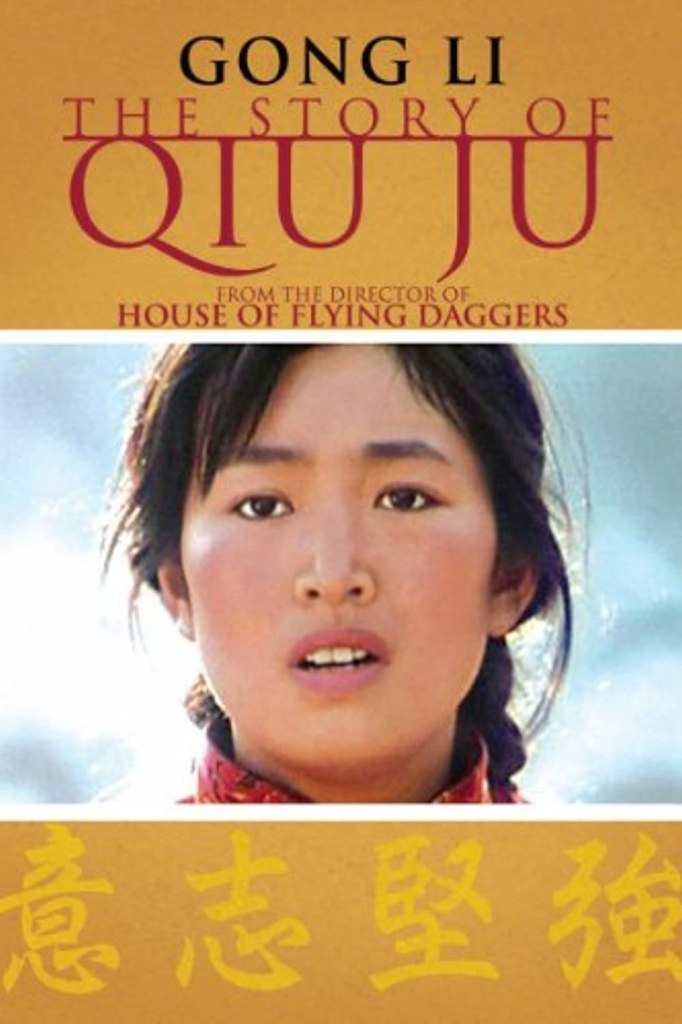
The Story of Qiu Ju (1992) marks a notable change for director Zhang Yimou. The movie departs from his past story-telling template, which had reached a culmination of sorts in his previous movie, Raise the Red Lantern. In contrast to Zhang’s earlier directorial efforts, Qiu Ju is not set in China’s pre-Communist past and does not center on an unhappy arranged marriage (although it does feature a young woman’s clash with a more powerful older man). The result of this different approach is a somewhat sad, somewhat comic, and deceptively simple tale with disturbing implications.
Written by Chen Yuanbin and Liu Heng, from a short story by Chen called “The Wan Family’s Lawsuit,” the movie follows Qiu Ju (Gong Li), a pregnant peasant woman living in a very small community in then-contemporary China. She and her husband Qinglai (Liu Peiqi) live with his parents and sister and farm chilies.

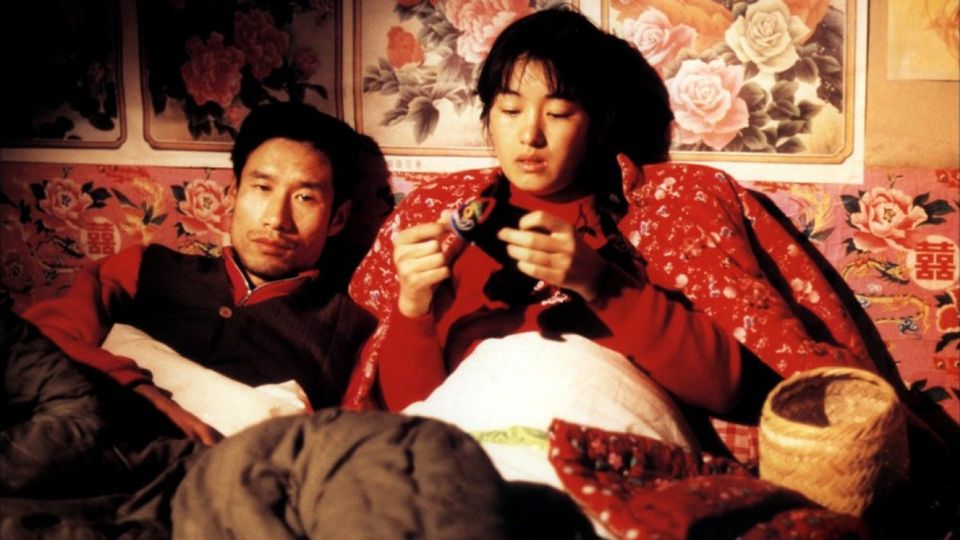
When the movie opens, Qiu Ju and Qinglai are dealing with a conflict with the village chief, Wang Shantang (Lei Kesheng). The couple wanted to build a storage shed on their farm; Wang denied them a building permit; they went ahead with the construction anyway, leading to an argument between Qinglai and Wang. Qinglai insulted Wang and Wang lashed out, kicking Qinglai in the groin. Now, Qiu Ju is seeking legal redress for the village chief’s assault on her husband.
The authorities, represented by a local official, are sympathetic to Qiu Ju and Qinglai’s complaint but also want to resolve the conflict quickly and with a minimum of fuss. The official requires Wang to pay compensation to the couple. The village chief does so but remains unrepentant and dismissive, insulting Qiu Ju even as he pays out the money. She decides the official resolution is inadequate—she does not want money, she wants a sincere apology.
Thus begins Qiu Ju’s quest, over the course of a winter, for an apology. The quest will take her through progressively higher levels of the Chinese legal system. She must seek redress at the village level, the district level, the city level, and beyond. At each step in the process, the pregnant woman must travel a farther distance from home to appeal to the relevant authorities. She is accompanied on these trips by her sister-in-law Meizi (Yang Liuchun) and totes a bushel of chilies that they sell at market to earn the money for their travels.

The movie spends ample time on the practical, logistical problems of Qiu Ju and Meizi’s quest. How do they get from one place to another? Where do they stay while far from home? (In the city they find all the standard hotel accommodations too expensive and end up sharing a room and bed with several other people.) How do they avoid getting scammed or looking too much like country bumpkins? Which gifts will best ingratiate them to the authorities? How can Qiu Ju best navigate the legal system despite being functionally illiterate? This last problem leads to a sequence that is both funny and poignant, in which Qiu Ju retains the services of a street-corner letter writer to craft her written appeal for justice. The man boasts of his diplomatic skill yet ends up writing an excessively strident and insulting critique of Wang.
Zhang and his cinematographers Chi Xiaoning, Lu Hongyi, and Yu Xiaoquin film this story using some of the same techniques as in Zhang’s previous films. Long shots, long takes, and sparing close-ups again predominate. Zhang also shows his usual skill in blocking, sometimes conveying scenes’ underlying significance through how the characters move.
Two stand-outs are an early scene where Qiu Ju must make her case to the local official and a later one where she and Qinglai argue about how far to push the case against Wang. In the first, Qiu Ju and the official are placed in the background of the shot while other citizen petitioners in the office occupy the foreground. The other people’s chatter competes on the soundtrack with Qiu Ju’s complaints. Our heroine must struggle to make herself seen and heard within the shot just as she does within the larger legal system.

In the domestic argument, Qiu Ju and Qinglai quietly but tensely discuss the situation even as they navigate household tasks, circling each other like boxers in a ring and never making direct eye contact.
However, The Story of Qiu Ju’s visual style also differs from Zhang’s past movies in crucial respects. The color palette is far drabber and dingier than in such vibrant-looking movies as Red Lantern and Ju Dou: the rural and urban landscapes here tend toward faded grays and browns. (A few exceptions pop up: Qiu Ju’s jacket and the chilies are bright red and a celebration toward the movie’s conclusion is awash in welcome color.) This muted look, together with the mundane, contemporary settings, give the movie a cinema verité, almost documentary, feel. Indeed, many scenes appear to have been filmed by Zhang simply dropping his actors into the middle of the city and filming them amid the crowds of ordinary people going about their business.
The movie is full of memorable, telling details that illustrate both the rough-and-tumble nature of life in Qiu Ju’s rural community and the odd culture clash between that life and the more prosperous, westernized world of urban China. The constant presence of heavy coats, blankets, and steaming food and drinks emphasizes the winter cold and our characters’ constant struggle to keep warm. When Qiu Ju and Qinglai visit a medical specialist to determine the extent of Qinglai’s injuries, the specialist greets them while chopping wood for the stove that heats his office. At one point, Qiu Ju and Meizi travel on a bus that also transports a goat on the roof.
Meanwhile, we get a wordless scene during one of her city sojourns where Qiu Ju stands in the street regarding with perplexed interest the chic clothes and hairstyles of urban women. In perhaps the funniest moment in the movie (which feels like it was improvised by the actress), Meizi puzzles over how to drink a can of soda, accidentally spilling some of it on the ground before just giving up on the endeavor.
The Story of Qiu Ju can be appreciated on different levels. It offers a glimpse of Chinese life circa the early 1990s, and not just by visually recording the era’s city life. The basic conflict between Qiu Ju and the village chief Wang is steeped in some tangled gender and population politics. Qinglai’s insult that provoked Wang’s assault was about how the village chief only has daughters and lacks a male heir. Qiu Ju’s indignation over Wang’s action is similarly about larger issues than mere assault. As she anxiously tells Qinglai, they don’t know if the child she is carrying is a boy or girl; if the child is a girl and the groin injury threatens Qinglai’s ability to father more children, what then? Also complicating the conflict is that Wang has clearly violated China’s One-Child Policy by having multiple daughters (he seems to have three or four)—presumably also in pursuit of a male heir.
At the same time, alongside its cultural specificity and quasi-documentary feel, The Story of Qiu Ju has a universal, fable-like quality. Qiu Ju’s progressive attempts to obtain a favorable legal verdict have the repetitive, escalating quality of trials or obstacles in a folk tale. Also, the basic situation of a woman relentlessly seeking justice against an official recalled the Parable of the Persistent Widow (Luke 18:1-8).
Yet this story ultimately is not a spiritually inspiring tale of persistence but something more ambiguous and unsettling. On the one hand, Qiu Ju is a basically decent woman who is sincerely upset over what she perceives as an injustice done to her family and Wang’s refusal to apologize for it. Further, anyone who has had to struggle their way through a baffling bureaucratic labyrinth can sympathize with her experiences.
On the other hand, her quest to force Wang to admit wrong-doing has a certain myopic, even perverse quality to it. Qinglai does not appear to have suffered serious harm and soon wants her to drop the case. While Wang is arrogant and somewhat mean-spirited, he is not fundamentally a bad man, and we see he will do the right thing when it really matters. Wang’s family is positively warm towards Qiu Ju: his daughters greet her as “Auntie Qiu Ju” and everyone is hospitable when she stops by the village chief’s house. Multiple officials try to mediate a settlement in the dispute. But Qiu Ju is not having any of it. She insists on pursuing her case until she is satisfied.
The movie eventually brings its troubling tale to an appropriate conclusion. The Story of Qiu Ju does not end in tragedy, but it does end in a bittersweet, ironic way that gives the story an Aesop-like quality. The proverb about being careful what you wish for is all too apt here.

 The Cameraman
Leave a comment