Next I review my second Marvel Cinematic Universe feature, Shang-Chi and the Legend of the Ten Rings.
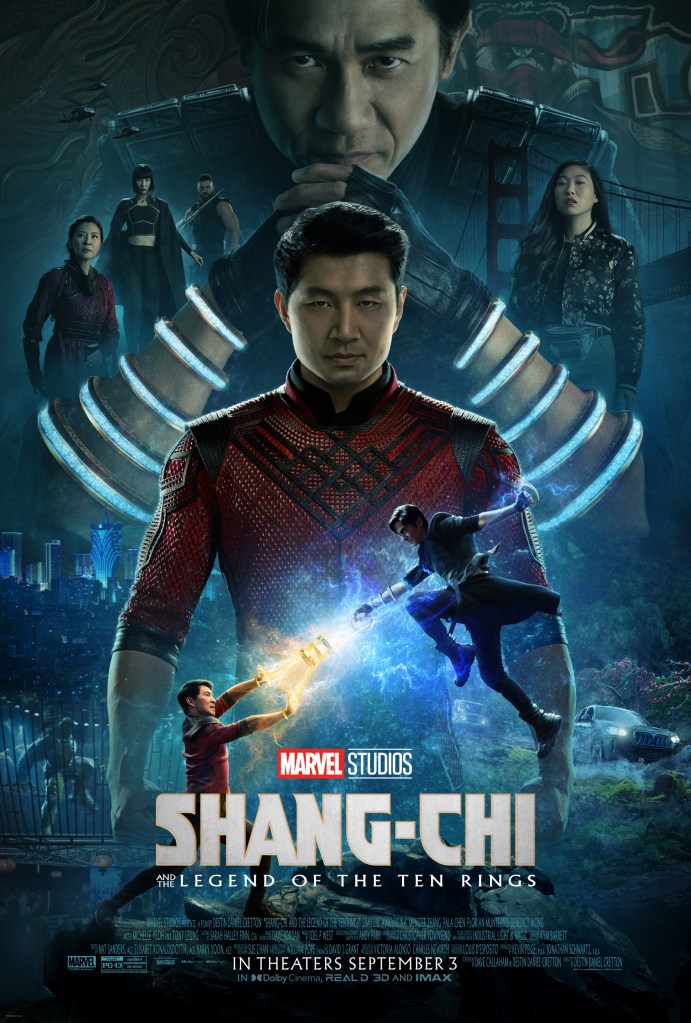
While calling Shang-Chi and the Legend of the Ten Rings (2021) “the Asian Black Panther” would be a bit flippant, the parallels between the two movies are notable. And I’m not just referring to the fact that both Marvel Cinematic Universe movies have casts made up almost entirely of people of color—the similarities go beyond that.
Both movies feature a somewhat stolid protagonist with a significant, aristocratic lineage; in both our hero has a pair of female companions, one a friend/love interest, the other his sister (although Shang-Chi reverses the Black Panther model by having the friend be an engaging character while the sister is under-developed); both have globe-trotting plots that unfold variously in northern California cities (Oakland in Black Panther, San Francisco in Shang-Chi), East Asian megalopolises (Seoul and Macau), and extraordinary, fantastical lands that are hidden from the outside world (Wakanda and Tan Lo); and both have villains who are the most interesting characters in the movies. In both our hero’s rocky relationship with his father is also a central conflict, but that goes without saying—it’s a Marvel movie.
None of this makes Shang-Chi a bad movie or even an unusually derivative one. The Marvel Cinematic Universe frequently recycles basic plots or plot elements from movie to movie: as others have noted, Marvel’s Doctor Strange (2016) is essentially a magically tinged remake of Iron Man (2008). Long-running franchises other than Marvel also generally follow a certain template: the James Bond movies come to mind.
However, because of how the various Marvel entries echo each other, what makes or breaks a particular movie is the details: does the movie contain specific elements (characters, overall style and atmosphere, or the like) that make the familiar stories interesting or fun or give them a fresh spin of some sort? Shang-Chi passes this crucial test, although not with flying colors. The movie is solid, but not exceptional.
Directed by Destin Daniel Cretton, who shares screenwriting credits with Dave Callaham and Andrew Lanham and story credits with Callaham, the movie begins with our hero, Shang-Chi, also known as Shaun (Simu Liu), working as a parking valet at a ritzy hotel in San Francisco. A rather aimless young man, he and his long-time friend and co-worker Katy (Awkwafina) spend their days driving cars and their nights partying.
However, the movie’s prologue makes clear that Shang-Chi/Shaun is not all he appears to be. He is actually the son of Xu Wenwu (Tony Leung), a centuries-old warlord and conqueror, whose life has been unnaturally extended through his possession of the magical ten rings of the title. The rings also make Xu a superhumanly powerful fighter. (Imagine Tolkien’s Ring of Power, except bracelet size and times ten and you’ve got the general idea.)
Xu met his match, though, in the mystically gifted Li (Fala Chen), an inhabitant of the mysterious land of Tan Lo. The two fell in love and had Shang-Chi and his sister, Xialing (Meng’er Zhang). Later events led to a falling out between Shang-Chi and his father and Shang-Chi’s flight to the United States.
Shang-Chi’s past reasserts itself early in the movie when some goons attack him on a city bus. Being quite a skilled fighter in his own right, Shang-Chi fends them off, but he also realizes that danger looms for Xialing as well. Accompanied by Katy, he goes to find his sister. Their subsequent journey not only reunites the siblings but takes them back to their mother’s homeland of Tan Lo—and forces them to confront their father.
Let’s start with what works well in the movie. The casting and performances are generally good. Awkwafina plays Katy pretty broadly, with lots of wisecracking and mugging, but her approach makes sense for the sidekick/audience surrogate role, and she brings a welcome energy to the part. Martial arts legend Michelle Yeoh, as Shang-Chi and Xialing’s aunt, has tremendous presence and warmth.

Fala Chen has a similar warmth as Li, along with a kind of ethereal elegance that makes her memorable in her relatively few scenes. Meng’er Zhang is sadly not given too much to do as Xialing, but she cuts an impressive figure with her black wardrobe and severe bob and her backstory is intriguing—perhaps the character will get more room to grow in future installments. Meanwhile, we get a couple nice cameos from the wonderfully vinegary Tsai Chin and from Benedict Wong, here reprising his recurring role as the irascible sorcerer also named “Wong.”
In the central role of Shang-Chi, Simu Liu is not quite as successful as many of the supporting players. He is somewhat bland and slightly stiff. As heroes go, he doesn’t grab your attention. Still, Liu’s non-demonstrative style is suited to the two sides of Shangi-Chi’s character, both the laid-back slacker and the quietly furious estranged son. Also, Liu and Awkwafina have chemistry: their characters’ diverging personalities allow them to play off each other well. The pair’s amiable bickering gives them the feel of real friends. Further, I appreciated that Cretton and his co-writers refrained from having romance blossom between the two, at least within this movie. Giving the relationship time to develop will make any eventual romance that much more believable.

The real stand-out of Shang-Chi is Tony Leung as Xu. In his performance, Leung appears to have taken deeply to heart the adage that “No villain is a villain to himself.” He accordingly presents Xu as a relaxed, smiling, seemingly benevolent patriarch and carefully underplays the moments of outright villainy, resisting any temptation to “act evil.”

The screenwriters also cleverly make Xu’s driving motivation not conquering the world or some other typical supervillain plan but a far more sympathetic goal. Xu’s worst actions paradoxically spring from his best impulses. With this assistance from the script, Leung gives us a subtle portrait of a charismatic yet deeply frightening antagonist. (Probably the movie’s most unsettling scene is a flashback to a nightmarish father-son trip that tells us a lot about Xu’s character.)
Beyond the performances, I appreciated the passages of Shang-Chi when the movie tossed aside any semblance of realism and embraced pure fantasy. I liked the land of Tan Lo and the bright colors of its flora and inhabitants’ clothes; the contrast of a tree with blood-red leaves against a surrounding light-green forest is particularly eye-catching. I also liked the ballet-like fight, shown in flashback, between the preternatural power couple of Xu and Li.

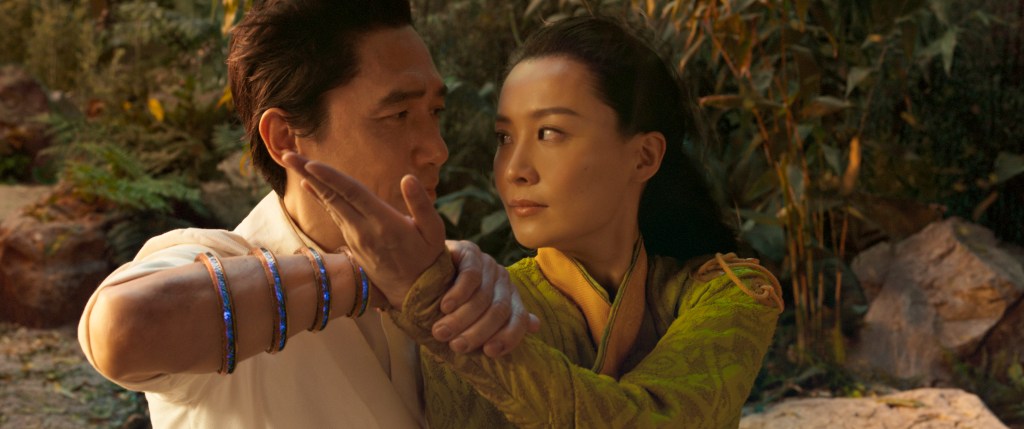
Above all, I liked the movie’s climax, which showcased not just one but two instances of an awe-inspiring creature that is always fun to see on screen and should appear in movies more often. I enjoyed the fanciful, fairy-tale-like quality of all these elements.
The movie also has a few good moments of humor. When Shangi-Chi arrives in Macau, he is instantly greeted as a celebrity because his fight with the goons on the San Francisco bus was recorded and went viral online. In an early scene, a long expository flashback is interrupted by the mundane routine of the present in an amusing way. Last but not least, a post-credits scene involving Shang-Chi, Katy, and Wong provides the movie’s biggest laugh.
In contrast, other parts of Shang-Chi don’t work so well. The first act drags a bit, weighed down by that plentiful exposition. Not all attempts at comedy land: a comic character from an earlier Marvel movie reappears here, and while the character’s presence has a certain logic to it, I didn’t find the character’s scenes very funny.
Perhaps most significant, some of the big action set-pieces fell flat for me. I’m not entirely sure why. The early bus fight and a later fight/chase involving scaffolding on a skyscraper are cleverly conceived. In execution, though, I wasn’t as thrilled as I should have been.

These action scenes may just have been too hampered by the same limitations found in 90 percent of contemporary movie action scenes: too much cutting, too much camera movement, too much slow motion, too much green screen/CGI.
I can overlook these issues in sequences such as the movie’s climax, which isn’t trying to look even remotely realistic. For scenes that are meant to be at least somewhat grounded, though, such limitations may have interfered with my enjoyment.
Let me make a comparison to another movie starring Michelle Yeoh. The scene below is hardly realistic, given the characters’ impossible movement, and involves a certain amount of quick cutting. Yet the scene still has a clarity and physical solidity that make it more entertaining than the action in Shang-Chi:
Heck, consider this scene from another Michelle Yeoh movie:
Dumb? Completely. Unbelievable? Absolutely. Still, I found it more fun than some of Shang-Chi’s set pieces, perhaps if only because we are at least watching real stunt people on real vehicles. (Also, it’s hard to beat the Bond theme, in any context.)
To be sure, none of these problems are fatal to Shang-Chi. In fact, each problem on its own isn’t even that big a deal. Little things tend to add up, though: too much exposition here, some clunky comedy there, plus a couple underwhelming action scenes—and a competent but un-charismatic lead performance—and the movie just doesn’t have quite the overall impact it should.
Notwithstanding my nitpicking, Shang-Chi and the Legend of the Ten Rings has topped the theatrical box office for a couple weeks now, which means we will probably see Shang-Chi, Katy, and company again. I hope we do. Origin stories are often the weakest parts of Marvel characters’ stories. The Marvel franchise’s great strength is long-running stories and building characters’ relationships over time, so future Shang-Chi installments may build effectively on the first movie’s foundation to give us an even more entertaining movie in the next round. Whatever else they do, though, they should bring back Michelle Yeoh.
 The Cameraman
Leave a comment