Next in my Zhang Yimou retrospective, I look at Raise the Red Lantern.

During his early career, Zhang Yimou was like a musician playing variations on a theme. Over a few years, he made three movies with a common premise and setting: a young woman in early 20th-century China is unhappily married to a wealthy older man and must deal with life in a complicated, messy household. After exploring this scenario in Red Sorghum (1988) and Ju Dou (1990), Zhang returned to it in Raise the Red Lantern (1991), which is the most accomplished version of the story.
Written by Ni Zhen and based on a novel by Su Tong, Raise the Red Lantern self-consciously echoes and comments on Red Sorghum from its first shot. Like Zhang’s debut feature, this movie also opens with a close-up of our protagonist, again played by Gong Li, looking straight ahead. However, while Jui’er, the bride-to-be heroine in Red Sorghum, was being dressed and done up in a traditional style by others’ hands, the heroine of Raise the Red Lantern, named Songlian, is in modern clothes and seems somewhat more in control of her situation.
She announces to her stepmother that she has decided to give in to the stepmother’s pleas and to get married. As we later learn, Songlian had been attending a university but her father’s recent death has diminished the family fortunes, so marriage is now the best option. Further, Songlian declares that she wants to marry a rich man. Her stepmother cautions against this: if she marries a rich man, Songlian will be only one of his many wives (polygamy being legal in China at this time; the practice wouldn’t be outlawed until the Communist revolution). She will be a junior wife of lesser status. Songlian grimly replies: “Let me be a concubine. Isn’t that a woman’s fate?” As she says this, tears begin to roll down her face.
The next scene continues with the contrast between Red Sorghum and this movie. We see a wedding caravan, including a red sedan chair such as the one that bore Jui’er to her new husband, proceeding along a wooded road. The caravan is in the background of the shot, moving away from the camera. Then Songlian, still in modern dress and carrying her own suitcase, steps into the foreground and starts walking toward the camera. She isn’t waiting for the traditional caravan to pick her up: she will walk to her new husband’s home on her own.
Songlian comes across as determined and brutally practical. Stuck with a bad situation, she is going to make the best of it in a business-like way. Indeed, being the fourth wife of a rich man has its benefits: in an early scene, Gong subtly conveys Songlian’s pleasure at having her feet washed by a servant. Songlian also wastes little time in bossing around a serving girl who is initially hostile to her new mistress.
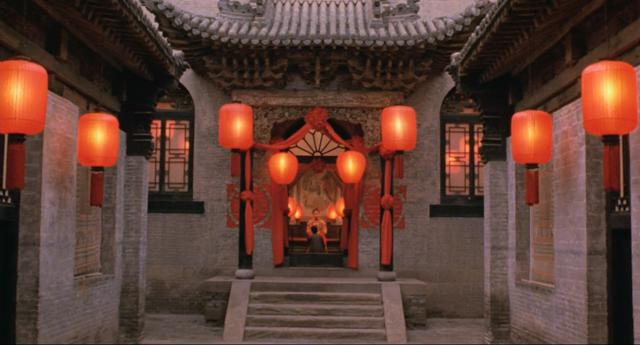
The rest of the movie unfolds within the rich man’s home, a palatial, two-storey complex of apartments connected by courtyards. Songlian and the man’s three other wives each have their own quarters. The master of the house chooses day to day which wife he will sleep with that night. The servants then hang red paper lanterns inside and outside the quarters of the chosen wife. Also, before the master spends the night with her, a favored wife gets a foot massage with a pair of tiny, mallet-like tools. The rather musical rattle the tools make becomes a recurring motif on the soundtrack, the aural companion to the red lanterns’ recurring appearances.

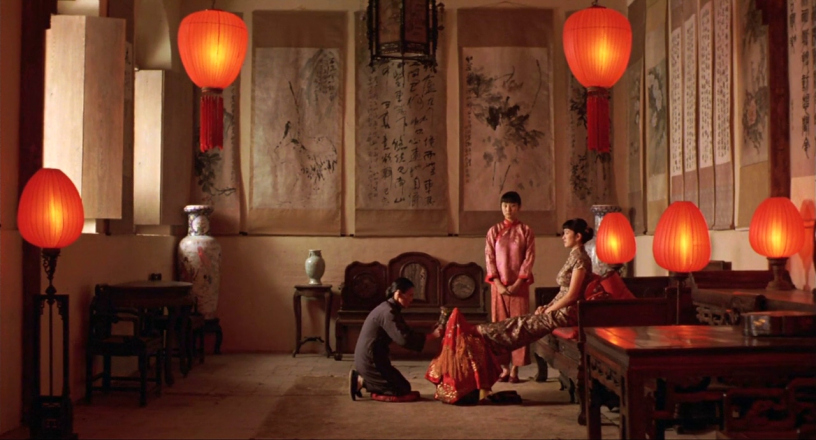
The raising of the red lanterns, the foot massages, and the conjugal visits are all parts of the household’s daily routine, but they have a deeper significance. Frequent night-time visits by the rich master reflect which wife is most favored at a given time. Being favored by the master makes a wife more powerful within the household.
This competition for relative domestic power is at the heart of Raise the Red Lantern’s drama. Like Ju Dou, this is a story about injustice, about men exploiting women and the rich exploiting the poor. Yet Raise the Red Lantern treats this theme in an even more subtle and sophisticated way.
While Ju Dou gave us a hateful villain in the gargoyle-like mill owner, the rich husband (Ma Jingwu) in Raise the Red Lantern is a rather faceless character. Indeed, he is almost literally so: throughout the movie, Zhang films the husband in long shot or medium shot, often in profile or with his back to the camera. We never see him in close up. The husband is kept at a distance because he as an individual is not the real villain: the villain is the larger unjust system he represents.
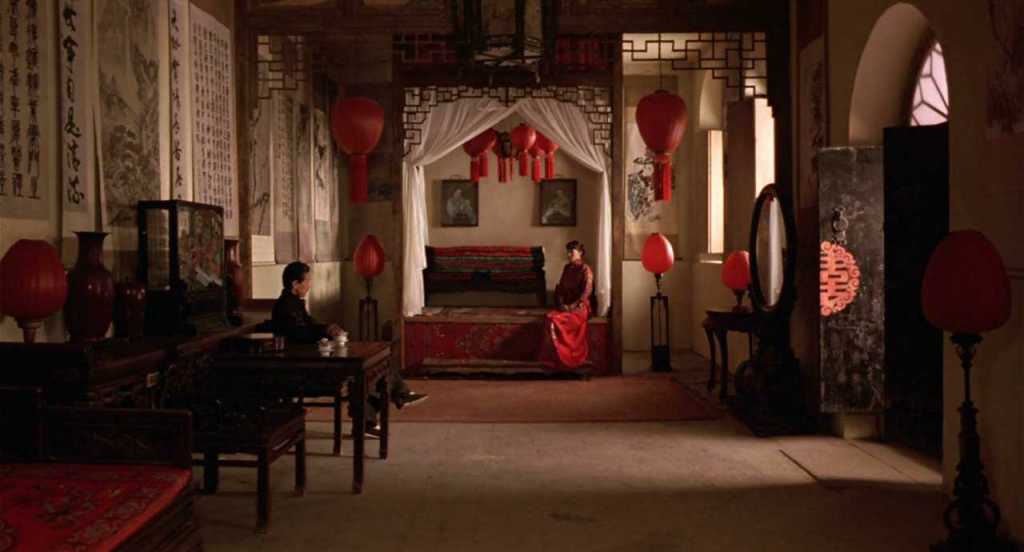
Moreover, the main consequence of this unjust system the movie focuses on is how it corrupts even its victims. In this household, the various wives respond to their situation not by rebelling against it but by ruthlessly jockeying for the privileged position of favored wife. As they seek the master’s attentions, the wives’ relationships with each other range from uneasy coexistence to open warfare.
Songlian’s main rivals within this (self-)destructive arrangement are the unctuous second wife, Zhuoyan (Cao Cuifeng), and the coldly elegant third wife, Meishan (He Caifei). Zhuoyan enjoys the benefit of seniority, but Meishan, a former opera singer, has her looks to recommend her. Above all, Meishan wields the trump card that she has given the master of the house a son, while Zhuoyan had a daughter. Meanwhile, the first wife (Jin Shuyuan), an older woman with an adult son, remains aloof from and quietly disapproving of the competition—one senses she long ago gave up hope of keeping her husband’s interest.
Against her two main rivals, Songlian has the advantages of youth, beauty, and the hope she might also bear a son. As Songlian plays the game and seeks to gain favor and influence within the household, she shows herself to be no less cutthroat than the others. She is willing to resort to deception and even violence. She also periodically takes out her anger and frustration in cruel ways on the hostile serving girl (Kong Lin)—who also has an agenda of her own. Yet as her tears in the opening shot suggest, Songlian might not ultimately be quite tough enough to compete in this household.
The movie’s emphasis on the wives’ rivalry not only illustrates the insidious nature of social injustice but also performs an important dramatic function. The wives’ scheming and backstabbing places the female characters and their actions squarely at the center of this story. While Songlian, Zhuoyan, and Meishan may be victims of a larger male-dominated system, they certainly aren’t passive characters. Their choices drive most of the movie’s events.
Ni’s screenplay and the performances work together to convey the household’s peculiar atmosphere of masked hostility. An array of telling little gestures capture the wives’ tug-of-war. For example, whenever the master spends the night with another wife, Meishan sings opera in the early morning hours to disturb the sleeping couple. During a phase when Songlian is favored, she requests meals in her room, away from the other wives. Gong, Cao, and He all superbly play the wives’ interactions with the right mixture of honey and vinegar.
Zhang, together with his cinematographer Zhao Fei, tells this story using the same techniques as in his earlier movies: filming scenes mainly in long shot and in long takes, careful use of the larger environment, and bold uses of vivid color. The first two techniques work effectively to portray the rich man’s massive home—perhaps the most sinister cinematic residence since the Overlook Hotel.
Keeping the camera at a noticeable distance from the characters while repeatedly framing the households’ residents in doors, passageways, or a series of successive rooms constantly emphasizes the physical presence and size of the building. Characters look dwarfed and lonely amid the cavernous rooms yet also simultaneously hemmed in by the house’s structures. This house is simply inescapable—it overshadows the people within it. (Also, the frequent presence of servants in the backgrounds or corners of scenes underlines the lack of real privacy.)

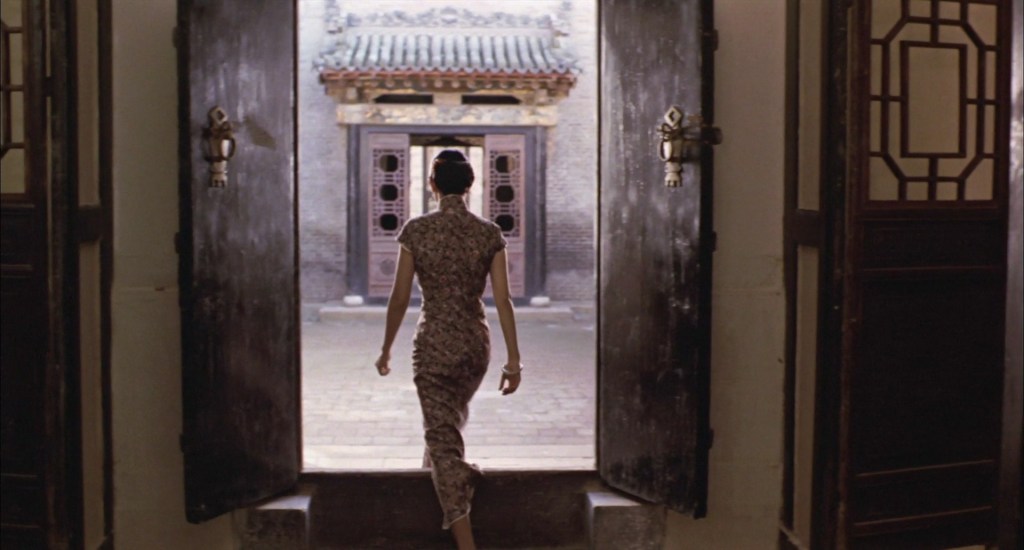
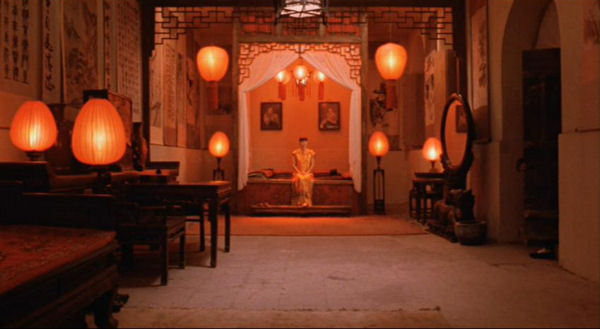
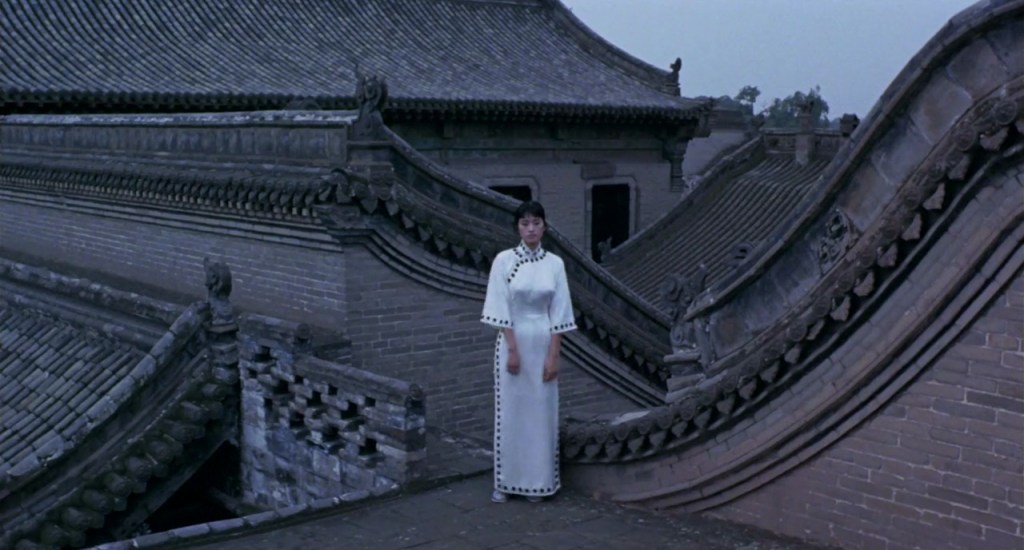
The movie’s use of color is intriguing. The overall color scheme is fairly muted: the house is all gray stone, white walls, and dark wooden furniture. The master of the house and the servants wear black clothes. Against such a backdrop, two main sources of color stand out. One is the clothing of Songlian, Zhuoyan, Meishan, and other female characters, which is yellow, purple, green, red, and the like. The other is the ubiquitous red lanterns, which cast a warm glow wherever they are hung. The effect of these rare colorful displays is to visually telegraph where the truly significant activity in the movie lies: in the wives’ actions and the shifting power reflected by the lanterns.
Apart from any dramatic significance they convey, many individual shots are memorably beautiful. Images such as the master sitting at a desk with his young son and servants gathered around him; a man playing the flute at dusk while Songlian regards him from a doorway; or a servant kneeling in a snowy courtyard could be paintings.
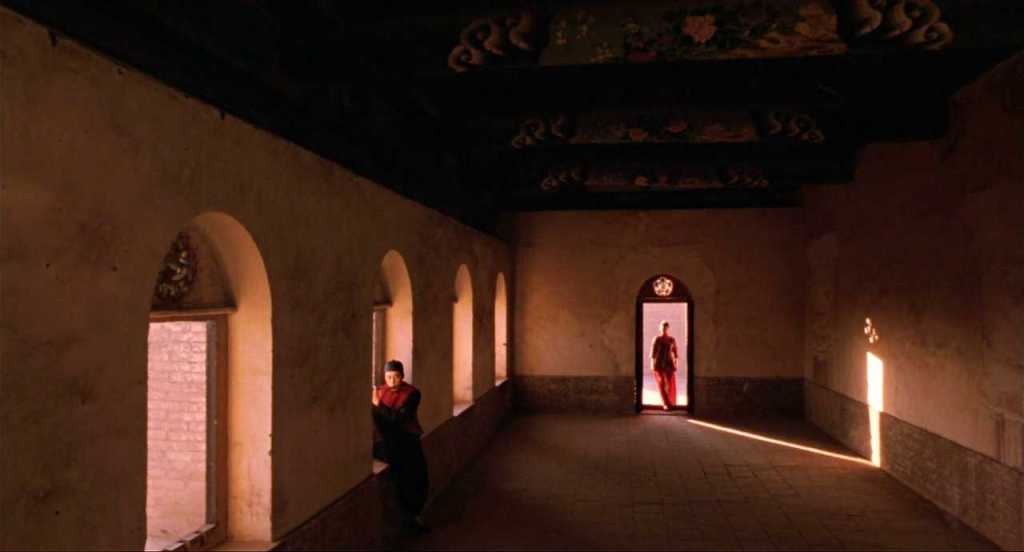
By contrast, two late scenes cross the line into outright horror in their presentation. In the first of these scenes, which echoes a certain French folk tale, Songlian watches from a distance as figures rush furtively along the upper level of the house on an ominous errand. She eventually goes to investigate what is going on; her point of view is shown through a rare use of handheld camerawork, which captures her agitation. What she then discovers is never shown but is made unmistakably clear by the soundtrack.
The other scene is the final one, which ends in a great overhead shot of Songlian in the courtyard outside her quarters. The shot, which Zhang holds for a long, long time, captures the grim culmination of Songlian’s story. It’s an appropriate final image for Raise the Red Lantern’s beautiful, tragic tale.
 The Cameraman
Leave a comment