Next in my Ghibli retrospective comes The Secret World of Arrietty.
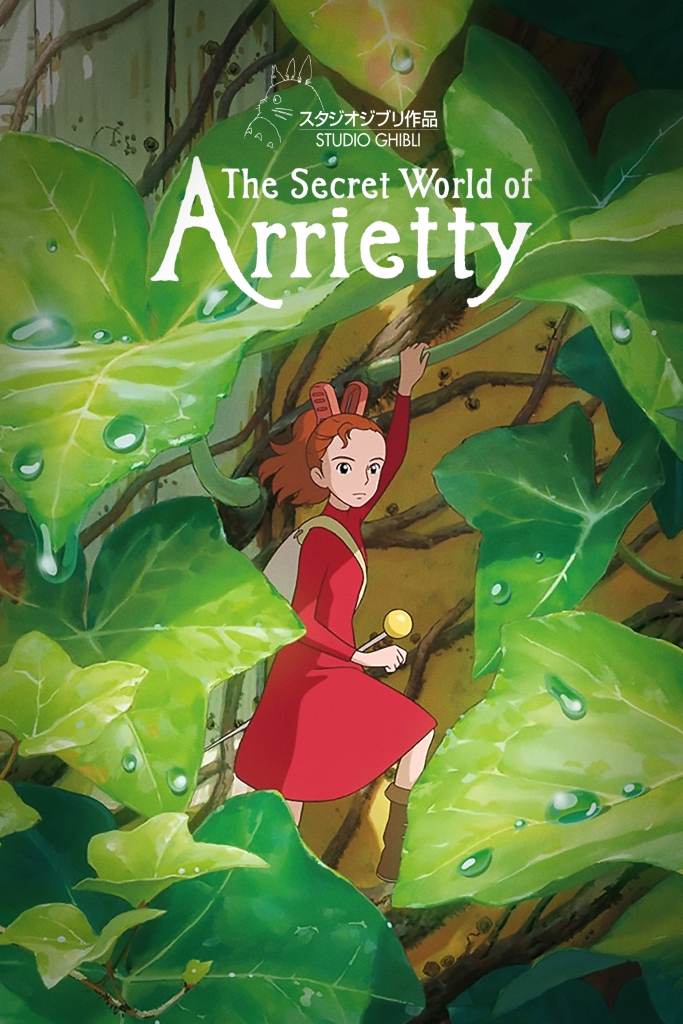
In reviewing a movie about diminutive—as in, only a few inches tall—people, the temptation is to use a lot of adjectives that are variants on the theme of small size. I must admit I cannot resist this temptation, if only because those adjectives are so perfectly apt for The Secret World of Arrietty (2010).
Directed by Hiromasa Yonebayashi and co-written by Hayao Miyazaki and Keiko Niwa, The Secret World of Arrietty is, in the best sense of the word, a small movie. Over a modest running time of 94 minutes, the movie tells a fairly simple, relatively low-stakes story with a very small cast of characters that takes place in a single location. Yet the movie tells this story with such charm, wonder, and sweetness of spirit that little more is required.
Based on the book The Borrowers, by Mary Norton, the movie follows a family of tiny people: father Pod, mother Homily, and teenage daughter Arrietty. The trio live in a miniature, makeshift home beneath the floor of an old house in the country occupied by regular-sized humans. This species of tiny people calls themselves “Borrowers,” as they meet their needs by taking small amounts of foods and various other odds and ends from the larger world around them. Meanwhile, they must fend off dangers from various beasts of prey (rodents, birds, cats) and, above all, evade detection by humans.

Arrietty is an adventurous young woman who is anxious to take on the adult responsibilities of “borrowing,” that is, foraging for supplies in the human house. However, Arrietty and her parents’ situation takes a new turn when the house gains a new resident, an ailing adolescent boy named Shawn. The house belongs to Shawn’s family and he is sent there to be cared for by his Aunt Jessica and a curmudgeonly housekeeper, Miss Hara. While Arrietty and her father are out on a borrowing mission one night, Shawn sees Arrietty. The boy soon becomes fixated on trying to find the tiny Borrowers inside the house. This situation leads to a threat to the Borrower family that they must somehow escape.
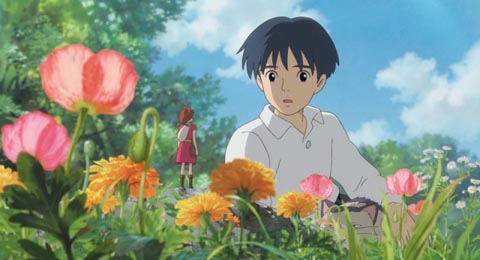
The plot isn’t really the main point here, though. The movie’s fun comes from how Yonebayashi and his animators realize the miniaturized world of Arrietty and her family and visualize the ordinary world as seen through the Borrowers’ eyes. Little, everyday objects take on new significance. Arrietty uses a tiny clothespin as a clip for her hair and wields a sowing needle as a tool/weapon, wearing it at her waist like a sword. Her room in the family home is filled with plants and wildflowers, presumably plucked from the yard outside the human house, in much the same way a human teenager’s room would be filled with posters. Items like a cube of sugar or a bay leaf are treated as treasures. A doll house appears as an elegant palace to the Borrowers. A tea pot, placed in a body of water, becomes a ship.

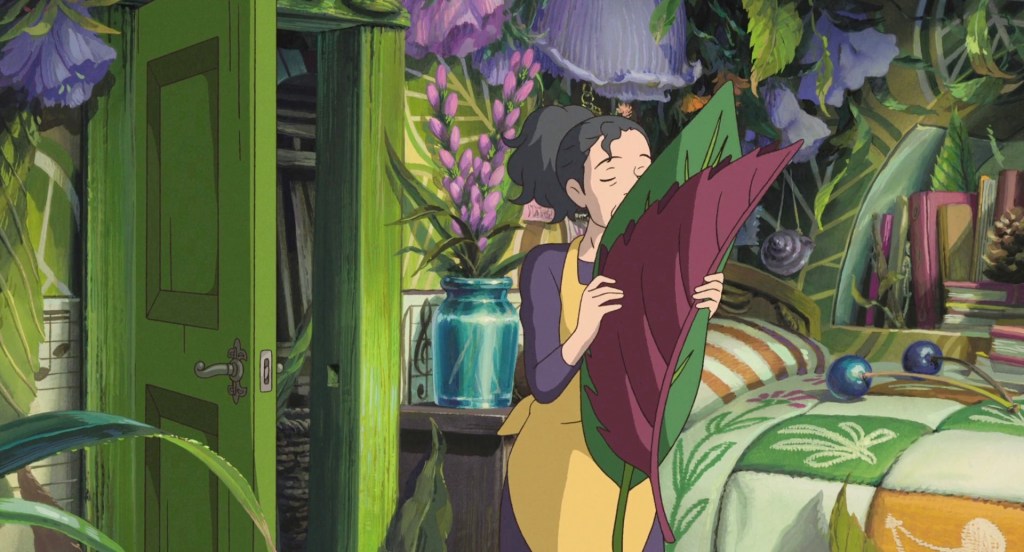
Meanwhile, the human-sized world is shown as vast and terrifying. In addition to predatory animals, the Borrowers must deal with insects, who here function like large, nosy dogs that must be shooed away. Smaller insects are more manageable, though, and the movie gets a good gag out of this when a millipede curls up in Arrietty’s hands and she absent-mindedly tosses it up and down like a ball. A fish in a stream is as majestic as a whale.
Humans seem monstrous when magnified to colossal proportions. Miss Hara, who is animated with a wonderfully frog-like, expressive face, becomes an ogre from our tiny protagonists’ perspectives.

A kindly intended gesture by Shawn, which would seem an utterly ordinary human action, registers as an earthquake-like event for the Borrowers.
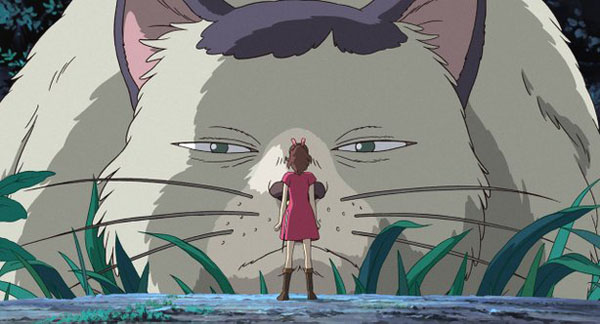
The filmmakers also give us a nice shift in perspective when, in Arrietty’s presence, Shawn must deal with an unruly house cat. We see Shawn, in medium shot, hold back the cat and the moment looks as natural and normal as could be. Yet we also get a quick insert shot of the cat’s maw from Arrietty’s perspective, in which the animal seems as menacing as a tiger.

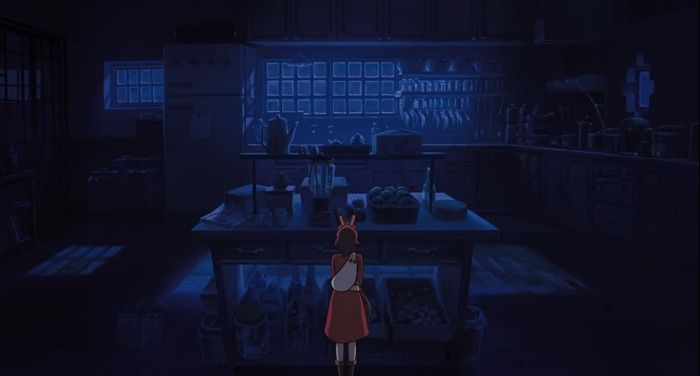
For Borrowers, venturing out into the human-sized world is akin to an odyssey into the wilderness. The filmmakers give us two entertaining sequences built around this idea. When Arrietty and Pod go on their first borrowing mission together, their journey inside the house’s walls is treated like the journey of two spelunkers, or perhaps two miners going down a shaft. Pod lights the way with a tiny electric lamp as father and daughter carefully find their way, using nails sticking out of the woodwork as precarious steps. When they finally emerge from the walls into the great panorama of the house’s darkened kitchen, the room looks vast, ominous, and a bit awe-inspiring. Indiana Jones encountering the Temple of Doom could hardly be more dramatic than Arrietty’s first glimpse of the kitchen. (It’s extraordinary how foreboding household appliances are when they look 20-feet tall.)
The other entertaining sequence comes late in the movie, when Arrietty, with Shawn’s help, must rescue her mother from a threat. These scenes take on the feel of a caper or prison break movie, with Arrietty using the needle/sword and tiny grappling hooks to make her way to her goal.
Because the protagonists are tiny people and the normal human world serves as the “otherworldly” component of the story, The Secret World of Arrietty is notable for presenting a very different view of nature from most other Ghibli movies. Our view of the natural world here is limited to the yard and woods around the old house. While this environment may look enormous to Arrietty, to Shawn and other human characters whose perspective we also share, the grass, flowers, and trees all look perfectly pleasant and ordinary. Nature thus doesn’t come across as wild, awesome, dangerous, or even especially big. It just seems peaceful and rather cozy—perhaps a faint legacy of The Borrowers English origins. The story does have a certain twee atmosphere.
(Side note: This Japanese adaptation of an English book also leads to a slight oddity in the movie. Watching it, I felt somewhat confused about where the story was meant to be set. Presumably it is set in Japan, given a brief opening scene in a city and the presence of Japanese lettering on a truck and household products. Yet Shawn and his aunt have English names. Are they meant to be expats living in Japan? Or is this just a quirk of the English dub translation? Also, given that Shawn appears to be about 14, why does his aunt look like she’s pushing 70? OK, I’m getting off track.)
The emotional heart of the story is the relationship between Arrietty and Shawn, who form an unlikely friendship. Shawn is both lonely and, because of his health problems, fatalistic about his future. Arrietty’s bravery and spirit give him inspiration and renewed hope. Their friendship adds a sweet, poignant tone to the movie.
In the English dub, the voice actors find the right notes for their characters. Bridgit Mendler captures Arrietty’s pluck while David Henrie conveys Shawn’s gentleness. Will Arnett has a nicely low, gravelly delivery as the taciturn Pod. Amy Poehler effectively applies her customary perky/batty manner to the worrywart Homily. And, as Miss Hara, we get an enjoyably nasty performance from Miss Hannigan herself, Carol Burnett.
My choice for favorite image in the movie would probably be a shot of Arrietty standing atop the house’s roof amid a patch of ivy. With the leaves towering around her as she looks down the great distance into the house’s yard, she looks like an explorer reaching a mountain summit. It’s a beautiful hero shot.

As befits a movie about little things, the movie abounds in small, humanizing details (hat tip to Luke Plunkett for pointing this out), so it’s hard to pick a favorite. I will mention a few: I love the exuberant way Arrietty alights onto the chair in her room, sitting with her legs drawn up; the natural, reflexive way Shawn holds back the house cat; and the little bump Miss Hara gives to the bridge of her glasses to settle them on her nose.
The Secret World of Arrietty is not a great movie, by any means, but it’s a fun, good-hearted, entertaining one. Moreover, viewed amid Studio Ghibli’s other, rather rocky, productions of the early 2000s, this is probably the most successful overall movie so far of the studio’s post-Spirited Away era. Sometimes, it’s the small ones who triumph.
 The Cameraman
Leave a comment