I review a Marvel movie for the first time, with a look at Black Widow!

Michael Caine’s first starring role was in a spy thriller called The Ipcress File. According to Caine, the movie’s director was so dissatisfied with the screenplay that he made a point of publicly burning it on set. To compensate for the less-than-stellar screenplay, the director emphasized atmosphere, giving the movie a lot of style to compensate for the script-level deficiencies.
I thought of this story while watching Black Widow (2021), directed by Cate Shortland and written by Eric Pearson from a story by Jac Schaeffer and Ned Benson. The latest installment in the Marvel Cinematic Universe movie franchise, Black Widow is also a spy thriller that suffers from a flawed screenplay. However, the movie compensates for those flaws with strengths such as style and overall atmosphere, as well as the actors’ appeal. Further, Black Widow is a movie very much aware of the legacy of previous spy cinema, which adds to the fun of watching it.
The movie gets off to a great start with a wonderfully suspenseful sequence. We begin with deceptively normal, even idyllic, scenes of two young sisters’ Middle American home life. Then events take an ominous turn as it becomes clear that the girls’ parents are not all they appear to be and the family must flee from the authorities. A family drive soon becomes a desperate chase that turns violent. This scenario of an ordinary domestic situation becoming perilous has a rather Hitchcock feel. Shortland does an excellent job of ratcheting up the tension as events shift from the mundane to the dangerous.
After the family reaches what looks like safety, we get the horrifying conclusion. The two young girls are drugged and abducted by sinister military figures—with their father’s seeming approval. Cue credits.
Flash forward some years, and we find one of those two girls, now grown into secret agent/superhero Natasha Romanoff (Scarlett Johansson) on the run. (Why she is on the run relates to events in other Marvel movies that fans will be aware of but shouldn’t be unduly confusing for non-fans—Black Widow can be appreciated pretty well as a standalone movie.)
Natasha’s history and the significance of the opening events soon become clear. Her “parents” were actually Russian spies working undercover in the United States. After completing their mission, they turned Natasha and her “sister,” Yelena (also no actual biological relation), over to a covert program known as the Red Room, which brainwashes girls from a young age and trains them to be assassins.
Natasha made it out of the Red Room program long ago, but Yelena (Florence Pugh) is still in it. Circumstances bring the two sisters together again, and they develop a plan to bring down the Red Room and its leader, the malevolent General Dreykov. By doing so, they can free the women still caught in a kind of slavery to this covert, murderous way of life. However, this plan means confronting their own past and specifically Alexei (David Harbour) and Melina (Rachel Weisz), the spies who once pretended to be their parents.
As I mentioned, Shortland directs this story with style. This was probably the biggest and most pleasant surprise I received from Black Widow. As others have noted, Marvel movies tend to be shot in a fairly bland way, and I feared this would be the case here. However, Shortland, aided by her cinematographer Gabriel Beristain and editors Leigh Folsom Boyd and Matthew Schmidt, make this movie look and feel, if not radically different from its predecessors, then at least more interesting than them.
Lighting is key here. Multiple scenes effectively use stark contrasts between light and shadow, as when a darkened house is flooded by searchlights or bright sunlight pours into a shadowy office. Colors are also used memorably: in the sickly yellow of streetlights on a bridge or the similarly unsettling dark green and red light that suffuse rooms in an enemy’s lair. The wise decision to set so much of the movie at night or at dusk helps immensely in providing both visual interest and an overall atmosphere of shadowy menace that suits this tale of spies and assassins.
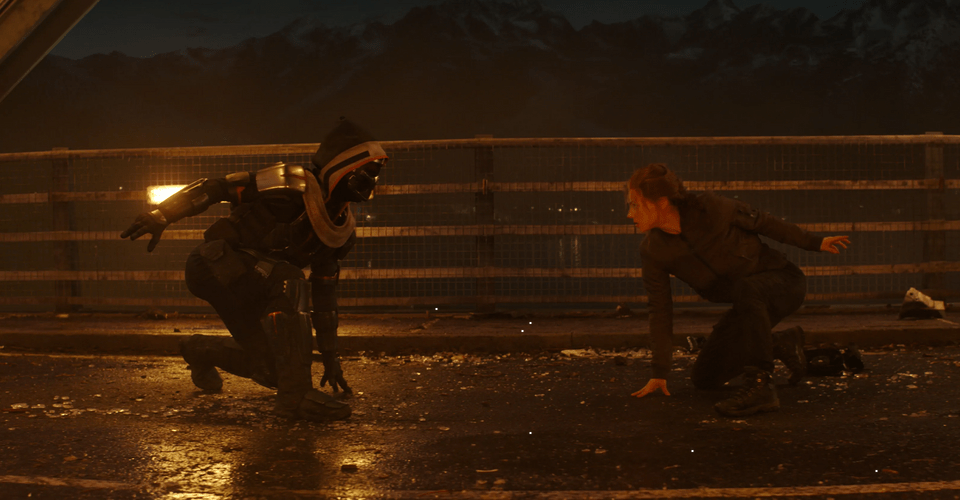
The filmmakers’ use of tighter close ups and shakier camera work also gives the movie a somewhat grittier feel. This style also compensates for the inevitable deficiencies in the various fight scenes: like so many contemporary movies, Black Widow relies on lots of quick cuts and rapid camera movements in its fights rather than clearly showing us unbroken action.
However, in this case the approach worked for me because the chaotic quality of the camerawork combined with often relatively grounded situations—people fighting in apartments or city streets—to convey an overall sense of danger and pain. When one character stabs another or two characters try to strangle each other, we don’t really see any actual violence, but we feel the essential brutality of what is happening (this is another Hitchcock-like feature of the movie, come to think of it).
I also appreciated that, for the most part, Shortland avoided that familiar-but-awkward action movie scenario in which our lone protagonist vanquishes a crowd of adversaries in hand-to-hand combat. That type of fight happens a couple times in Black Widow, but most of the fighting is either kept between two combatants or requires an outnumbered character to rely on some aspect of the surrounding environment to prevail. This also helps keep the action a bit more realistic and hence exciting.
This quasi-cinema verité approach owes a lot to the Jason Bourne franchise, as does the basic story of people once trained as assassins trying to break free of their intelligence overlord’s control. The brainwashed assassin trope recalls the Manchurian Candidate, as well. Black Widow also makes nods to the James Bond franchise, most explicitly in an early scene where Natasha watches Moonraker on TV. The clip foreshadows a climatic scene toward the end which is lifted pretty directly from that Bond movie. Black Widow is awash in influences from and homages to earlier spy thrillers, but I didn’t mind—these kinds of references are fun if executed well, which they are here.
Beyond atmosphere, Black Widow’s great strength is its central actors. As she has in previous Marvel movies, Scarlett Johansson is able to move back and forth from dry humor to genuine emotion with equal believability. As good as Johansson is, though, she is slightly eclipsed by the real scene-stealer—I might even say the real star—here: Florence Pugh as Yelena.

Yelena is a broadly similar character to Natasha, which is unsurprising given their common life experience and de facto sister status. However, perhaps because Yelena isn’t an Avenger and thus an established heroine, Pugh is free to play her as a darker, more damaged character. She is as deft at quipping as Natasha (and gets some of the movie’s best lines), but Pugh conveys the emotional deadness, even self-destructiveness, behind the humor. Yelena jokes in the face of danger not because she is an unflappable superhero but because she might not really care whether she survives. When she betrays vulnerability, these moments similarly have more of an emotional punch because we don’t know her character and thus aren’t sure of how level-headed and stable she ultimately is.
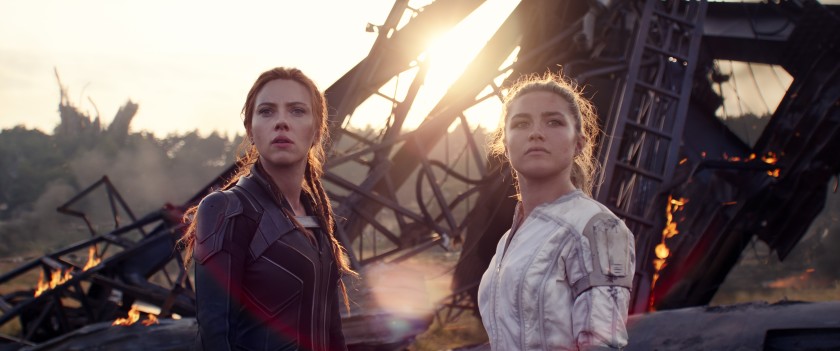
In addition to playing strong, interesting characters, Johansson and Pugh have real chemistry together. They bicker, kid each other, and talk indirectly about serious matters in a way that feels like two real siblings. Some scenes in the middle of Black Widow that just consist of Natasha and Yelena traveling and talking about their less-than-ordinary lives are among the best parts of the movie. We get a nice bit of self-referential comedy when Yelena teases Natasha about her public image as an Avenger. Later, Natasha’s teasing of Yelena leads to a small, telling revelation about the latter.
David Harbour and Rachel Weisz’s performances are not as successful. The conceit behind Alexei’s character is an intriguing one: he is essentially a washed-up superhero, a man of superhuman strength who fell afoul of General Dreykov and has spent years in prison as a result, his heroic exploits now long past. Harbour plays the character so broadly, though, that he comes across mainly as a comic buffoon. This approach is a waste of a potentially interesting character, as well as of the air of menace he had in those great early scenes. Weisz is more restrained, but her character, a guilt-ridden scientist specializing in mind control, ultimately isn’t very interesting either.
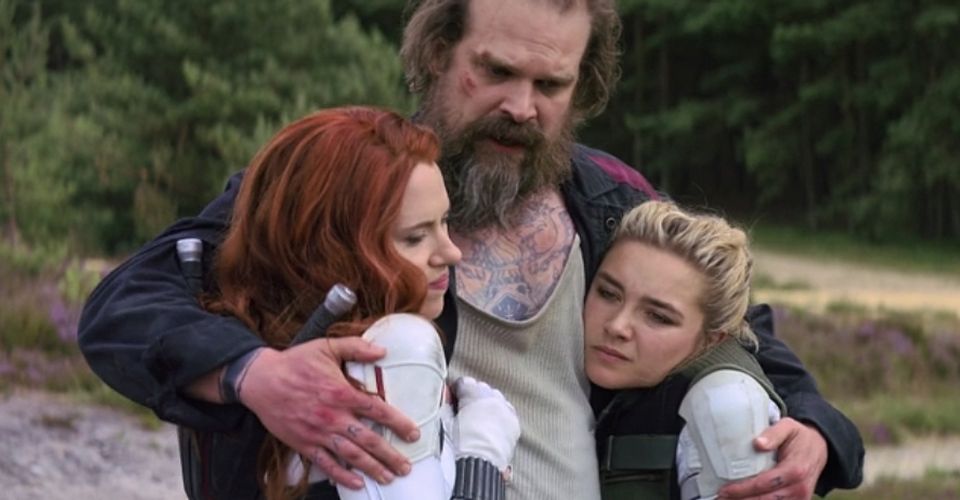
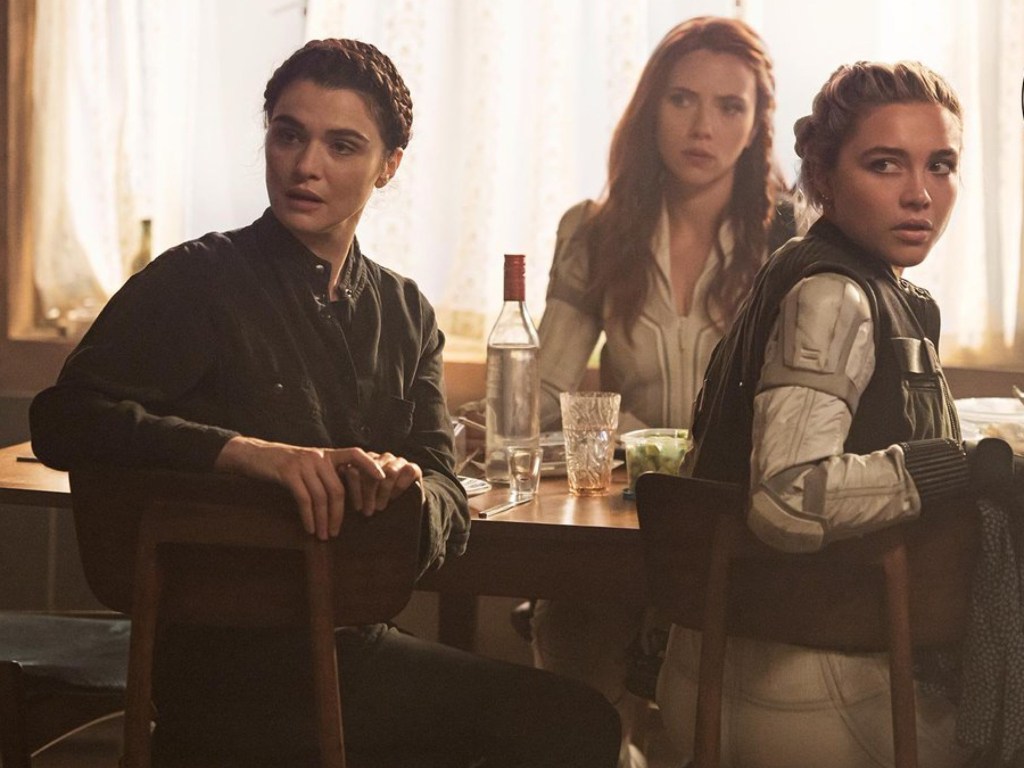
Still, Harbour and Weisz also have chemistry, both with each other and with Johansson and Pugh. In their scenes together, the four interact like a pretty believable family. They convey that recognizable mixture of exasperation, anger, regret, and deep underlying affection found in many real families.
Yet the actors’ chemistry, while one of Black Widow’s biggest strengths, also reveals the fundamental problem at the heart of the screenplay. Because of course Natasha, Yelena, Alexei, and Melina aren’t actually a recognizable family or anything like it. They are four people who have spent most of their lives in the darkest, bloodiest corners of society, working as professional killers. Alexei and Melina aren’t just a lovable oaf and his put-upon wife but two adults who handed over the girls they had once treated as daughters to be tortured and brainwashed into being near-robotic assassins. The Corleones were positively functional in comparison to these four.
Black Widow deals in some extraordinarily disturbing situations that could make for powerful psychological drama—the kind of movie hinted at in the opening scenes. The filmmakers clearly don’t want to make such a movie, though, but the kind of fun popcorn movie that Marvel specializes in. To squeeze this kind of potent material into the Marvel template therefore requires a lot of fudging and breezing past uncomfortable issues.
Thus, wrenching trauma is addressed in a few lines of dialogue; character development that would require whole chapters of a novel occurs in 30 minutes; psychologically damaged killers become a sitcom family. The effect is rather like watching John Iselin and Eleanor Shaw morphing into Homer and Marge Simpson. Or like seeing the murky moral and psychological content of a John Le Carré novel being slapped together with the silliness of…well, Moonraker.
Black Widow’s reluctance to deal seriously with the issues it raises are nicely encapsulated in a climactic confrontation between Natasha and General Dreykov (who although given considerable build-up is played by Ray Winstone as just another generically gloating supervillain).
In this scene, the plot demands that Dreykov lose his temper and lash out at Natasha. As written, though, I found the blow-up rather unconvincing. Dreykov seems implausibly easy to provoke with just a few insults. The moment’s awkwardness is only underlined by the fact that there is an alternative—and very dramatically and emotionally logical—way Natasha could provoke Dreykov. Yet playing the scene this way would highlight ugly aspects of Natasha’s character and past while giving at least a semblance of humanity to the villain. And Black Widow isn’t about to ruin a big crowd-pleasing showdown by introducing all that pesky moral and psychological complexity.
None of these gripes mean that I didn’t enjoy Black Widow. I did. In fact, I enjoyed it a lot: for its style, its ambience, its lead actors and their chemistry. Enjoying the movie definitely depends greatly on not thinking too much about the serious undercurrents beneath the entertaining surface. I don’t know if Black Widow’s screenplay quite demands the Ipcress File treatment, but maybe some rewrites would have helped.
 The Cameraman