Next in my Ghibli retrospective, I look at The Cat Returns.

The Cat Returns (2002), directed by Hiroyuki Morita and written by Reiko Yoshida, marks the beginning of an interesting new phase in Studio Ghibli’s work and hence in my retrospective of Ghibli movies.
The studio’s previous movie, Spirited Away, was a turning point in several respects. First, that movie was (and remains to this day) the height of Ghibli’s commercial and critical success. Second, Spirited Away came roughly at the midpoint in Ghibli’s total output—it began the latter half of the studio’s movies. Third, from this point on, studio founders Hayao Miyazaki and Isao Takahata would make far fewer movies. While almost all the earlier Ghibli movies had been Miyazaki or Takahata’s work, they would direct less than half of the remaining 11 Ghibli movies released to date. Other, younger directors would come to the fore in this phase.
Reaching such a point in an artistic group’s work can be a cause for anxiety among fans. Now more of the group’s work is in the past than in the future and the most accomplished artists, who produced the most-beloved works, will play a smaller role.
Yet reaching such a point is also an occasion for fans to relax a bit. Once a group of artists have succeeded spectacularly and produced a string of classics, I think they have also earned the right to try something different. They’ve assured their place in history—now they can experiment, try out different styles or genres, and bring in new talent to share their visions. In other words, it’s time for The White Album. Maybe not every new creation will be a winner, but if fans can keep an open mind, they might find they like this next stage of creativity as well.
However, having said all this about Studio Ghibli’s history and The Cat Returns’ notable place in it, I must also acknowledge that The Cat Returns, judged on its own merits, is not a very interesting movie.
It’s not bad, by any means. The Cat Returns is cute and sweet and has some good laughs—and never takes itself too seriously. It’s not particularly memorable, either, though.
In fairness, I am not sure this movie could have avoided being a bit disappointing. To steal a line from Max Williams, doing the follow-up to Spirited Away was always mission impossible, and Hiroyuki Morita is no Ethan Hunt. I suppose doing a very short (only 75 minutes), featherweight comedy-adventure such as this one was the best option under the circumstances.
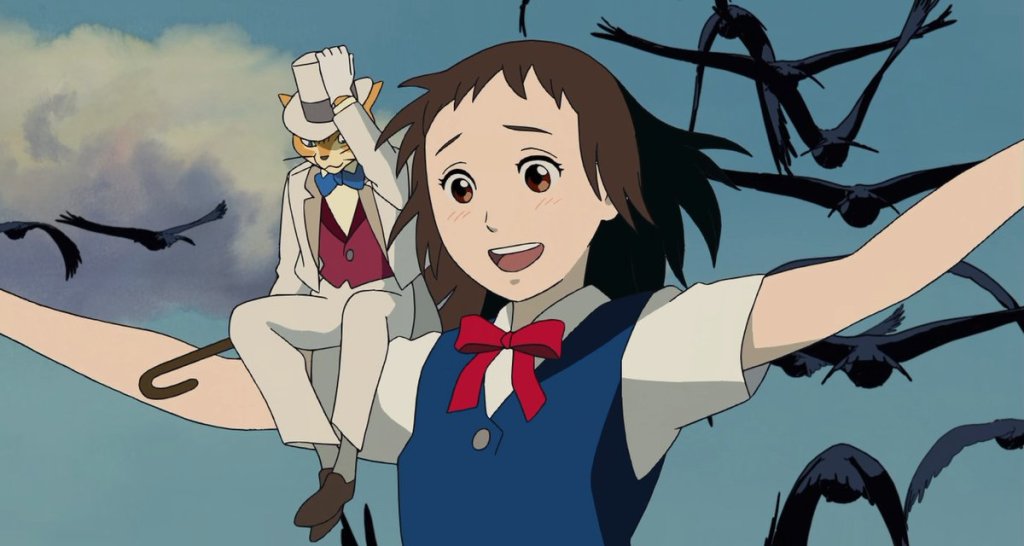
The Cat Returns, which is based on a manga by Aoi Hiiragi, follows Haru, a rather scatter-brained and insecure teenager. Walking home from school one day, Haru narrowly saves an elegant-looking cat from being run over by a truck, snatching the cat out of harm’s way with her field hockey stick. She is then shocked when the cat stands up on his hind legs and thanks her for rescuing him.
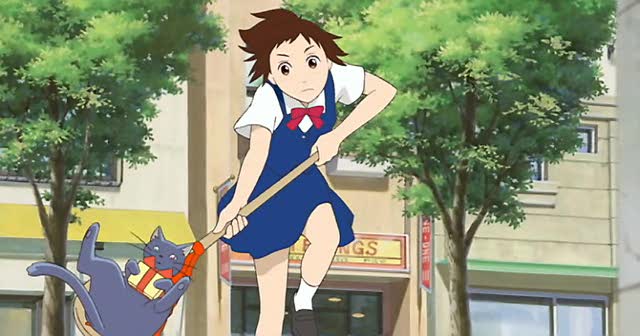

The cat Haru rescued, we learn, is Prince Lune of the Cat Kingdom. Because of her good deed, the prince’s father and his servants decide to reward Haru lavishly in the ways they know how. She finds her front yard has been planted thick with cat tails, while at school her locker is filled with mice (in elegant present boxes). Most alarming, she learns that the King of Cats is now determined to marry Haru off to Prince Lune.
Wishing to avoid such a fate, Haru seeks help and eventually finds it in the services of Baron Humbert von Gikkingen, an elegant, swashbuckling cat who works to help those in need. We last saw the Baron in Whisper of the Heart, where he was a statue in Mr. Nishi’s antique shop. Assisting the Baron (rather reluctantly) is Muta, a fat, grouchy white cat who seems to be the same character as the cat Moon/Muta who also appeared in Whisper of the Heart.


The Cat Returns, probably wisely, never explains how these versions of the Baron and Muta relate to the versions in Whisper of the Heart, where they were just a statue and an ordinary cat. Is this movie a sequel to the earlier one? A prequel? An alternate reality?
My own theory is that The Cat Returns is a dramatization of a novel by Shizuku Tsukishima, the heroine of Whisper of the Heart. In that movie, we saw Shizuku write a fantasy novel in which she imagined the Baron as the protagonist. Here, we see her continuation of the Baron’s adventures, now realized in cinematic form. (Although judging from this adaptation, I fear that Shizuku, like many young writers, may have had a bit of a sophomore slump.)
In The Cat Returns, the Baron and Muta soon have their work cut out for them. Haru is abducted and carried off to the magical Cat Kingdom, where marriage preparations begin. More alarming still, the Kingdom’s influence starts to transform Haru into a cat. Can the Baron and Muta rescue her in time? Will she make it back to our world and her true human form?
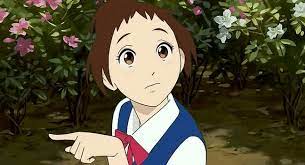
Morita and his animators find an appropriate animation style for this tongue-in-cheek tale, using a lighter color palette and more exaggerated drawing. Two characters’ designs are especially striking. Haru, who has perhaps the most impressive big brown eyes in the Ghibli canon, starts off adorable and becomes even more so when she is part cat. Meanwhile the tyrannical Cat King is all wild fur and giant googly eyes.

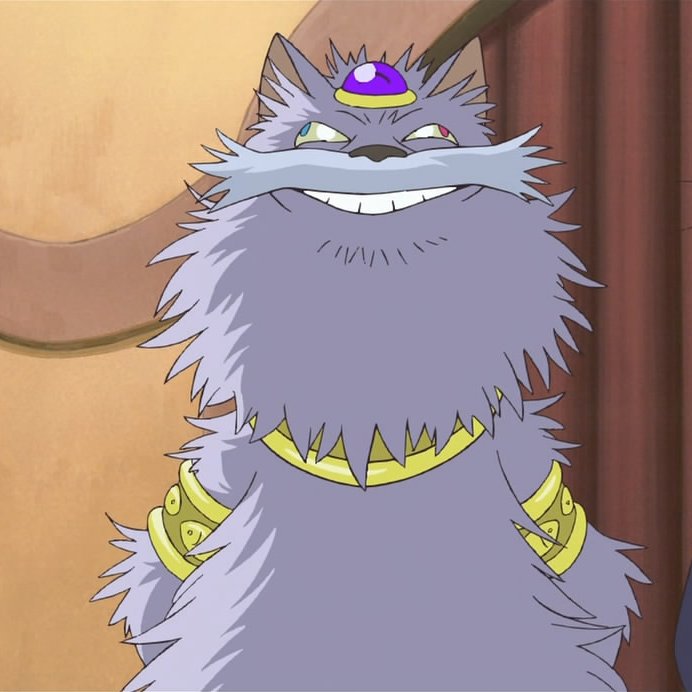
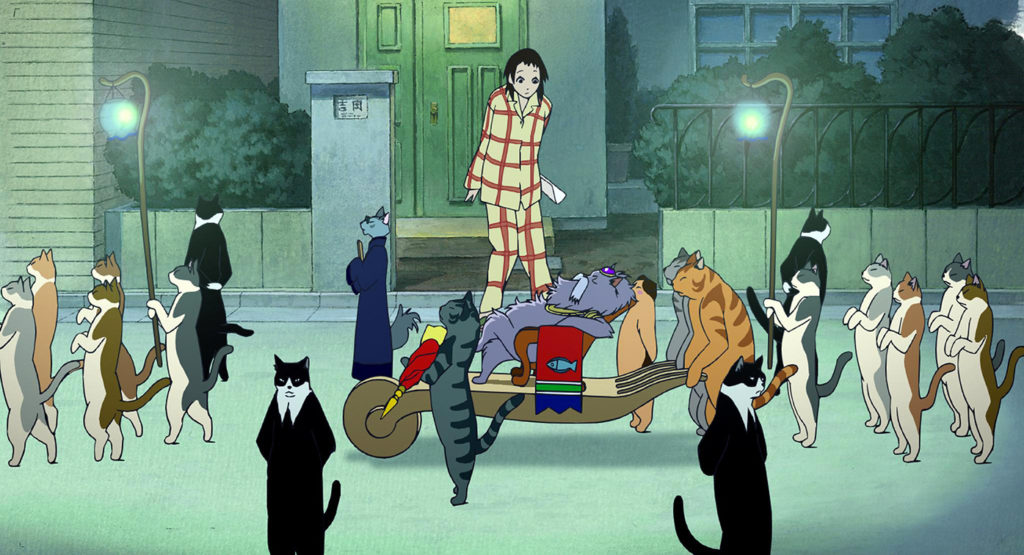
The movie has some pretty good visual gags, as well. I liked the recurring use of fish imagery in the ornamentation and heraldry of the Cat Kingdom. A nighttime visit by the King and his entourage to Haru’s home is nicely done. First a procession of cats, walking on two legs and carrying lanterns, proceed down Haru’s street while haunting, ceremonial music plays on the soundtrack. The scene initially seems like a piece of Egyptian art come to life. Then the solemnity of the moment evaporates as a team of cat bodyguards, their black-and-white fur mimicking the suits of Secret Service agents, swoop in to secure the street. The further revelation that the haunting music is being produced by a band accompanying the entourage just adds to the joke.


The Cat Returns comes up with some funny situations, too. I liked the scene where various entertainers attempt to amuse the Cat King and his court only for the King to respond with fairly definitive dismissals. I also liked a moment when Haru, the Baron, and Muta attempt to escape the Cat Kingdom and are saved from a group of guards by some poor construction work. A bit involving the Cat King, his advisors, and the detonator for some explosives is also funny.
Beyond funny moments, though, the movie doesn’t offer much to discuss. Haru has a minor character arc as she gains some self-confidence. Otherwise, the characters are pretty static and one-dimensional. We get a few gestures toward themes of believing in yourself and being kind to others, but neither of these are developed much. These limitations aren’t necessarily flaws: the filmmakers were clearly not aiming to create anything more significant than a goofy, amusing little movie.
The Cat Returns does have two significant distinctions, although admittedly not ones Morita and his team can take direct credit for. First, the movie’s English dub has perhaps the best—certainly the most fun—voice cast of any Ghibli movie dub. Anne Hathaway gives an entertaining performance as Haru (technically her first time as cat woman), being appropriately dreamy, perplexed, passionate, or hysterical as the story requires. Meanwhile, as the Baron, we get none other than Westley himself, Cary Elwes. Elwes sounds precisely as courtly and dashing as the Baron should be.
The supporting characters’ voices are similarly well cast. As the flamboyant, feral Cat King, we have Tim Curry. Of course—who else could it be? The late Peter Boyle was the perfect choice to be the towering, irascible Muta. Former Conan O’Brien sidekick Andy Richter was a rather unusual choice to be the Cat King’s servant Natoru—a role voiced by a woman in the Japanese original. Nevertheless, Richter uses a smarmy delivery to great comic effect. Perhaps my favorite, though, is the late Rene Auberjonois as the King’s prime minister, Natori. Auberjonois plays the role with the anxious prissiness one would expect from a feline Clayton Endicott III.
The movie’s second distinction is the song “Become the Wind” (Kaze ni Naru) by Ayano Tsuji. While hardly Disney-style musicals, Ghibli movies typically have memorable songs featured over their end credits, and this one is probably my favorite. The relaxed, acoustic ballad is hypnotically catchy, and I find it always puts me in a good mood. Listen to it below:
My choice for favorite image in The Cat Returns would be from a climactic moment when Haru, the Baron, and Muta are falling to earth from a great height. The image of the three hurtling through the sky as the sun rises behind them is beautiful and bizarre at once.

My choice for favorite humanizing detail (although I use the adjective loosely) is a brief moment when the half-cat Haru sits flexing the paw that has replaced her hand. She contemplates the new appendage, trying to get a sense of how it works.
I don’t have too much else to say about The Cat Returns. I enjoyed it and would gladly watch it again. This is one of Ghibli’s most forgettable works, however.
 The Cameraman
Leave a comment