Who says animated movies can’t be subtle, character-based dramas? I continue my Studio Ghibli retrospective with a review of Only Yesterday.

Some moments in our lives can take on an importance far beyond what any objective measure would suggest. This is especially true in childhood, because children lack perspective and minor incidents can be rapturous or devastating. Memories of such out-sized experiences from childhood can remain persistent parts of people’s emotional life for years. These memories can influence people’s views of themselves or of life and remain seemingly as important and immediate as when they were first formed.
Childhood experiences and how their memory can shape us is the main theme of Only Yesterday (1991), the second Studio Ghibli feature written and directed by Isao Takahata, from a manga by Hotaru Okamoto and Yuko Tone. The familiar Ghibli theme of respect for nature and the importance of harmony between humans and the natural world is also present, but childhood and memory are the movie’s primary concerns. Out of such concerns, Takahata and his animators made a lovely and achingly poignant movie.
Only Yesterday examines the life of Taeko, a 27-year-old woman who goes on a summer vacation from her Tokyo office job to visit her brother-in-law’s family in the countryside. Drawn to country life, Taeko helps out on the family farm and begins to form a relationship with Toshio, an affable young farmer in the village. Throughout her vacation, however, her mind keeps turning back to memories of her childhood, specifically her life circa the Fifth Grade. The movie accordingly divides its time between present and past, between the farming vacation and flashbacks to 11-year-old Taeko’s experiences.
Slow, episodic, and largely plotless, Only Yesterday avoids big, obvious drama in favor of a subtle but emotionally resonant character study. On the face of it, Taeko is a quite ordinary young woman. She is not particularly intellectual, artistic, idealistic, rebellious, or tortured. Her childhood seems to have been an unremarkable middle-class existence as the youngest of three daughters, free of significant trauma or loss. The scenes of Fifth Grade life we are shown are all normal and relatable experiences: avoiding unpleasant foods; squabbles with siblings; struggling with math class; an early crush; the awkwardness of puberty’s start; acting in the school play and dreaming of future stardom.
However, what emerges, with a piercing clarity, from these glimpses of domestic and school life is Taeko’s profound loneliness. Lacking significant gifts or distinctions, growing up in a family that is basically loving but not especially interested in her (her father is aloof, her mother is distracted and rather sad, her older sisters are wrapped up in their own concerns), and apparently without close friends, this is a girl who just didn’t “fit in” anywhere. This inner misfit status has carried over into adulthood: talking with Toshio, Taeko comments that she doesn’t understand life—and the implication is that this includes her own life most of all.
Takahata and his team find the appropriate visual approach to this story that hops back and forth between present and past. The present-day scenes in the countryside are rendered in detail, with bright colors. Taeko and the other characters are drawn with a high degree of realism, including subtle facial expressions. The rural landscapes fill the entire frame.


In contrast, the flashback scenes of Taeko’s childhood are rendered with minimal detail and washed-out colors. Ten-year-old Taeko, her family, and her classmates are stylized, with big, cartoony facial expressions. Large sections of the frame are frequently left empty, white space occupying the picture’s edges.
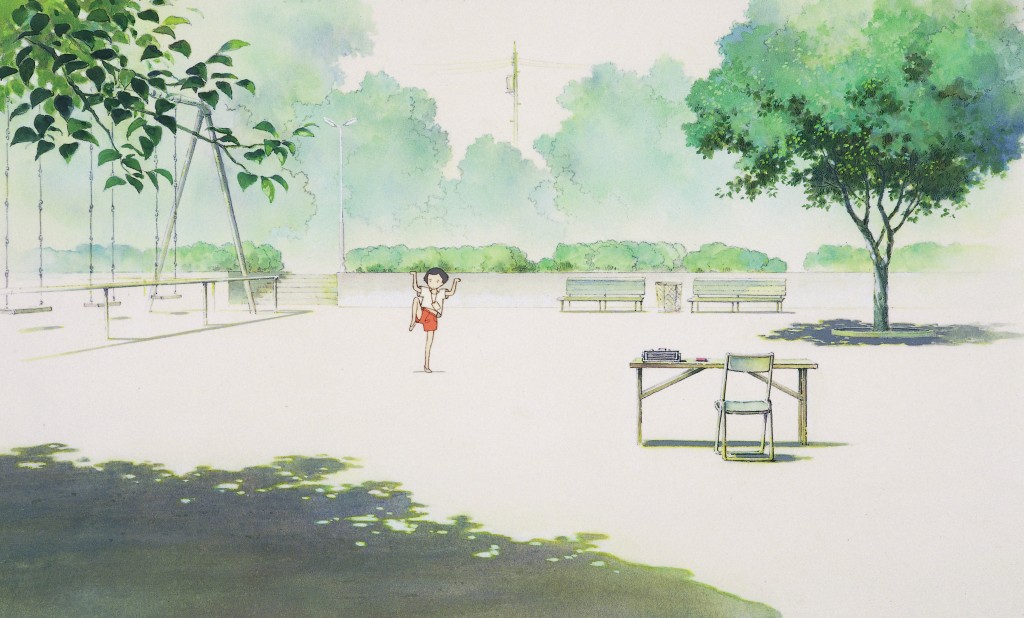
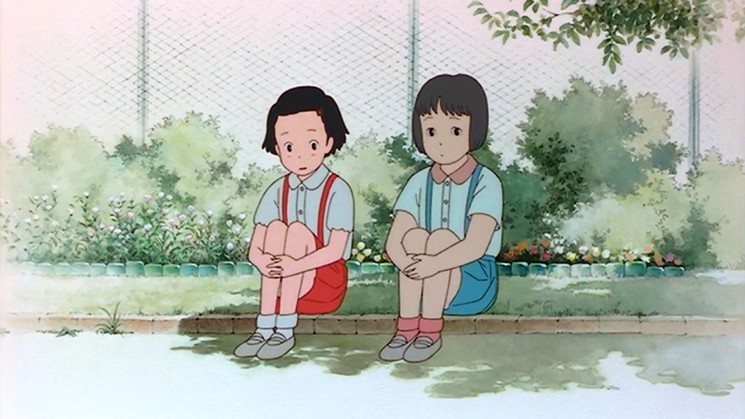
These differing styles make clear which time period we are seeing at any given moment, but they do more than that. The minimalism, cartoonish characters, and white space make the flashback scenes resemble a child’s drawing: they not only are about childhood experiences but capture how a child would see these experiences. Also, the comparative emptiness of many images underlines Taeko’s isolation as powerfully as any events or dialogue.
Beyond their stylized visuals, Only Yesterday’s flashback scenes depart from strict realism in other ways. Two flashbacks, one to an exceptionally happy experience and the other to a similarly unhappy one, stand out in this respect.
In the first scene, Taeko and a boy, a baseball star at their school, communicate, through the awkward semaphore of kids, their liking for each other. Takahata and his team play with time here, extending to a noticeable length the moment before either child works up the nerve to say anything. They also use sound effectively, having the encounter unfold first in silence and then, as Taeko approaches the boy, dropping in the quiet noise of her footsteps on the sidewalk. The whole moment plays out rather like the build up to a showdown in a Western (which I suppose is a fair approximation of early romantic experiences).

Once the two kids start talking, the filmmakers playfully use some metaphorical imagery, with entertaining uses of the romantic clichés of both “striking out” and “walking on air.”
The second scene involves a quarrel involving Taeko, one of her sisters, and their parents, with Taeko’s petulance finally prompting an uncharacteristic display of anger from her stoic father. The quarrel unfolds in a painfully all-too-recognizable way, as Taeko’s bad mood escalates into ever more contrary behavior. The crucial moment involves another elongation of time, as the girl waits in silence for a reaction from her father, clearly hoping for some sign of comfort or support. The delay makes the inevitable disappointment sting all the more. One could believe such an experience would stay with her into adulthood.
In contrast to the heightened emotions of the flashbacks, the present-day scenes are more low-key. Taeko works in the fields harvesting safflowers, learns how they are turned into rouge, visits different parts of the countryside, and chats with Toshio and her relatives. Although they reveal information about the characters and their feelings, the dialogue scenes are not snappy or artful. Instead, consistent with these scenes’ general realism, they sound a lot like actual human conversation. As Taeko and Toshio talk about childhood, work, and country life, a believable relationship gradually forms between them. Late in the movie, Taeko comes to the quiet but undeniably romantic realization that she feels at ease talking to him.
I suppose I should make it an official regular feature of these Studio Ghibli reviews to pick my favorite images and favorite humanizing details, since memorable examples of both are reliable features of their work.
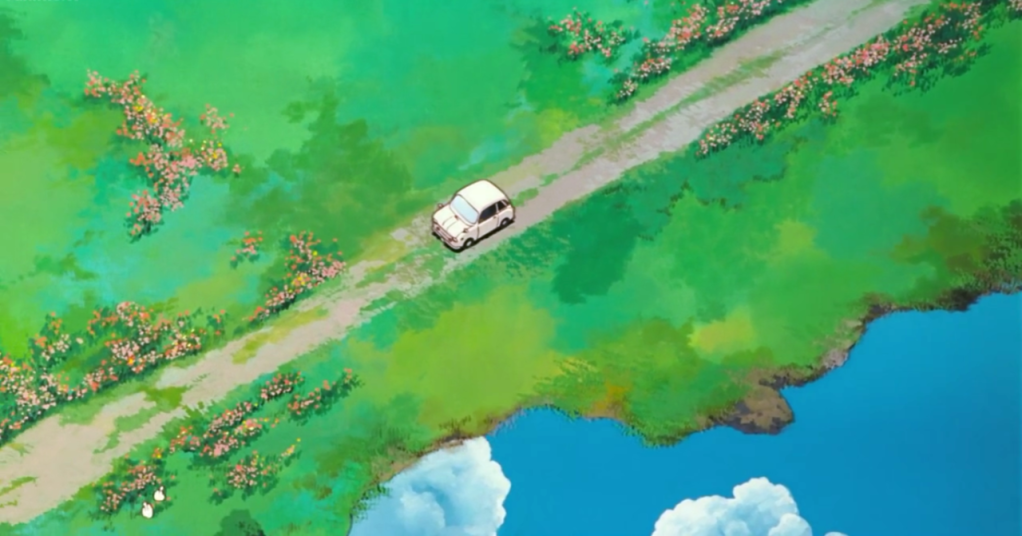
Among the present-day parts of Only Yesterday, my favorite images were two parallel shots of the sky. In the movie’s opening shot, we see blue sky and clouds reflected in the gleaming surface of the Tokyo office building where Taeko works. Later, we see similar images of the sky reflected in a stream as Toshio drives her through the green countryside.

Among the flashback parts of Only Yesterday, my favorite image is one of Taeko standing by herself in the street. The tiny figure framed by buildings that literally fade away around her evokes so much vulnerability and solitude.

My choice for favorite humanizing details is perhaps a bit of a cheat, as technically they are ones Taeko, rather than the filmmakers, provide. In the flashback about her school play, we see Taeko charged with playing Village Child #1. Limited to saying only one assigned line—“Oh, look, the crows are flying away! There!”—she pads her part with some stage business: pausing to watch the crows fly off, then giving a small, delicate wave.
As she comments as an adult, looking back on the performance, “What I couldn’t do with words, I could express in the way I moved.” That observation says something about our heroine, while also serving as a nice description of the Ghibli approach to animating characters.
As good as Only Yesterday is, the movie has its problems. The final childhood memory Taeko must grapple with, a guilty one involving a classmate, comes across as somewhat anti-climactic. Although it makes sense this memory would weigh on her more than others, its introduction relatively late in the story and Takahata’s decision to present it partly in flashback but largely through dialogue robs the episode of the power it should have had.
I also didn’t quite like the movie’s ending. While broadly plausible, given everything we have seen up to that point, the resolution is abrupt and a little too pat. I would have preferred a more open-ended conclusion, that allows the viewer to imagine what might have happened next.
Nevertheless, even at the movie’s ending, Takahata and his team allow for some ambiguity. The final shots have a melancholy, haunting quality that echoes Only Yesterday’s central theme: leaving childhood behind is never easy.
 The Cameraman
Leave a comment