Having previously been called upon, by my Studio Ghibli retrospective, to review one of the saddest movies I have ever seen, I am now called upon to review one of the most delightful.

My Neighbor Totoro, directed by Hayao Miyazaki, was released by Studio Ghibli in 1988. The movie notoriously appeared on a double bill with Isao Takahata’s Grave of the Fireflies, in a pairing that must have given audiences some of most severe emotional whiplash of their movie-going lives. While Grave of the Fireflies grimly shows us children’s vulnerability and suffering in a merciless wartime world, My Neighbor Totoro celebrates children’ vitality and imagination amid the warmth of family love and the natural world’s beauty. Despite these extreme tonal differences, however, the two movies do have some similarities. Both center on a pair of young siblings. Both are set in Japan’s recent 20th-century past. And both are clearly masterpieces.
Praising My Neighbor Totoro is much easier, however, than describing what it is about or explaining the peculiar delight it gives. Set in the 1950s, the movie follows two sisters, Satsuki, who is about eight years old, and Mei, who is four, as they move with their university professor father to a new house in the countryside. They make the move to be closer to the girls’ mother, who is being treated in a nearby hospital for an unidentified but clearly serious illness. As the girls settle into their new home over the course of the spring and summer months, they become first aware of and then friendly with various supernatural beings that inhabit their house and the surrounding forest. These new otherworldly acquaintances include “Sootsprites,” sentient balls of soot that look like puffy spiders and that fill the dark, long-unused sections of the house; and an array of vaguely rabbit-like sprites presided over by the titular “neighbor,” a gray, furry, ten-foot-tall creature that lives deep within an enormous camphor tree.
Such a thumbnail summary might sound like the premise of a fantasy adventure, perhaps a Japanese Chronicles of Narnia. Such an approach certainly could make for a perfectly entertaining story, but My Neighbor Totoro aims for something very different. Far from being action-packed, the movie has a rather leisurely pace and almost no plot to speak of. Not until the final third does anything akin to conflict emerge, and when it does that conflict has nothing to do with the story’s supernatural elements.
Instead, the movie is mostly just a series of episodes in which Satsuki and Mei go about their days and explore their house and the areas around it. They do household chores, eat meals, and play with their father. They visit and write to their mother in the hospital. Satsuki goes to school. They spend time with members of the local farm families. These include a kind elderly woman they call “Granny” and Kanta, a little boy who seems to have an incipient crush on Satsuki that (in the grand tradition of little boys) he expresses by acting weird and obnoxious. Amid this very ordinary and peaceful existence, the girls also have a series of fantastical encounters with Totoro and the other magical creatures.
If conventional conflict or action is not what gives this story interest, what does? Well, to start with, the central characters of the two sisters. In contrast to Grave of the Fireflies’ comparatively restrained character design, My Neighbor Totoro unabashedly embraces stylization in its design of Satsuki and Mei. Each girl, in her own way—Satsuki being tall and spindly, Mei being squat and cherubic—is as cute as a bagful of buttons.

Despite their stylized look, however, the girls manage to be not merely cute but also believable children. Probably the movie’s greatest triumph is how perfectly it captures how kids behave and, above all, move. A multitude of details contribute to this portrayal, and I will mention only a handful of the more memorable ones:
- How the sisters skid to a halt when they stop running.
- The way Satsuki, told to remove her shoes when indoors, instead opts to “walk” around on her knees, carefully keeping her feet off the floor.
- Mei’s tendency to loudly repeat or second what her older sister says.
- How Mei wakes up her father in the morning by climbing on top of him (this moment is echoed later when she does the same thing to the sleeping Totoro).
- The way the girls are still small enough to climb up a staircase as though it were a ladder
- Mei’s frog-like way of crouching down to look at something on the ground.
- Mei’s ticklish glee when she touches and nuzzles the giant slumbering form of Totoro.
- How, in what is perhaps the movie’s funniest moment, the girls are initially startled by a swarm of Sootsprites fleeing a room, only to rally themselves by first roaring in defiance and then marching into the room with determinedly “mean” faces.

Just watching these sweet, high-spirited sisters’ daily lives is entertaining when they are rendered with such careful observation. (The English dub of the movie also benefits tremendously from having the girls voiced by real-life sisters Dakota and Elle Fanning, who at the time were close in age to their characters.) This care extends to the character of Kanta as well; I appreciated how, at a point when the boy is especially pleased with himself, he punctuates his run down the road with sudden leaps forward.
The portrayal of the two sisters’ father is equally memorable. No stern patriarchal figure, Professor Kusakabe is pretty close to the ideal dad: gentle, easy-going, and playful with his daughters. In a memorable scene, set during evening bath-time, the girls are scared by the wind shaking the house, and he comforts them with a game that involves loudly laughing and splashing water. Later, when they are playing in the forest and Mei’s hat falls off, Kusakabe mischievously puts the hat on his own head—a little throwaway detail that nevertheless tells much about his character.
We see less of the girls’ ailing mother, but in her few appearances she is also warm and loving. During one of the hospital visits, there is a nice moment when she tenderly brushes Satsuki’s hair. While the mother’s illness creates a specter of possible sorrow, that specter is kept in the background for much of the story. Satsuki and Mei seem to live largely untroubled lives, being doted on by their parents. The verdant forest, fields, and rice paddies of the animated countryside further add to the idyllic quality of the movie’s world. Even the crisis that takes up the final act unfolds amid green fields and trees lit up by the red-gold sunlight of a summer evening, giving these scenes a feel that is more bittersweet than harrowing.
My Neighbor Totoro’s appeal does not rest just on how the human characters and natural environment are realized, though, but also the treatment of the magical characters and elements. Combining tall, rabbit-like ears with a bear-like bulk and cat-like whiskers, Totoro is easily Studio Ghibli’s most iconic character—his image became the studio’s official logo.
What is crucial to the character, however, is how Miyazaki and his animators resisted giving Totoro an obviously “human” personality. Like his smaller companions and the other supernatural creatures in the movie, Totoro never speaks conventional language. He communicates in looks and gestures and growls (his name is Mei’s interpretation of some of those growls). Totoro comes across as a beast—a highly intelligent beast, to be sure, but decidedly different from a human. Moreover, his size, long claws, fixed stare, and huge teeth leave a rather unnerving impression. He may be benevolent, but he is not exactly safe. “Neighbor” gets it about right; this creature is not a friend or a pet.
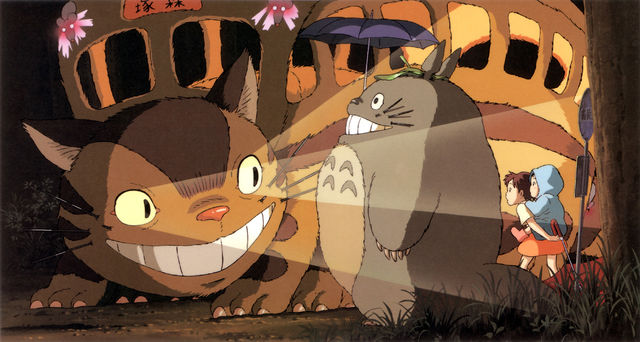
If Totoro is unnerving, then another of the movie’s magical creatures is outright creepy. This would be a second iconic Ghibli character, the Catbus. A gigantic, ten-legged yellow cat with a hollow interior, the Catbus is a sort of mutant Cheshire Cat that apparently serves as the preferred mode of transportation for Totoro and other supernatural inhabitants of the forest. (In an especially grotesque touch, the Catbus’ front and back “lights” are provided by the glowing red eyes of large rats attached to the host creature/machine’s sides.) The Catbus’ eyes and enormous grin initially frighten the girls and frighten me too. A viewer cannot feel sure if this being is more likely to give Satsuki and Mei a ride or gobble them up.
This pervasive strangeness, with a whiff of danger, of the supernatural elements is essential to My Neighbor Totoro’ success. It prevents the movie from becoming saccharine and instead adds a sense of awe. We sense these little girls are coming into contact with something profoundly wild and mysterious.
Such a sense is most clearly conveyed in two encounters Satsuki and Mei have with Totoro around the movie’s midpoint. The first comes on a rainy evening when the sisters go to a bus stop to meet their father on his return from work. The situation is somewhat ominous: two children hanging around alone in the forest at night. A bus arrives but Professor Kusakabe is nowhere on it. The girls wait for the next one, and the filmmakers take their time with this period of waiting to let anticipation build. Satsuki plays a game of cat’s cradle while Mei splashes in some puddles. Finally, Mei starts to nod off and Satsuki holds her piggy-back-style so her younger sister can doze. Then we get a shot from Satsuki’s perspective, looking down at the ground—and we see Totoro’s massive feet step into view beside her.
After overcoming her initial fear, Satsuki eventually offers Totoro her extra umbrella. Unfamiliar with the object, Totoro is at first surprised and then amused by the sound rain makes on the umbrella. He makes the most of this new pleasure in a way that changes the scene from tense to funny. Then the Catbus arrives to whisk him away.

The second encounter also begins on a faintly scary note. Satsuki and Mei awake one night to see Totoro and his two companions engaged in a curious procession outside their house. The sisters go outside and soon join the beasts in what is half ritual and half romp, in which they conjure a colossal tree out of their home’s garden.


Throughout all these events, the movie wisely leaves much unexplained. We don’t learn much about the logic or significance of these magical creatures’ actions or even precisely what Totoro and the other creatures are. One character suggests Totoro might be a “spirit of the forest” but doesn’t elaborate on that idea. These beings seem to be forces of nature, but their appearances also have a dreamlike quality.
For that matter, My Neighbor Totoro leaves it nicely ambiguous, for much of its running time, whether Totoro, the Catbus, the Sootsprites, and all the rest are real at all or products of the girls’ imaginations. The movie eventually resolves this question, and I wonder whether that might be its sole creative misstep. (Although the resolution of this point is also genuinely moving, so I hesitate to do away with it.)
One aspect of this ambiguity that I appreciated, not least because it avoids an obvious conflict, is that the adult characters more or less accept at face value the girls’ stories of their supernatural encounters. We don’t get any manufactured drama out of the girls being scolded for “making things up.” Instead, their father calmly takes in stride Mei’s account of Totoro. He even uses the story as an occasion to teach the girls about venerating nature and the bygone times when “trees and people used to be friends.” Granny similarly seems to believe stories of the Sootsprites and even provides her own old-wives’-tale explanation of what the creatures are. Are the adults being serious? Are they just kindly going along with the children’s imaginative play? The movie leaves that up to us to decide.
Having discussed all these different elements of My Neighbor Totoro, however, I am finally faced with an inevitable question: What is this movie actually about? What is the significance of this story?
Various interpretations are possible. As the rural setting and Professor Kusakabe’s comments suggest, harmony between humans and nature is clearly a theme. The supernatural elements and the recurring presence of Buddhist and Shinto shrines that dot the countryside point toward a possible spiritual significance to the events. Also, I suppose I should acknowledge a bizarre fan theory that attributes to My Neighbor Totoro a subtext that makes it an even darker story than Grave of the Fireflies (Studio Ghibli has explicitly repudiated this interpretation, and I personally think an eye-roll is the best response to the theory.)
For me, however, what My Neighbor Totoro is about is capturing the feel of being a child, or at least a child growing up in an essentially happy household and community. Crises and sorrows might sometimes arise, but the main characteristics of life are being loved by your parents and siblings and finding the woods by your house the most exciting place on earth to explore. The larger world might be strange or even scary, but who knows what wonders you might find or imagine there?
Even as I offer this interpretation, though, I must admit I find it inadequate to capture the movie’s unique magic. To be honest, I would much rather just watch My Neighbor Totoro than try to explain it. Whatever its precise significance, when I see Totoro and the girls raise that vast tree up to the heavens, I know that I am watching something extraordinary.
In the end, the most important comment I can make about My Neighbor Totoro is also the simplest: Watch it.

 The Cameraman
Leave a comment