“Emma Woodhouse, handsome, clever, and rich, with a comfortable home and happy disposition, seemed to unite some of the best blessings of existence; and had lived nearly twenty-one years in the world with very little to distress or vex her.”
Today, I look at the latest cinematic version of Jane Austen’s Emma!

Groucho Marx supposedly once said that drama was easy and comedy was hard, because everyone cries at the same things but not everyone laughs at the same things. I was reminded of his comment while watching Emma, the latest adaptation of Jane Austen’s novel, directed by Autumn de Wilde, from a screenplay by Eleanor Catton. The movie delivered as far as the story’s drama and romance, making me care about the central characters and their relationships. The comedy fell pretty flat for me, however. I rarely laughed during the movie (although my fellow moviegoers in the theater seemed to laugh a lot, in a further demonstration of Groucho’s bit of wisdom).
Austen’s tale of Emma Woodhouse, a wealthy, intelligent young woman who likes to play matchmaker but is far less insightful about people than she thinks, has been adapted to the screen many times before. Memorable past versions include a 1996 movie starring Gwyneth Paltrow and Clueless (1995), which transposed the story to a 20th-century California Valley Girl setting. Despite their differences, these adaptations, as well as a very fine 2009 British TV miniseries version, were alike in finding the comedy in Emma and the other characters’ many pretensions, deceptions, and self-deceptions as they seek love and happiness.
This new Emma is far less adept. Subtlety does not appear to be among the instruments in de Wilde’s cinematic toolkit. Supporting actors such as Miranda Hart as the talkative spinster Miss Bates, Josh O’Connor as the unctuous clergyman Mr. Elton, and Tanya Reynolds as Mrs. Elton have been directed to overplay their roles egregiously. Granted, many of the supporting characters are very silly people we are invited to laugh at, but what should have been richly comic figures generally end up grating caricatures. Emma’s sister Isabella and her family are handled especially badly: during their brief time on screen, Isabella does little but shriek in anxiety over her children while her husband grumbles and growls and the children cry and act like brats. A viewer would hardly guess that these are people Emma or her father care deeply about and miss being close to.
The actors are not helped by other aspects of the production, which attempt to hammer home the comedy in a ham-fisted way. Mrs. Elton cannot simply be vain and pretentious, for example; she must be given ridiculous hairdos and costumes to make her look absurd. Not content with humor arising from dialogue and characterization, the filmmakers must add lumbering bits of physical comedy. The movie also ratchets up the quota of actors mugging in comical reaction shots, a tendency made worse by de Wilde’s relentless overuse of extreme close-ups in which the characters all but look directly into the camera.
The overall clumsiness of the movie’s approach to comedy was summed up for me by a teatime scene where Emma and her companions are being bored by one of Miss Bates’ monologues. They all wear expressions of such sullen annoyance that you would swear they were meant to be in the dock at a murder trial. You can almost hear the director shouting from off-screen: “The joke is that you’re not having a good time! Look more bored!”
As comedy, then, I thought this Emma was something of a bust—which, for an adaptation of a comic novel, is a serious failing. The movie as a whole is not a bust, however. If some performances fail, others succeed. As Mr. Knightley, Johnny Flynn captures the right blend of stuffy self-righteousness, wry intelligence, and fundamental, unshakable decency. You can understand how a man like this would simultaneously annoy and appeal to Emma. Callum Turner makes Frank Churchill, Mr. Knightley’s chief rival for Emma’s affections, likable while also giving him an appropriate air of untrustworthiness. Bill Nighy, as Emma’s hypochondriac father, is ultimately playing just another caricature, but he does get one memorable moment where he tries, silently and helplessly, to comfort his distraught daughter.
The most interesting and surprising performance, though, is from Mia Goth as Harriet Smith, the naïve schoolgirl friend whom Emma fantasizes of marrying off to a gentleman. When Goth first appears on screen, acting shy and looking rather dowdy and dull, I expected the movie to present her, as other adaptations have, as just an endearing ninny. Yet as written and still more as played, Harriet comes across as something quite different.

Goth conveys a tremendous depth of feeling in the role. In an early scene, she tells Emma of how her infatuation with Mr. Elton has led her to transcribe all his sermons and how excited she is to hear him preach on Christmas Day. Harriet’s fixation with Elton is hopelessly misguided, yet Goth displays such a beatific smile as she enthuses over him as to express real imagination and passion. Later, she is slighted by Elton at a ball only then to be rescued by Knightley’s invitation to dance. During the scene, de Wilde gives time and attention not just to the two men’s contrasting behavior but Harriet’s changing emotions. Her tears and subsequent joy are affecting.
Two other, noticeably sweet, moments with Harriet stick in my mind. In one scene, Emma teaches the inexperienced Harriet dance steps. In another, Harriet and her schoolmates delightedly play a 19th-century game similar to bobbing for apples. All these touches make Harriet seem like an engaging young woman with actual feelings rather than just another comic character.
This more serious treatment of Harriet is crucial to the movie’s dramatic heart, which is Emma’s moral growth. De Wilde and Catton highlight the unhealthy nature of Emma and Harriet’s friendship, how Emma’s dreams of matchmaking and socially elevating Harriet harm her younger, poorer, and less-confident friend. By breaking up Harriet’s budding romance with a kindly farmer, Robert Martin, and setting her on the futile pursuit of Elton, Emma causes her friend tremendous pain, and the movie does not let her off the hook for it. A late scene has Harriet quietly but powerfully reproaching Emma for the role she has played in Harriet’s life.
To talk about Emma’s development, though, brings me to the movie’s central performance, Anya Taylor-Joy as Emma. Taylor-Joy appropriately encapsulates all the movie Emma’s weaknesses and strengths. The opening line of Austen’s novel describes Emma as having a “happy disposition,” but you would hardly guess that from what is onscreen. For most of the movie’s run-time, Taylor-Joy rarely smiles, delivers most lines coldly, and generally gives off an air of disdain for those around her. Again, humor and warmth are not present in abundance in this adaptation.
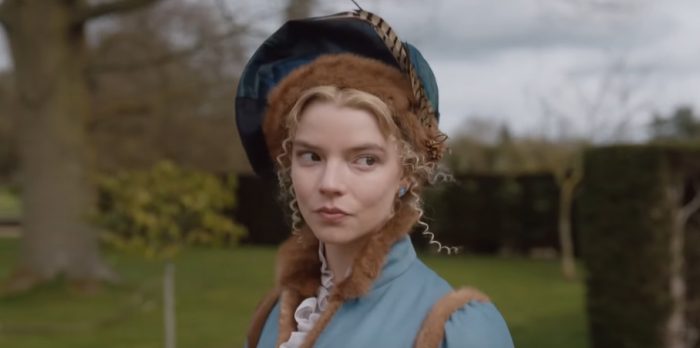
Drama is present, though. As the movie went on, I began to see that the filmmakers were emphasizing Emma’s flaws—arrogance, snobbery, and a lack of consideration for others—to highlight her eventual reformation. This aspect of the film I found moving: I flinched at a terrible moment when Emma publicly insults another character (judging from the noises around me in the theater, I was, in this reaction at least, in sync with other attendees). Flynn brings off Mr. Knightley’s resulting fiery reproach of Emma with all the requisite force. Emma’s shame is perfectly captured, as well: she returns home in tears and curls up like a little girl in the hallway windowsill. In this and other later passages of the movie, Taylor-Joy softens into a more vulnerable, uncertain Emma.
Emma realizes she must make amends to those she has harmed, and here de Wilde and Catton show a welcome canniness. Toward the end of the movie’s running time, they give us a romantic scene that seems to be shaping up to a climactic declaration of love between Emma and Knightley—only to cut it short abruptly with a grotesque, comical twist. (All that is missing is a record scratch on the soundtrack.) At first, I thought this was another instance of the movie’s clumsiness with humor, but it turned out to be another step in Emma properly learning her lesson. The filmmakers were not going to let her find love until she had corrected the damage to Harriet’s romantic life.
The following scenes show our heroine humbling herself and doing the necessary restorative work. Once Harriet’s happiness is assured, then, and only then, does Taylor-Joy’s Emma finally get her happy ending. The filmmakers’ sensitivity and care in getting to this point lead to a truly satisfying resolution for the story.
In creating the movie’s overall look, de Wilde and her cinematographer, Christopher Blauvelt, seem to have borrowed a little something of Wes Anderson’s aesthetic. Like Anderson, the filmmakers give us countless painterly shots with characters arranged in perfectly symmetrical compositions that draw attention to themselves. The way the passage of time through the year’s seasons is announced by large title cards also has a rather Rushmore-esque feel.
The movie’s color scheme offers a noticeable study in contrasts. The characters’ costumes and cavernous country houses tend to be white, pale pink, yellow, gray, and similar colors, while all outdoor scenes are dominated by the lush, deep green of the English countryside. The resulting impression is of rather anemic, fragile people carrying on their lives amid a far more vital natural world. (Meanwhile, the repeated sight of Harriet and her schoolmates in uncharacteristically bright red cloaks as they tromp along in near-military formation is used as a running visual gag.) I also appreciated how the movie’s soundtrack uses choral performances of hymns and folk songs.
For all its strengths, I would judge this version of Emma to be a bit underwhelming overall. As good as some performances are, and as well as the central story of Emma’s growth is handled, the botched humor is a serious problem. An adaptation of Emma should make me laugh, and this one didn’t. Those seeking a nice-looking, sometimes emotionally powerful romance would do well to see this latest version of the Austen novel. Those seeking a fun, comedic rendering of Emma should probably seek out one of the earlier versions.
 The Cameraman
Leave a comment